Better late than never—that is probably what palaeontologists are thinking now that a mystery fossil from the Isle of Wight has finally been recognised as a brand-new species of dinosaur. The strange specimen was found more than a century ago at the foot of a cliff on the island’s south-west coast, and for decades it sat in a drawer at the Natural History Museum in London after being acquired in 1924. Generations of researchers walked past it without realising that this chunk of bone belonged to an animal no one had ever described. Yesterday, however, a paper in Royal Society Open Science announced that the fossil represents a previously unknown theropod dinosaur, a carnivore named Invictibellatrix amberina. The name means ‘unconquered female warrior,’ and it evokes something fierce, elegant and resilient. The creature lived around 120 million years ago during the Early Cretaceous, when the world was much warmer, when the polar regions were draped in rainforests and the continents were arranged differently from today. It belonged to a group called megaraptorans—light-footed, feathery predators with long, powerful arms and terrifyingly large claws. Unlike the hulking Tyrannosaurus rex that we usually picture when we think of meat-eating dinosaurs, these animals were built for speed and agility. They were the sleek hunters of their world, perhaps more like a cross between a bird of prey and a velociraptor than a movie monster. Dr Cassius Morrison, the lead author from University College London, and his colleagues used modern technology to re-examine the old bone and were astonished to find that it did not match any known dinosaur. It was a perfect example of how scientific discovery does not always require digging in the desert; sometimes it just requires opening the right drawer.
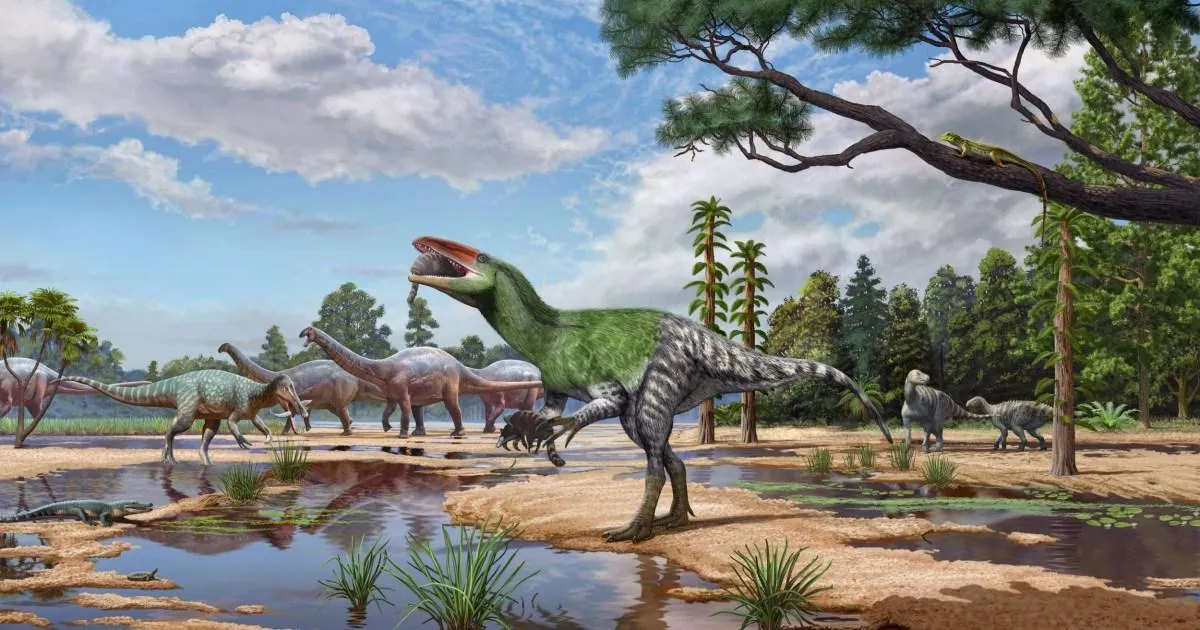
So what did Invictibellatrix actually look like in the flesh? Despite its fierce name, it would not have been as visually intimidating as a T. rex. It was smaller, sleeker and covered in feathers, more like a bizarre flightless bird than a classic dinosaur monster. Yet that does not mean it would have been harmless. In fact, for a human, encountering Invictibellatrix might have been far more terrifying than meeting a T. rex face to face. The animal stood about a metre and a half tall at the hip—roughly the height of an adult person—and measured between three and four metres in length from snout to tail. Its claws, attached to those long, muscular arms, could reach 10 to 20 centimetres long, curved like sabres and built for gripping struggling prey. It weighed perhaps three times as much as an average human, which made it not the largest predator in its environment, but certainly a fast, agile and dangerous one. Its feathers were probably not for flying; they may have served for display, insulation or simply for adding a little extra menace as it raised its arms and lunged. If you could somehow travel back in time and stand face to face with this creature, you would see a sleek, sharp-eyed hunter, maybe with a flash of colour in its plumage, assessing you with a predator’s calm focus. The name ‘unconquered female warrior’ fits surprisingly well. Although we cannot know the animal’s sex, the name gives it an air of mythic strength. And unlike the bulky, short-armed T. rex, Invictibellatrix could actually use its forelimbs with great dexterity. Those claws were its primary weapons, and it would not have hesitated to use them. For a dinosaur that was not even at the top of the food chain, it was still a formidable presence—especially if you happened to be exactly the right size for its dinner.
One of the most fascinating aspects of this discovery is the ecological niche that Invictibellatrix occupied. It was not an apex predator, despite belonging to the same broader carnivore group as the mighty tyrannosaurs. Instead, it played a role similar to that of a modern hyena—an opportunistic, intelligent hunter that could tackle prey smaller than itself and scavenge when necessary. Its diet probably included small dinosaurs, lizards and early mammals, all of which would have been abundant in the lush Early Cretaceous ecosystems of what is now Europe. The comparison to a hyena is particularly useful because it helps us picture how this dinosaur lived. Hyenas are not the biggest predators in their habitats, but they are relentless, adaptable and highly effective. Invictibellatrix probably patrolled its territory in search of easy targets, using speed and agility to run down prey, then relying on those powerful arms and long claws to grab hold and deliver the killing blow. It may have been a solitary hunter, or perhaps it lived in small family groups, though we do not have enough fossil evidence to say for certain. What really captures the imagination is the way researchers describe its potential danger to humans. A T. rex would likely have ignored a person simply because we would have been too small to be worth the effort. Invictibellatrix, on the other hand, would have seen a human as perfectly sized prey—about a third of its own body weight. Dr Morrison put it bluntly: ‘They definitely would have chased us. A T. rex would not have bothered, as we would have been too small.’ That is a chilling thought. Imagine being hunted by a feathered, clawed predator that could outrun you, outmanoeuvre you and had no reason to consider you anything more than lunch. It would have been like something out of a nightmare, but a very real nightmare for the small creatures that shared its world. It also shows that danger in the dinosaur world was not limited to the giant celebrities we know best. Sometimes the mid-sized hunters, the ones that never make it onto movie posters, were the ones you really had to fear.
The story of how this dinosaur was finally identified is almost as interesting as the creature itself. Megaraptors, as a group, are notoriously difficult to study because their bones are unusually light and air-filled, a feature that helps scientists infer they were active, agile animals but one that also makes them poor candidates for fossilisation. Air-filled bones break down more easily, which means palaeontologists are often left with only fragments and scraps. Most megaraptor remains have been found in South America, Asia and Australia, and until now none had been discovered in Europe. That made the Isle of Wight fossil especially exciting, even if it took a century to recognise its significance. The fossil in question was a fragment of skull, found at the base of a cliff on the island’s south-west coast. It was eventually acquired by the Natural History Museum in London, where it was catalogued, placed in a drawer and largely forgotten. The museum’s collections contain countless such specimens, and it is only when researchers take the time to re-examine old finds with new techniques that hidden treasures come to light. In this case, the team took a CT scan of the bone and compared it in detail with other meat-eating dinosaurs, including the tiny-armed tyrannosaurs and the distinctive spinosaurs with their sail-like backs. The scan revealed features that set the fossil apart from every known dinosaur species. It had an odd, oval-shaped hole and an hourglass-shaped crest on the skull that had never been seen before anywhere in the dinosaur fossil record. These unusual details were enough to confirm that this was not just another megaraptor, but a completely new genus and species. Professor Paul Barrett, the study’s senior author from the Natural History Museum, highlighted the importance of historical museum collections, saying that ‘work like this shows the exceptional value of working with historical museum collections where there are still many discoveries to be made.’ It is a lovely reminder that scientific progress is not always about finding new fossils in the field. Sometimes it is about looking again at things that have been sitting under our noses for generations, waiting for the right person to ask the right question.
Beyond identifying a new species, the research provides fresh insights into the broader evolutionary story of megaraptors. By combining the new fossil evidence with mathematical modelling, the team was able to trace how these dinosaurs may have spread across the ancient world. The fossil scraps suggest that megaraptors were among the great hunters of the Early Cretaceous in what is now Asia. Over time, they moved westward into Europe, and the Isle of Wight specimen is now the first confirmed European member of the group. But their dominance did not last forever. Tens of millions of years later, megaraptors in northern Europe died out, while those in other parts of the world continued to evolve, growing larger and developing even more enormous claws, some up to 35 centimetres long. The reasons for this uneven pattern of extinction are still unclear. Researchers suspect that megaraptors may have been unable to compete with their younger offshoots—the tyrannosaurs—during the Late Cretaceous. It is a classic evolutionary drama: a successful group spreads across the world, flourishes for a time, and then is slowly pushed aside by newer, more adaptable relatives. The new study helps flesh out this timeline, showing that dinosaur evolution was not a simple straight line but a complex web of migrations, extinctions and survival. It also underscores how much we still do not know. The fact that a single fragment of skull, stored in a museum for a hundred years, can overturn our understanding of where a dinosaur group lived is both humbling and exhilarating. It suggests that many other forgotten fossils may be waiting in collections around the world, holding the keys to questions we have not even thought to ask. As Dr Morrison put it, ‘Who knows what else is waiting to be discovered?’ That sense of possibility is what drives palaeontologists to keep digging—both in the dirt and in the dusty drawers of museum storage rooms.
For those of us who are not scientists, this discovery is a wonderful reminder of how much of the natural world remains unknown, even in an age when we think we have seen everything. The image of a small, feathered carnivore prowling the rainforests of Cretaceous Europe, far from the famous lumbering giants, challenges our usual picture of dinosaur life. It also makes the past feel surprisingly close. The Isle of Wight is a popular holiday destination today, but 120 million years ago it was home to creatures like Invictibellatrix, chasing small mammals and lizards through a green, warm landscape. The same rocks that beachcombers walk past are packed with remnants of a lost world. And yet those remnants are often so fragmentary that it takes more than a century to understand them. This discovery is a testament to patience, curiosity and the importance of preserving scientific collections. Every bone in a museum drawer has a story, even if no one has figured it out yet. The researchers who studied this fossil used modern technology—CT scanning, three-dimensional imaging, mathematical modelling—to coax secrets out of a piece of bone that had been sitting quietly for decades. That blend of old-fashioned collecting and cutting-edge science is exactly how many great discoveries are made. It also gives us hope that the great age of dinosaur discovery is not over. In fact, it may just be beginning. As new tools become available and more researchers take the time to revisit old specimens, we will likely see more surprises emerge from museum collections and forgotten field sites. The ‘unconquered female warrior’ may have lived 120 million years ago, but her legacy is only now coming to light. And if this story has a moral, it is this: never underestimate the value of an old bone in a drawer. It might just turn out to be a new species, a missing piece of the puzzle, or a window into a world we never knew existed.