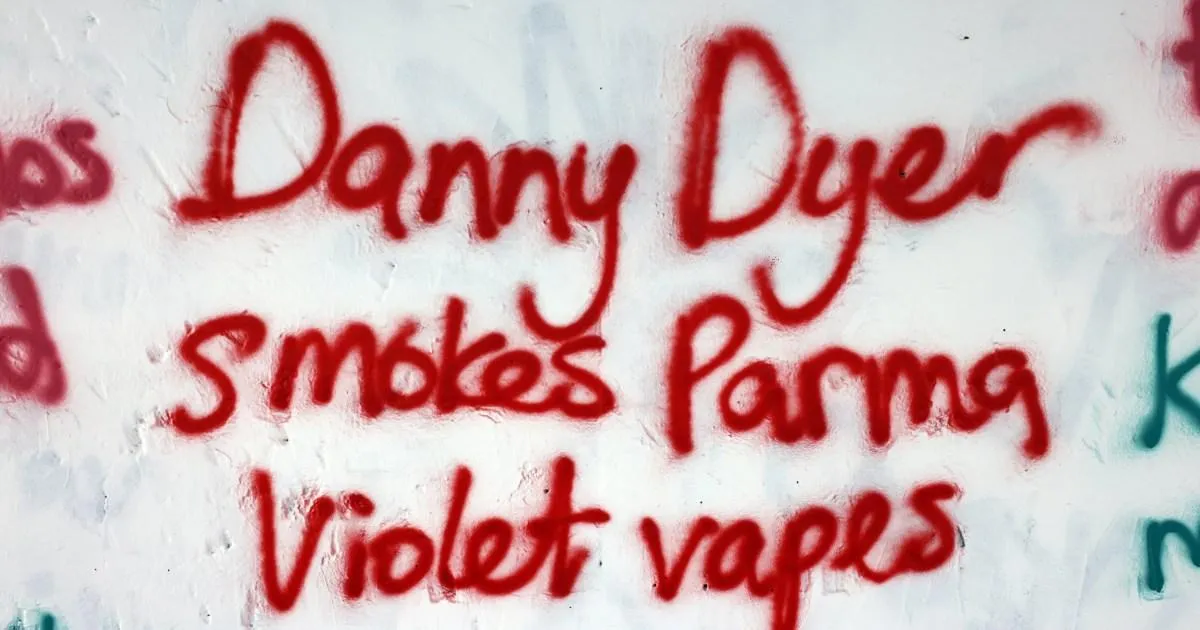
In the quiet residential corner of West Denton, Newcastle, something strange began appearing on the walls of a local underpass—something that left neighbours scratching their heads and, in some cases, laughing out loud. The graffiti wasn’t the usual territorial tagging or angry political statement. Instead, it was a bizarre and oddly specific collection of celebrity-themed scribbles that seemed to have been written by someone with an offbeat sense of humour and far too much time on their hands. One message claimed that Danny Dyer, the hard-man actor best known for EastEnders, smokes Parma Violet vapes—a detail so oddly specific and unglamorous that it was hard not to smile. Another insisted that beloved TV presenter Lorraine Kelly has been banned from Wetherspoons for stealing cutlery. These were not the kind of accusations that make tabloid headlines; they were the kind of weird, mundane claims that might come up in a pub quiz written by someone who’s had one too many. The graffiti quickly became a talking point for the community, with residents wondering who was behind the strange messages and why they had chosen these particular celebrities for such oddly ordinary, almost affectionate, defamations.
The strangeness didn’t stop there. More scribbles appeared, each one more bizarre than the last. One claimed that Little Mix singer Jade Thirlwall buys her makeup from Poundland—a seemingly harmless, if unlikely, shopping habit. Another stated that Rita Ora has the Lidl Plus app, which felt less like an insult and more like a strangely relatable confession. There was even a message about Stacey Solomon giving her husband Joe a sticker for helping with the dishes, which sounded like something from a wholesome family sitcom rather than an act of criminal damage. Perhaps the most eccentric of all was the claim that Ross Kemp dabs Zoflora behind his ears—a line that mixes the tough-guy image of the former EastEnders actor with the distinctly unglamorous world of household disinfectant. It was surreal, almost poetic, and utterly confusing. Some of the graffiti, however, had a darker edge, featuring slurs and sexual tones that made it clear this wasn’t all harmless fun. But for the most part, the underpass had become a strange art gallery of celebrity micro-fiction, with each new message adding to a growing local legend. Residents were torn between reporting it to the council and taking photos to share with friends and family, unsure whether they were witnessing vandalism or a very strange form of public art.
Newcastle City Council, however, was not amused. Once they became aware of the graffiti, officials moved quickly to clean it up, describing the messages as unacceptable and a blight on the community. Councillor Peter Lovatt, the cabinet member for neighbourhoods and local services, made it clear that the council takes a zero-tolerance approach to offensive graffiti, no matter how absurd or celebrity-focused it might be. He noted that this type of vandalism damages public spaces, creates unnecessary costs for taxpayers, and can lead to police action, including arrest and prosecution. The council urged residents to report any similar incidents through their Envirocall service or via the council’s website, stressing that swift removal is key to preventing further damage. For the people of West Denton, the cleanup was probably a relief—while the graffiti was often funny, it was still a reminder that someone was defacing shared public property. And for the council, it was another costly example of anti-social behaviour that takes time, money, and resources away from other neighbourhood priorities. But the story didn’t end with a fresh coat of paint. The police were already on the case, and it wasn’t long before they tracked down the person responsible.
Northumbria Police confirmed that a 33-year-old man had been arrested on suspicion of criminal damage in relation to the West Denton graffiti. In an interview, the man admitted to carrying out the vandalism, and instead of going through the courts, he was referred for an out-of-court disposal—a common outcome for lower-level offences, often involving a fine, community resolution, or some form of restorative justice. A police spokesperson said that anti-social behaviour of this nature is “completely unacceptable” and that they will always take action when made aware of it. The news of the arrest brought a mix of reactions from the community. Some people were amused that such a quirky and seemingly harmless series of graffiti had led to a police investigation, while others were satisfied that action had been taken. After all, even the most entertaining graffiti is still vandalism, and the people of West Denton had to look at these messages every day, whether they wanted to or not. The man’s identity was not released, and the details of his out-of-court disposal were not made public, but the case served as a reminder that even the most bizarre crimes have consequences.
Beyond the humour and the headlines, the incident raises questions about why people do the things they do. Was the graffiti artist simply bored? Were they trying to create a viral moment? Or did they genuinely believe that the world needed to know about Danny Dyer’s vaping habits and Lorraine Kelly’s alleged cutlery theft? In an age where social media can turn the strangest stories into global sensations, it’s easy to imagine someone seeing the graffiti as a form of guerrilla comedy—a way to make strangers smile and maybe, just maybe, end up on a news website. But for the people who live and work in West Denton, the underpass is not just a canvas. It’s a daily route to school, work, and home. It’s a place where children walk and older residents pass through, and finding it covered in scribbles—some offensive, all unauthorised—can feel invasive and disrespectful. Even the funny messages can leave a sour taste when you realise that someone took time and effort to damage public property. The council and police have both emphasised that this type of behaviour is not a victimless crime; it costs money, creates fear or discomfort, and ultimately makes the area feel less cared for.
In the end, the West Denton graffiti saga is a story about the strange intersection of celebrity culture, everyday life, and community responsibility. It’s hard not to chuckle at the idea of Ross Kemp spritzing disinfectant behind his ears or Stacey Solomon handing out stickers for household chores. There’s something almost endearing about the vandal’s imagination, a kind of surrealist comedy that would feel at home in a sketch show or a niche Twitter account. But the laughter comes with a serious side. The man responsible has now admitted his actions and will face the consequences, however minor they may be. The graffiti has been cleaned, the underpass restored, and the residents of West Denton can go about their days without wondering what new celebrity rumour might appear next. The story may fade, but it leaves behind a gentle reminder: even the most ridiculous acts can have real-world effects. And while it’s fun to imagine a world where Jade Thirlwall shops at Poundland and Lorraine Kelly is banned from the local spoons, the reality is that public spaces belong to everyone. A bit of humour is fine, but respect for shared places matters more. So next time you walk past a blank wall and feel the urge to write something funny, remember West Denton—and maybe just tweet it instead.