


Imagine an ordinary weekday afternoon on the edge of London, when the sky is heavy and grey, and hundreds of drivers are simply trying to get home. The Essex-London border is a place of familiar routines: commuters inching along the A13, vans changing lanes, people listening to the radio, perhaps already thinking about dinner. Then, in an instant, the rhythm is shattered. A grey Audi A4 appears, moving in the wrong direction, cutting through traffic at terrifying speed, forcing drivers to swerve and brake. This is not a scene from a video game, although it could easily be mistaken for one. It is a real police chase, the kind that makes your stomach drop just by watching it on screen. At the centre of it all is Alan McDonnell, a 29-year-old man who made a series of catastrophic decisions on that December afternoon. He was not a bank robber or a fugitive from a major crime; he was simply a driver who had been pulled over because his car was uninsured. But when the police told him to stop, he chose to run. What followed was a heart-stopping, high-speed pursuit that put lives at risk across Basildon, Dagenham, and the roads in between.
The chase began in Basildon, where officers spotted the grey Audi and signalled for it to stop. The reason was straightforward: the car was uninsured, and McDonnell had no business being behind the wheel. At first, he appeared to comply. He pulled over, and for a brief moment, it seemed the situation would end quietly. But then something shifted. Perhaps panic set in. Perhaps he remembered that he was already disqualified from driving, and the consequences of another offence felt overwhelming. Whatever went through his mind, he made the reckless choice to accelerate away, turning a routine traffic stop into a nightmare for everyone else on the road. He burst onto the A13, a major route that carries thousands of vehicles every day, and began weaving through rush-hour traffic at speeds of up to 115 miles per hour. He overtook cars on both sides, undertaking vehicles in gaps that were never meant for such manoeuvres, forcing drivers to brake hard and pray. Then came the most dangerous moment of all: he sped the wrong way down the Southend-bound slip road, directly toward oncoming traffic. Drivers approaching from the opposite direction must have been stunned, seeing a grey Audi hurtling toward them in their lane, with nowhere to go. It was a miracle that no one was killed. McDonnell was not just fleeing the police; he was playing roulette with dozens of innocent lives, and the fact that everyone survived is more luck than judgement.
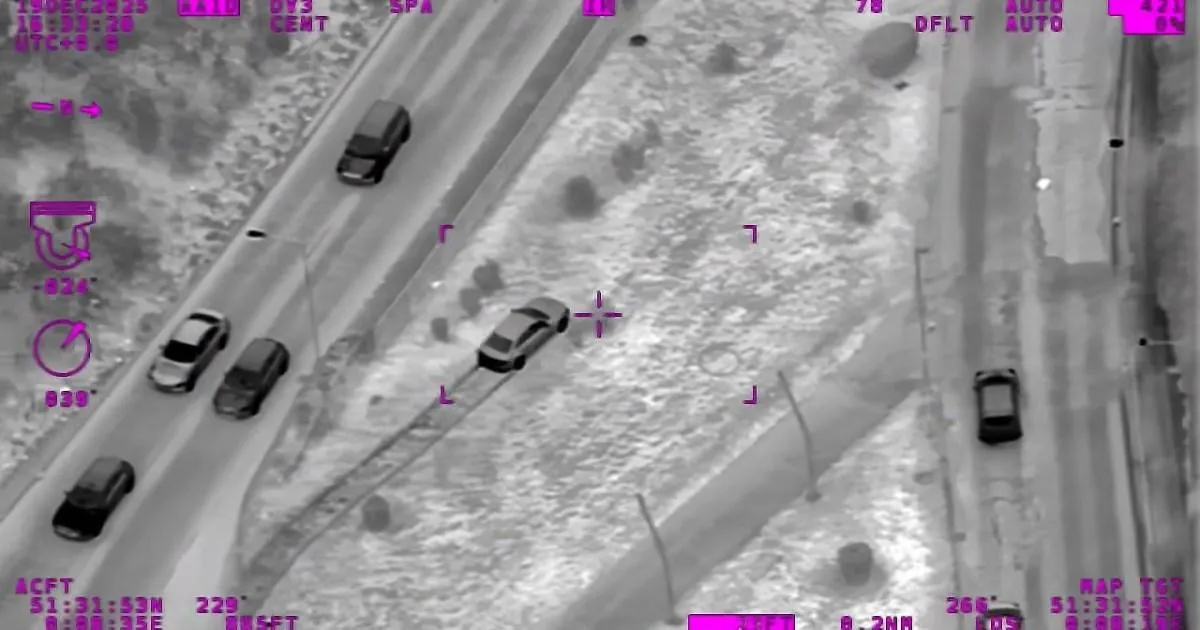
What makes this story particularly striking is the technology that eventually brought McDonnell to justice. While he may have believed he could lose the police cars in the chaos of rush-hour traffic, he was not just being chased from the ground. Above him, unseen and unheard, hovered a helicopter from the National Police Air Service, equipped with thermal imaging cameras that could see his every move. From the moment he fled, the helicopter tracked him with cold precision. It watched as he cut between lanes, as he veered onto grass verges, as he tried to disappear among other vehicles. Every swerve, every acceleration, every desperate attempt to shake off his pursuers was recorded from above. McDonnell was trying to drop the officers between Basildon and Dagenham, but he could not drop the eye in the sky. Thermal imaging does not blink, does not tire, and does not lose focus. It captures the heat of a car engine and the outline of a running man, turning darkness and distance into a clear picture. This aerial perspective is a reminder that modern policing is not just about fast cars and brave officers; it is also about intelligence, coordination, and technology. The helicopter did more than follow the chase; it ensured that there would be no escape, no matter how fast McDonnell drove or how far he ran.
Eventually, the chase reached its inevitable end. Near Cook Road in Dagenham, McDonnell abandoned the Audi, veering onto a grassy verge before jumping out and attempting to flee on foot. It must have been a desperate moment: heart pounding, breath short, the realisation dawning that there was nowhere left to go. He ran, but the helicopter stayed with him, guiding ground officers to his location. They found him lying on the ground, exhausted and defeated, and arrested him without further drama. The footage shows a young man sprawled on the earth, the chase finally over. In court, at Chelmsford Magistrates’ Court on October 5, McDonnell admitted the full catalogue of offences: dangerous driving, failing to stop when directed by police, driving while disqualified, and driving without insurance. The sentence was swift and severe. He was jailed for a year, banned from driving for a further three years and four months, and ordered to pass an extended retest before he could ever legally hold a licence again. For a man who had already been disqualified, the message was clear: the law will not tolerate this level of recklessness. But a prison sentence cannot undo the fear he caused, and it cannot bring back the minutes of terror experienced by the innocent drivers who shared the road with him.
Speaking after the case, Adam Pipe, from Essex Police’s roads policing unit, captured the broader significance of the incident. He said that the case shows “the lengths some drivers will go to in an attempt to avoid us,” but also demonstrates “the resources and tactics we have available to keep our roads safe.” His words are a reminder that every police chase is not just about catching one offender; it is about protecting everyone else on the road. Officers who pursue dangerous drivers are constantly weighing risks, and they rely on tactics and technology to minimise the danger. In this case, working alongside the National Police Air Service meant that McDonnell was tracked even after he abandoned the car and tried to run. The helicopter turned what could have been a vanishing act into a controlled arrest. But there is a deeper point here, too. McDonnell’s decisions were not just illegal; they were profoundly selfish. He was uninsured, which means that if he had collided with another vehicle, the innocent driver could have faced enormous financial and legal hardship. He was disqualified, which means he had already been told not to drive and had ignored that warning. And he drove at 115 miles per hour through rush-hour traffic, which means he was willing to trade other people’s lives for his own fleeting freedom. The sentence he received is not just punishment; it is a public statement that such behaviour is unacceptable.
Yet it is worth pausing to humanise McDonnell, not to excuse him, but to understand him. He was a 29-year-old man who, in a single moment of panic, threw away his future and endangered strangers. He is not a cartoon villain; he is someone who made a terrible choice and then kept making it worse, second by second, mile by mile. Perhaps he thought he could get away. Perhaps he was terrified of the consequences of being caught. But that fear did not justify turning a public road into a racetrack. Now he sits in prison, with time to reflect on the weight of what he did. He will eventually be released, and one day he may be allowed to drive again, but only after proving that he has changed. The extended retest is not a formality; it is a hurdle designed to force him to relearn the rules and respect the responsibility of driving. In the meantime, the rest of us are left with a simple but powerful lesson. Road safety is not guaranteed by luck. It depends on people making sensible choices, obeying the law, and thinking about the strangers around them. On that December afternoon, Alan McDonnell failed that test in the most spectacular and dangerous way possible. But thanks to the skill of the officers, the technology of the helicopter, and a great deal of good fortune, the only thing he truly lost was his freedom. For everyone else, the worst moment was a few seconds of fear. And that is a result worth remembering, because it could so easily have been a tragedy.