


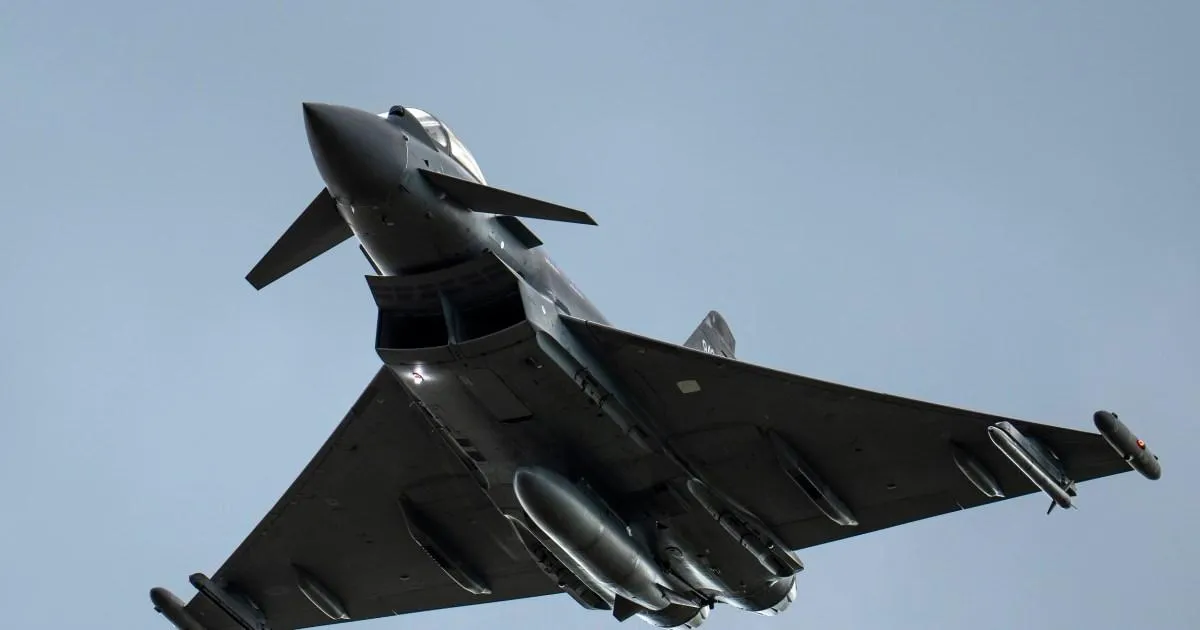
Imagine the roar of a Royal Air Force Typhoon tearing through the cold February skies over the North Sea. The pilot is focused on simulated combat, the kind of high-stakes training that keeps British air power sharp and ready for anything. But something else is sharing that same stretch of sky, something that was never filed in a flight plan and never cleared by air traffic control. According to incident logs seen by The Telegraph, the RAF came dangerously close to colliding with two unidentified drones in British skies earlier this year, on two separate occasions just days apart. One of those drones was hovering at around 16,000 feet—roughly 40 times higher than the legal limit for commercial unmanned aircraft, which normally stops at 400 feet to keep drones away from manned aviation. The other close call happened during an air-to-air refuelling exercise, a manoeuvre that demands absolute concentration and leaves no room for surprise visitors. These were not distant, harmless dots on a radar screen. These were near misses. They involved fast jets, a busy training corridor, and unknown objects that had no business being there. The first incident, according to reports, involved a Typhoon flying out of RAF Coningsby, a Lincolnshire base steeped in fast-jet history. The second involved F-35 Lightning jets refuelling from an RAF Voyager tanker—again, a moment when pilots must trust the sky to be empty. The RAF reported both sightings to police, and multiple external investigations have since been launched. But the biggest question remains unanswered: what were those drones doing there, and were they simply reckless hobbyists, or something far more deliberate? For people on the ground, it might be easy to brush off as a minor technicality. But for the pilots involved, it was a stark reminder that the skies are becoming more crowded, more complicated, and more contested than ever before. A collision at that speed would have been catastrophic, likely bringing down a multi-million-pound aircraft and ending more than one life. The thought of a drone mixing it with a Typhoon is almost absurd; yet it happened, and it could happen again.
To understand why this matters, consider the physics. A drone does not need to be large to be dangerous. A small quadcopter striking an aircraft at high speed can shatter a windscreen or disable a jet engine. The 400-foot limit is not an arbitrary rule; it is a safety buffer designed to keep unmanned aircraft out of the way of manned aviation. A drone at 16,000 feet is not just breaking the law; it is operating in the same airspace as fast jets, commercial airliners, and military tankers. That altitude requires sophisticated equipment and a certain level of skill, which makes the possibility of accidental intrusion less likely. It is also worth noting that the incidents were flagged to police and that “multiple different external investigations” have been launched. That language, drawn directly from incident logs, suggests the authorities are taking this seriously. Yet the Ministry of Defence has been careful not to speculate about the drone operators’ identity. A spokesperson said the RAF “remain highly vigilant to the potential threats posed to defence and stand ready to respond appropriately.” They added: “While reports of drones sightings are not necessarily hostile, where activity is assessed to pose a credible threat, Defence has measures available to respond appropriately and we do not comment on specific threat assessments.” The cautious tone is understandable, but it also leaves the public wondering: how worried should we be? The answer may depend on whether these sightings are viewed as isolated moments of recklessness or as part of a broader pattern. And the evidence increasingly points to the latter. Drone operators who want to fly legally can do so within designated areas and under strict rules, so an aircraft climbing to 16,000 feet over a military training area is not an accident; it is an anomaly that demands an explanation.
The scale of the problem became clearer last month when figures obtained by The Independent revealed a startling rise in drone security incidents at or near Ministry of Defence sites across the UK. In the most recent 12-month reporting period, which ended in August, there were 340 such incidents—an average of nearly one every day. In 2025 alone, there were 250 incidents recorded, almost double the 126 reported the year before. Those numbers do not include every drone sighting in the country; they only cover the ones deemed significant enough to log as security incidents at military locations. That means British bases are being buzzed, surveilled, or at the very least approached, at an alarming rate. The increase has coincided with escalating tensions with Russia and Iran, and while many incidents may turn out to be harmless, the sheer volume has forced the military to take notice. It is also important to remember that these are only the incidents that were detected and reported. The true number could be far higher, especially for small drones flying low and slow, which are notoriously difficult to spot on radar. These figures were obtained under the Freedom of Information Act, meaning they are not leaked or unverified numbers but official logs recorded by those responsible for base security. Former Conservative defence minister Tobias Ellwood, an army veteran, said the trend shows that the British military is being viewed “as a target.” He warned that the UK is not doing enough to protect its critical national infrastructure, including military bases, and described drones as “such an easy way to disrupt.” Perhaps his most chilling observation was the next step: at the moment these appear to be passive, unarmed drones, but it would not be a huge leap to add a “kinetic dimension”—in other words, to turn them into weapons. The difference between a drone that spies and a drone that kills is only a matter of what it carries.
Ellwood’s words are especially uncomfortable because they echo what many security experts have been saying for years. The UK has invested heavily in defence technology, but drone defence remains a patchwork, especially for the civilian infrastructure that keeps the country running. Power grids, communication networks, transport hubs, and government buildings are all vulnerable to small, cheap unmanned aircraft. And if military bases—which are by definition guarded and hardened—are being targeted hundreds of times a year, the risk to softer targets is even greater. Ellwood did not stop at pointing out the problem. He argued that the UK is failing to take the rise in threat levels seriously, especially compared with European allies who have been forced to adapt faster to the new reality of drone warfare. “All this points to the fact that we are not taking the rise in threat levels that our European cousins are addressing seriously at all,” he said. It is a damning assessment, made worse by the fact that so many of these intrusions go unexplained. In some cases, drones are simply lost or flown by careless operators. But in other cases, the timing and altitude suggest deliberate intent. The drone that hovered at 16,000 feet was not a beginner’s mistake. It was flying in military airspace, at an altitude that required significant technical capability, and it was doing so during active RAF exercises. That is a message, even if the sender remains unknown. The tactics, fuel states, and coordination visible during simulated combat or refuelling would be of enormous value to any adversary planning to disrupt or attack UK forces. This is not a problem that can be solved by waiting for the next close call to end in disaster. European nations, many of whom have faced drone incursions from state-backed groups, have already begun deploying counter-drone systems and changing their airspace rules; the UK risks being left behind.
The Ministry of Defence, for its part, has tried to strike a tone of calm but firm resolve. When asked about the latest drone reports, a spokesperson did not address any specific incident, but said: “National security is the first duty of Government. The public should be reassured that the UK and its allies remain vigilant against potential threats and adversaries should be in no doubt about this Government’s resolve to stand against aggression towards the UK and our allies.” That statement, while carefully worded, reflects a growing sense that the UK is no longer dealing with a handful of rogue hobbyists. The government has repeatedly stated that it has measures available to respond when drone activity is assessed as a credible threat, though it does not comment on specific threat assessments. This is standard practice, but it leaves a lot of room for interpretation. What exactly would the military do if a hostile drone approached a Typhoon? Electronic jamming? Projectile interception? Cyber takeovers? The public may never know the details, but the fact that such questions are being asked is a sign of how much the threat has evolved. It was only a few years ago that drone sightings near airports caused massive disruptions and left authorities scrambling for countermeasures. Now, drones are being treated as a persistent security challenge, not a novelty. The increase in incidents at RAF bases, and the specific nature of these latest near misses, suggests that the threat has moved from nuisance-level to national security level. And if the government’s response remains limited to vigilance and reassurance, the gap between threat and readiness may only widen. With drone technology becoming cheaper and more advanced every year, the danger is not going to fade on its own. Countermeasures exist, but they need to be deployed, tested, and integrated into everyday military operations before the next encounter turns from a near miss into a tragedy.
The broader geopolitical backdrop makes these incidents all the more worrying. Last month, the Kremlin warned that British military facilities in Ukraine would be considered “legitimate targets” if they are used to support long-range strikes against Russia. That threat hangs over every British military deployment and every training exercise, even those conducted over the North Sea. Closer to home, there have been arrests and court cases that paint a darker picture. Two Latvian men were recently bailed after being arrested for allegedly trespassing at an RAF base. A 24-year-old Royal Navy serviceman appeared in court accused of spying for Russia. And in a separate case, a seventh man was arrested over an alleged “terror plot” targeting RAF Fairford. None of these developments are directly connected to the drone near misses, but together they form a mosaic of threats against British military installations. It is not paranoia to connect the dots; it is prudence. Drones are cheap, difficult to detect, and easy to operate, making them an ideal tool for reconnaissance, harassment, or attack. If a foreign state wanted to test the UK’s air defence systems, or to map the locations of sensitive equipment, a drone flying high over the North Sea during an RAF exercise would be a perfect first move. The pilots who nearly collided with those drones were lucky. The next crew might not be. The challenge now is not just to investigate what happened in February, but to ensure it cannot happen again—before what was a near miss becomes something far worse. In an age of cheap drones and great-power rivalry, the skies over Britain are no longer just a backdrop for training; they are a frontline. For the public, the lesson is not to panic, but to pay attention. The next generation of warfare is already overhead, and it is often silent, small, and hard to see.