


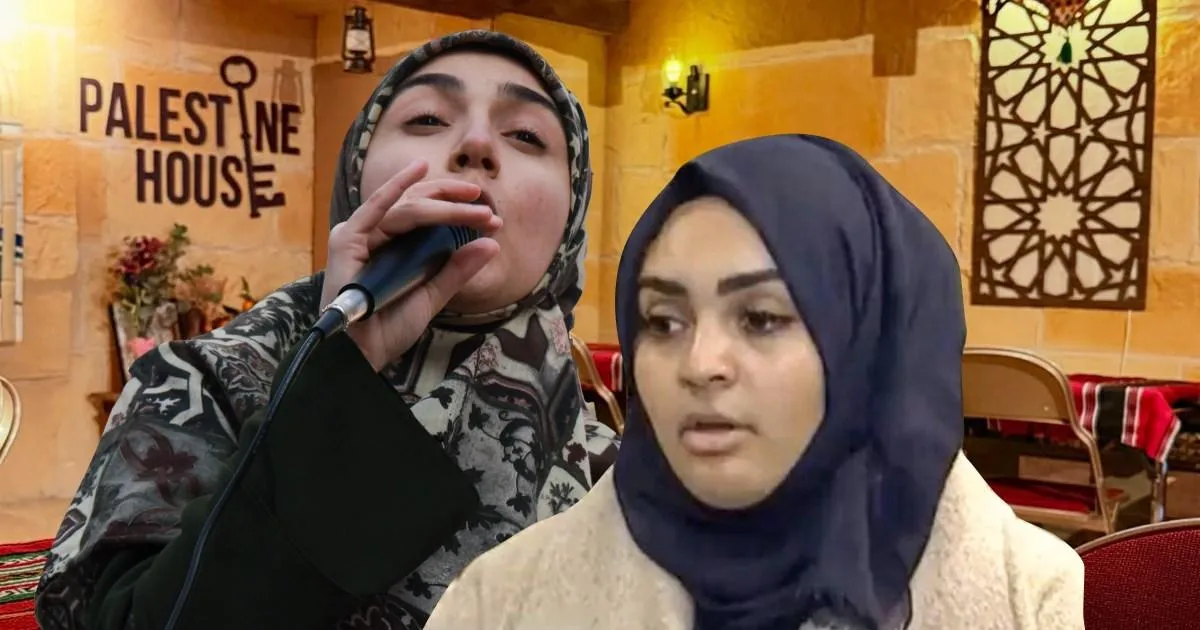
The recent hosting of a panel at London’s “Palestine House” has sparked intense scrutiny and public outcry after it was revealed that two of the featured speakers—Latifa Abouchakra and Batool Subeiti—have previously celebrated the October 7th attacks against Israel. These figures, who possess a history of publicly endorsing the violence that left 1,200 people dead and hundreds taken hostage, were provided a platform under the guise of an event titled “Lessons of Resistance.” The gathering, organized in collaboration with a student group, aimed to draw parallels between historical religious struggles and the current political situation in Gaza, yet the choice of speakers has caused profound distress within the Jewish community and among those affected by the ongoing crisis.
The controversy centers on the incendiary rhetoric both speakers have employed regarding the Hamas-led incursion into Israel. On the very day the attacks occurred in 2023, Abouchakra, a presenter for the Iran-backed outlet PressTV, characterized the mass violence as a “moment of triumph” and a “homecoming.” Similarly, Subeiti has spoken in glowing terms about the “unprecedented revenge” of the operation. Their public records, which include the circulation of inflammatory imagery and expressions of support for figures aligned with Hezbollah and the Iranian leadership, have led advocacy groups like the Community Security Trust (CST) to voice deep concern. Critics argue that presenting such individuals as community role models—particularly as Subeiti has reportedly contributed to educational programming for children—is not only irresponsible but harmful to social cohesion.
The inclusion of these speakers in a prominent central London venue has reignited debates about the boundaries of free speech versus the promotion of extremism. For representatives of the families of October 7th hostages, the event was described as “heartbreaking,” emphasizing that such platforms effectively normalize the glorification of terrorism. The Jewish Leadership Council has been vocal in demanding accountability for organizations that offer space to voices promoting radical ideologies, noting that such events exacerbate fear and division within the UK, where anxiety over antisemitism has remained at a historically high level.
In response to the mounting criticism, Palestine House has firmly defended its position, asserting that it serves as a critical cultural embassy for a community currently suffering through a humanitarian crisis in Gaza. The organization maintains that its primary mission—having hosted over 600 events—is to provide a voice for those perspectives during a time of immense hardship. Regarding the controversy, they stated that they do not systematically vet the personal views of every participant and warned against what they perceive as an attempt to shift the focus away from the atrocities occurring in the Middle East by policing the individual opinions of guests who pass through their doors.
The speakers themselves have dismissed the allegations, categorizing the backlash as part of a targeted harassment campaign. This defense highlights the widening chasm between activists who view the October 7th events as an act of legitimate resistance and a broad segment of the public—including government and civil society leaders—who view the celebration of such violence as an intolerable incitement to hatred. The dispute underscores a difficult reality: as the conflict in the Middle East continues to dominate global discourse, the friction between cultural expression and the moral implications of political advocacy is likely to intensify, leaving community centers caught in the crossfire of deeply entrenched ideological battles.
Ultimately, this incident