Paragraph 1
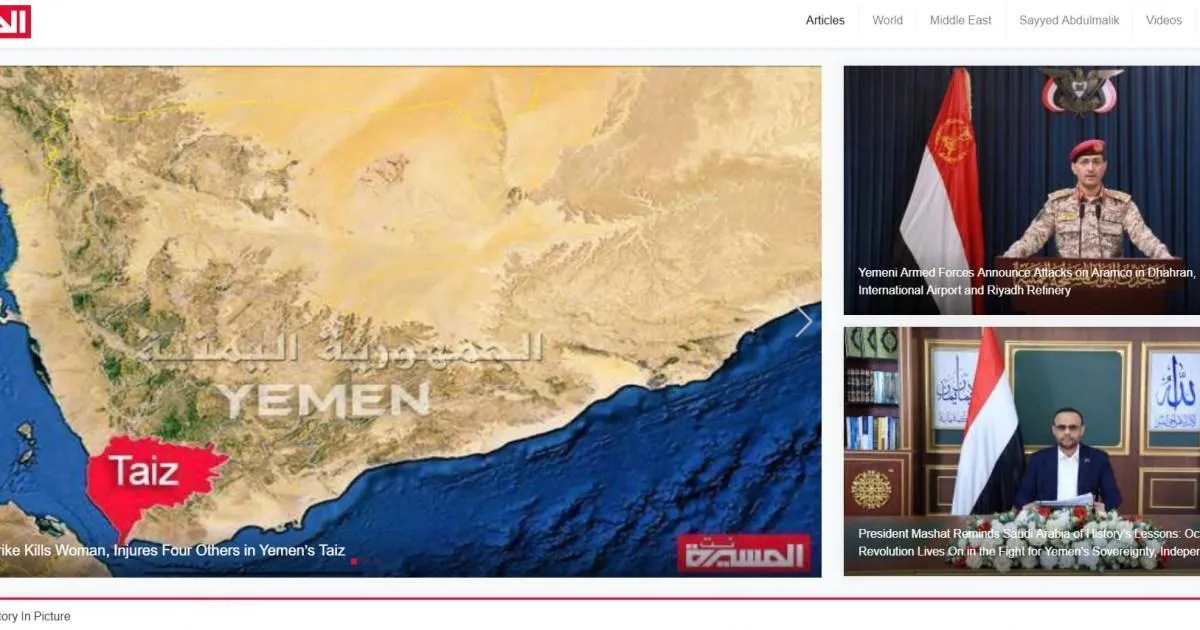
Imagine discovering that a television station linked to a militant group that has just launched a deadly missile attack on a civilian airport has quietly maintained a registered address in your capital for more than a decade. That is exactly what a new investigation has uncovered about Al-Masirah TV, the main propaganda network of Yemen’s Houthi rebels. According to official records at Companies House, the channel has operated a registered company in London since 2014. For years, this entity was described in dry bureaucratic terms as a business involved in “television programming and broadcasting activities.” But behind that innocuous phrasing lies a far more unsettling story. The men listed as directors are not ordinary media executives. They are senior figures within a movement that has targeted international airports, aligned itself with Iran’s revolutionary regime, and taken aim at Britain’s allies. The revelation arrives at a moment when the Houthis have just claimed responsibility for an airstrike on King Khalid International Airport in Saudi Arabia, an attack that killed twelve people and left more than three hundred injured. Footage of a missile striking a parked Saudia Airlines jet, engulfing it in black smoke, has already become a symbol of the chaos spreading across the Middle East. In Washington, the American president said he was deciding whether to join Saudi airstrikes against the rebels. In London, defence officials condemned the assault as a “dangerous escalation.” Yet amid all the urgent talk of missiles, air defences, and military responses, a quieter scandal has emerged: a channel described by American officials as a hub for Iranian disinformation appears to have had a foothold in the United Kingdom for twelve years, largely unnoticed and unchallenged.
Paragraph 2
The details of this London connection are buried in Companies House filings that have only now come under scrutiny. A company called Almasirah Network Limited was first registered in September 2014. Its stated purpose was television programming and broadcasting, but its actual activity was, according to financial records, virtually nonexistent. The company filed dormant accounts for a decade, held no significant assets, and remained a paper entity rather than a functioning broadcaster. What makes this more than a clerical curiosity is the identity of its directors. One of them, listed as Ammar Al-Hamzy, appears to be an alternative spelling of Ammar Al-Hamzi, the current director general of Al-Masirah TV. Al-Hamzi has publicly described the channel’s work as exposing the “heinous crimes” of what he calls an “arrogant aggression headed by the US, Israel and Britain.” Another director, listed as Embrahim Mohammed Al-Dailami, appears to be the same person as Ibrahim Al-Dailami, a former director general of Al-Masirah who now serves as the Houthi ambassador to Iran. Al-Dailami has not been shy about his hostility toward the West. He has attacked the UK’s ambassador to Yemen, accusing him of suffering from “political Alzheimer’s,” and has made threats against Western powers intervening in Yemen. In 2024, the company changed its name to Almassira TV Channel, but the underlying reality remained the same. For more than a decade, two men deeply embedded in a Tehran-backed militant network were legally connected to a British-registered company. To national security campaigners, that is not a coincidence. It is a potential avenue for influence, a quiet doorway into the United Kingdom that remained open while successive governments looked the other way.
Paragraph 3
What exactly was this London-based company doing? According to financial experts, almost nothing—at least on paper. Ben Crowne, a financial accountant who reviewed the filings, told reporters that the operation was “clearly a shell company.” It had no material assets beyond a nominal £200. It had filed ten years of dormant accounts. It was overdue on recent filings, and its directors had not completed the identity verification that Companies House now requires. In other words, it was a hollow structure, a name on a register, a dormant entity that could serve little legitimate purpose. But former intelligence operatives warn that dormancy itself can be a strategy. Johnathan Hackett, a former American intelligence operator and an expert on Iran’s covert operations, explained that “dormant media outlets have historically been exploited by malign foreign intelligence entities.” He pointed out that Iran’s state-controlled media apparatus uses UK-based outlets like Al-Masirah to obscure the true origins of propaganda and extremist viewpoints, particularly messages aimed at vulnerable populations in Britain. Even more worrying, he said, the Iranian government uses such outlets “to keep potential access points on ice for long periods of time, allowing them to reactivate when needed inside the UK with little notice or scrutiny.” That is a chilling thought. A dormant company may seem harmless, but in the shadowy world of intelligence and influence, it is like a key left under a doormat for years, waiting for someone to return and use it. The fact that the company is now due to be struck off and dissolved because of overdue filings may bring some comfort, but it does little to erase the concern that for over a decade, a channel aligned with the Houthis and Iran had a legal presence in Britain without any apparent oversight or alarm.
Paragraph 4
The political reaction to these findings has been swift and angry. Priti Patel, the former Home Secretary, did not mince words. She described the Houthi terrorists as “sponsored by the murderous regime in Tehran,” and accused them of killing civilians, targeting shipping, and damaging the interests of Britain and its allies. She demanded that any links and operations taking place in Britain be fully investigated and that the full force of the law be used to stop them. Her comments reflect a growing frustration among security-conscious politicians who feel that Britain has been too permissive towards hostile actors. Iain Duncan Smith, the former Conservative leader, went even further. He called the revelation “a shocker” and asked with evident anger: “Why are we allowing these people to exist in the UK? What the hell are we doing? We are so wide open right now. We know the Houthis have been pumping out rubbish in the UK and yet we still turn a blind eye to it.” That sense of being “wide open” is not just rhetorical. It resonates with ordinary people who worry that hostile powers are operating freely in Britain, hiding behind shell companies, dormant accounts, and ambiguous legal structures. The discovery of Al-Masirah’s London base feeds a broader anxiety about foreign influence in British life. It raises uncomfortable questions about how many other entities like this are sitting quietly on the Companies House register, waiting to be discovered. It also highlights the gaps in a system that allows directors to register companies without rigorous verification, file years of dormant accounts, and escape serious scrutiny until something goes wrong. The fact that the company is now overdue on its filings and may be dissolved does not reassure those who believe the damage has already been done.
Paragraph 5
To understand why this matters so much, it is necessary to look at the wider context. The Houthi movement, officially known as Ansar Allah, has been fighting a devastating war in Yemen for years. The conflict escalated in 2015 when a Saudi-led coalition intervened in support of Yemen’s internationally recognised government. Iran has long been accused of arming, training, and financing the Houthis, transforming them from a local rebel group into a significant regional threat. The Houthis have fired ballistic missiles at Saudi cities, attacked commercial shipping in the Red Sea, and now struck the main airport in Riyadh. The attack on King Khalid International Airport killed twelve people and left over three hundred injured, making it one of the deadliest Houthi strikes against Saudi infrastructure. Defence Secretary Wes Streeting called the attack “contemptible” and “a dangerous escalation,” adding that it was part of an increasing pattern of Houthi behaviour targeting civilian sites in Saudi Arabia. He confirmed that the UK is providing support to Saudi Arabia in the form of air defences and air-to-air refuelling, while insisting that Britain wants to see an end to the conflict. But the connection to Al-Masirah TV complicates that message. How can Britain claim to be defending its interests and those of its allies while, at the same time, allowing a Houthi propaganda channel to maintain a corporate presence in London? How can the government condemn the rebels in one breath and tolerate their presence in the UK in the next? These are the questions that now hang over Whitehall. The attack on the airport was a direct reminder that the Houthis are not just a distant problem in a faraway land. They are capable of projecting violence across borders, and their media arm has been busy in Europe too. The lines between broadcasting, propaganda, and intelligence operations have become blurred, and Britain, for too long, seems to have been asleep to it.
Paragraph 6
The discovery of Al-Masirah’s London base should be a wake-up call, not just for politicians but for the wider public. It shows that foreign influence does not always come through dramatic hacking operations or secret agents in the dead of night. Sometimes it comes through the most mundane channels: a registered company, a dormant account, a name on a form. For over a decade, a network linked to the Houthi rebels and by extension to Iran had a foothold in the United Kingdom. It may not have been broadcasting from London, and it may not have had employees or offices, but it existed. It was a presence, a potential access point, a small piece of hostile infrastructure buried in plain sight. The fact that it was only uncovered by journalistic investigation, rather than by government vigilance, is deeply troubling. It suggests that the systems designed to monitor corporate activity are not adequately protecting national security. It also suggests that the threat from Iran and its proxies is broader and more subtle than many people realise. The Houthi ambassador to Iran was, until recently, a director of a UK company. A man who has threatened Western powers and insulted British diplomats has been connected to a British-registered entity. That is not something any country should take lightly. The solution is not panic, but vigilance. Companies House must be given stronger powers to vet directors, verify identities, and scrutinise dormant companies. Security services must pay closer attention to media outlets linked to hostile powers, even when they seem inactive. And politicians must understand that influence operations are not a thing of the past. They are happening now, under our noses, through shell companies and propaganda channels and carefully placed connections. As the smoke rose over King Khalid International Airport, the paper trail led back to London. That should alarm everyone who cares about Britain’s security, and it should compel those in power to act before the next dormant company wakes up.