
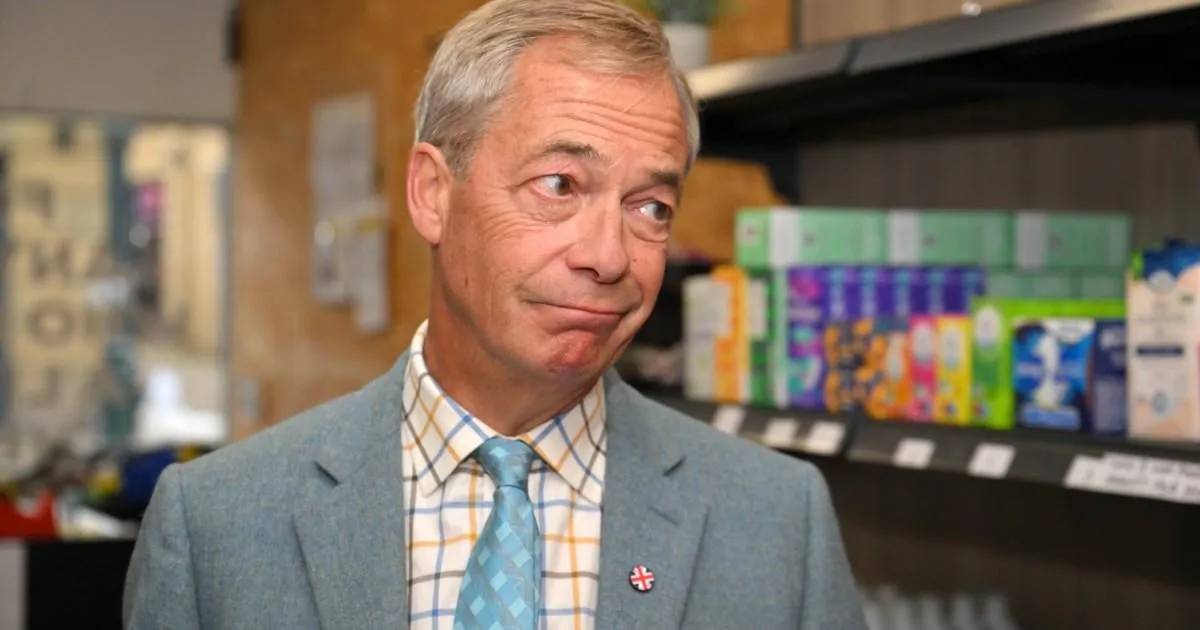
Nigel Farage has never been one to sit quietly and wait for the political calendar to unfold. He is a man who likes to shape events, or at least to claim he saw them coming first. That is why his latest announcement feels significant. The Reform UK leader has revealed that he placed his party on “emergency measures” three weeks ago, and he is now out on the road, touring the country and trying to generate the kind of momentum that could carry his movement into government, or at least into a position of serious influence. His core message is simple: there will be a snap election, and it will happen sooner than anyone in Westminster expects. Farage has gone as far as predicting that the Prime Minister will call a vote next May. He even name-checked Andy Burnham, though since Burnham is the Mayor of Greater Manchester and not the PM, the name was almost certainly a slip for Sir Keir Starmer. Farage’s real point was that Labour is trapped by its own manifesto promises, the economy is in a difficult state, and things are likely to get worse before they get better. He imagines the Prime Minister sitting down, looking at the numbers, and deciding that an early poll is better than a long, painful decline. Farage even suggested the leader would say to himself, “You know what, this is going to get worse,” and then pull the trigger. The Prime Minister has denied this, insisting the next election will not happen before 2028. But Farage is not waiting around to be proven right or wrong. He is preparing for a campaign, and he wants everyone to know it. For a politician who has spent decades fighting elections, “emergency measures” is a dramatic phrase. It suggests a party in crisis mode, but also a party that is taking the next battle seriously. Farage has always thrived when he is treated as an outsider, and this sense of urgency plays directly into that narrative. He is not going to sit back and hope for good news. He is going to force the conversation, and he believes the public will eventually be asked to choose much sooner than the official timetable suggests.
The urgency makes sense given how difficult the last few months have been for Reform UK. The party spent much of the year looking like a genuine electoral threat, but a series of damaging stories have knocked it off course. Polls now show Reform falling behind Labour, and the slide has been driven by controversies around money, donors, and internal behaviour. The most damaging episode involved a Channel 4 undercover investigation. A fake American billionaire, played by an actor, met with senior Reform officials Dan Jukes and James Orr. The fictional donor offered to pay for favourable polling and to funnel money into the party from overseas through his London-based son, which would have breached funding rules. The resulting footage was broadcast on national television and made Reform look careless, if not worse. The party denied paying for any of the polls, which were conducted by JL Partners and featured on the front pages of the Telegraph and the Times. An internal inquiry was launched, and it eventually cleared both Jukes and Orr of breaking electoral law. The inquiry did criticise them for using inappropriate language and made recommendations for tightening party procedures. It also attacked the Channel 4 documentary, saying it presented a distorted version of events. For Reform, the whole affair was a mess. It allowed critics to paint the party as financially reckless and politically naive. It also forced Farage to spend weeks defending his colleagues rather than talking about the issues he wanted to talk about. The fact that the internal investigation cleared the men has not entirely washed away the public impression left by the undercover footage. In politics, a denial rarely travels as far or as fast as the original accusation. Farage knows this, and it is one of the reasons he is now trying to change the subject. He wants to talk about the future, about elections, about the economy. But the summer has taught him that the past has a way of catching up. Even when Reform tried to fight back on a by-election letter, the party managed to misspell its own name, which only added to the sense that the organisation was struggling to keep its act together.
Farage’s own financial affairs have added to the pressure. The parliamentary standards commissioner is looking into his personal arrangements, and the Metropolitan Police are investigating claims connected to a £5 million donation from Christopher Harborne, a crypto billionaire who has also given more than £60 million to Reform. Farage has insisted the money was intended for his personal security, but he has also made comments suggesting he could spend it however he liked. The ambiguity has not helped his cause. The situation became so serious that Farage resigned from his Clacton seat, triggering a by-election that he then won. The contest was boycotted by all the major political parties, leaving the satirical candidate Count Binface as his most recognisable opponent. That did not stop Farage from presenting the result as a triumph, but it was not the kind of victory that silences doubters. It looked less like a vindication and more like a consequence of a political system that no longer knew how to deal with him. The investigations remain unresolved, and they hang over Farage as he tries to relaunch his party. He has always operated best when he can claim to be the victim of a hostile establishment. The scrutiny of his finances gives him an opportunity to cast himself in that role, but it also exposes him to questions he would rather avoid. For a leader who wants to be taken seriously as a potential participant in government, having a live police investigation and a standards probe is not ideal. Farage, though, has never been the kind of politician who waits for the dust to settle. He would rather move forward, embrace the chaos, and hope that voters are more interested in his message than in the details of his money. Whether that strategy works remains to be seen, but he is clearly betting that the public will not punish him for the same things that have damaged other politicians. He has always been treated differently by his supporters, and he is counting on that loyalty now more than ever.
The question of alliances has also been floating around Reform, and Farage has handled it with his usual mix of bluntness and ambiguity. He and other senior party figures have dismissed the idea of a pre-election pact with the Conservatives. Robert Jenrick, who serves as a Treasury spokesperson for the Tories, made the point with a memorable insult. He said that the Tories ruling out a deal with Reform was like him telling Thomas Tuchel that he was ruling out being selected for the England squad against Croatia. The joke was designed to show how absurd the idea was. Kemi Badenoch, the Conservative leader, had already rejected any arrangement with Farage in her keynote speech at the party conference. She wants to rebuild the Conservative Party on its own terms, not by borrowing support from a rival. Farage, for his part, has said that any agreement before an election is “extremely unlikely.” But he has been much more vague about what might happen after the votes are counted. “After an election, who’s to say?” he said. That is classic Farage. He never shuts the door completely. He knows that the electoral map could change dramatically, and that a hung parliament might give him real bargaining power. He also knows that the Conservatives, despite their current hostility, might one day decide they need Reform more than they want to admit. The two parties are currently fighting for the same slice of the electorate, and their leaders have sharp words for each other. But politics is a strange game, and alliances can shift overnight. Farage’s willingness to leave the question open is not a sign of weakness. It is a reminder that he is thinking several moves ahead. He wants to be the kingmaker, not just the protest candidate. And he is careful not to promise anything that might limit his options later.
What all of this adds up to is a politician doing what he does best: turning pressure into publicity, and using chaos as fuel. Farage’s decision to put Reform UK on “emergency measures” sounds alarming, but it is also a clever piece of political theatre. It tells supporters that the party is under attack and needs their help. It tells the media that Reform is a serious operation preparing for a serious fight. And it tells his rivals that he is not going anywhere. The tour he has launched is a way of bypassing the national press and taking his message directly to voters. He can stand in front of crowds, blame the media for distorting the truth, attack the Labour government for its failures, and mock the Conservatives for their disarray. He can remind people that he has been counted out many times before, only to come back stronger. That resilience is central to his appeal. His supporters do not see him as a conventional politician. They see him as a fighter, someone who says what he means and refuses to be silenced. The recent scandals have tested that narrative, but Farage has used them to reinforce it. He is not hiding from the controversies. He is presenting them as evidence of a system trying to bring him down. It is a risky strategy, because some voters may simply be put off by the constant drama. But Farage has always understood that his base is not looking for a safe, managerial leader. They want someone who will shake things up, and he is happy to play that role. The next few months will be crucial. If he can turn the party’s fortunes around, the snap election he predicts could be his moment. If not, the “emergency measures” might end up being a permanent state of being.
So what should we make of Farage’s prediction of a snap election? It is easy to dismiss him as a showman who cries wolf, but his instincts have been surprisingly sharp over the years. He spotted the potential of Brexit long before most politicians were willing to talk about it. He understands the moods of angry voters better than almost anyone else in British politics. When he says the Prime Minister will be tempted to call an early election, he is not just guessing. He is reading the political temperature. Labour is in government, but it has already found itself squeezed by the limits of its manifesto and the realities of the economy. If those pressures continue to build, an early vote might begin to look attractive, if only to avoid a longer period of suffering. The Prime Minister insists the next election will be in 2028 at the earliest, and there are good reasons to believe that. Governments rarely choose to go to the country when the economic outlook is grim and the polls are uncertain. But Farage does not need the prediction to come true immediately. He just needs people to believe it might. The very possibility of a snap election gives him leverage and attention. It makes every move he makes seem more important. It allows him to demand that Reform be taken seriously as a force in the next campaign. Whether he is right or wrong, he has already succeeded in shaping the conversation. Farage is a man who has spent his whole career betting on the unexpected. He is betting again now, on an early election, on a party that can survive its own scandals, and on a public that is ready for another dramatic political upheaval. The odds may be against him, but he has beaten worse odds before. The only thing certain is that he will not stay quiet.