


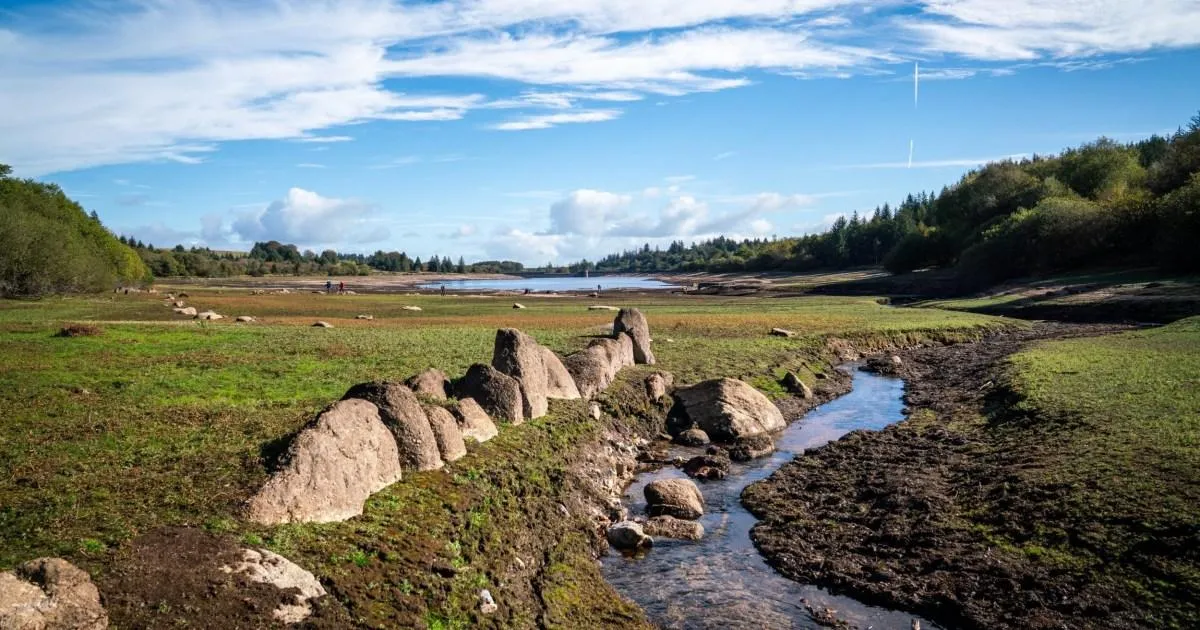
Imagine standing at the edge of a reservoir on a hot, brittle afternoon. The water has pulled back so far that the shore looks like cracked clay, a landscape of dry mud and exposed stone. At Fernworthy Reservoir in Devon, this is not a scene from some distant archaeological dig but a stark reality. After a summer of intense heat and little rain, the water level has fallen to just 30 percent of its total capacity, and the reservoir has begun to reveal something extraordinary. Bronze Age stone huts, built by people who lived on Dartmoor thousands of years ago, have emerged from the receding water. Their outlines are visible in the earth—circular foundations, low stone walls, and the faint traces of doorways and hearths. For locals and visitors alike, the sight is both breathtaking and unsettling. A prehistoric village, hidden for decades beneath an artificial lake, is now exposed to the sky, as if the landscape itself is remembering a past it was forced to forget. You do not have to be an archaeologist to feel the weight of it. The stones are laid out with purpose, arranged in shapes that were once filled with smoke and voices and the smell of cooking. It is one thing to read about ancient history in a textbook; it is another to stand on a cracked reservoir bed and see the floors of houses that people walked on four thousand years ago. The water, which once covered all of this, has become a temporary curtain, and the curtain has been pulled back. What remains is not a neat museum exhibit, but something messier and more real: the rough stones of everyday life, worn by weather and time, standing stubbornly in the sun. The scene asks a quiet question: who lived here, and what did they think as they watched their world change?
These are not just random stones. They are the remains of a settled community, part of one of the most remarkable concentrations of Bronze Age life in Britain. Humans have lived on Dartmoor since at least 2300 BC, but by around 2500 BC something important changed. Farmers began to clear the woodlands, opening up the land for grazing and crops. They built elaborate monuments—stone circles, burial cairns, and ceremonial avenues—to honor their dead and mark their place in the world. They also built villages of stone roundhouses, with thick granite walls and thatched roofs, where families cooked, slept, and raised children. To walk among those remains today is to feel a connection across the ages. The people who lived there shared the same needs we do: shelter, warmth, food, community. They had names, stories, fears, and hopes. They watched the seasons change, celebrated births, mourned losses, and buried their loved ones under the same wide Dartmoor sky. The stones left behind are not merely archaeological features; they are echoes of human lives. Perhaps the most remarkable thing about these settlements is how ordinary they were. This was not a place of kings and warriors, but of farmers and herders, families and neighbors. They lived in small clusters of houses, perhaps with a central area for meeting and ceremony. They kept animals, grew barley and wheat, and gathered wood from the forests they were gradually clearing. Their world was slow and seasonal, bound to the rhythms of sun and rain, and yet it was not static. They were shaping the land, for better and worse, in ways that would eventually come back to haunt them. The monuments they built were not just for the dead; they were for the living, too—places to gather, to trade, to remember. And when we look at those circles and foundations today, we are seeing the roots of the very idea of community.
But these settlements did not last forever. By around 1000 BC, the land that had sustained them was becoming exhausted. The soil, overused and stripped of trees, became waterlogged; the climate grew harsher; and many of the villages were abandoned. It is a sobering reminder that human societies can damage the very landscapes they depend on. The people who had cleared the forests and worked the land had changed the place so deeply that it could no longer support them. They moved away, and the stones slowly sank into the earth, swallowed by grass and peat and time. In 1942, thousands of years later, the valley was flooded to create Fernworthy Reservoir. The construction covered around 76 acres of land and held 380 million gallons of water, submerging the old stone houses beneath a cold, artificial lake. For generations, the remains lay hidden—not lost, exactly, but out of sight. The people who built the reservoir probably never thought much about the ancient homes they were drowning. They had their own urgent needs: a nation at war, an industrial economy, a growing demand for water. But now, with the reservoir at less than a third of its capacity, the hidden village has emerged again. The water that once erased it has retreated, and the old stones are back in the light. There is a certain irony in this. The same modern infrastructure that was meant to control and store water has become a vessel for revealing the deep past. And the same drought that caused so much anxiety has given us a rare glimpse of a world that existed long before the reservoir, before the war, before the industrial age. It is as if the land has a long memory, and it will not be silenced forever. We may cover things up, but we cannot make them disappear.
The reappearance of these Bronze Age settlements is a direct consequence of the same extreme weather that left the UK reeling this summer. The country has spent months recovering from severe drought and record-breaking temperatures. Rivers ran low, fields turned brown, and reservoirs shrank to fractions of their normal levels. Fernworthy is not an isolated case; it is a visible symptom of a changing climate. But the story does not end with the dry season. As the world shifts between extremes, forecasters are now warning that Britain could face a very different kind of winter. The phenomenon behind the heat and drought is also helping to set the stage for severe cold. Experts have pointed to an incoming super El Niño, a powerful climate event that could be one of the most severe on record. While El Niño is often associated with warming in the Pacific Ocean, it can also disrupt the Arctic polar vortex—the band of winds that normally keeps frigid air locked around the North Pole. If that vortex weakens, colder air can drift southward into Europe and North America, bringing blizzards, heavy snow, and dangerous conditions. The same climate system that dried up reservoirs and exposed ancient ruins could soon be sending a deep freeze across the continent. It is a dramatic example of how interconnected the Earth’s systems are, and how small shifts in one part of the world can produce enormous consequences in another. For now, the exposed village is a symbol of a summer of extremes. But the same forces that made it visible are still at work, quietly reshaping the season ahead. The dry earth at Fernworthy may soon be covered in snow, and the stones that reappeared in the heat may be buried once again—not by water this time, but by ice.
For the UK, that would mean a jarring pivot from one extreme to another. After months of worrying about water shortages and wildfires, the same country could be bracing for icy roads, snowdrifts, and power cuts. The effects of a disrupted polar vortex are not limited to cold temperatures. The changing pressure systems can also create wet, stormy conditions, raising the risk of flooding. It is a strange and sobering thought: the very forces that dried out the land and revealed ancient villages could soon be dumping snow and rain on the same region. In London, authorities have begun advising residents to prepare for severe weather, including keeping emergency food supplies for up to three days. It is not panic, but prudence. The message is simple: the weather is no longer something we can take for granted. The same climate system that gave us a summer of blazing heat may now deliver a winter of biting cold, and the ancient stones at Fernworthy stand as a strange monument to that volatility. For many people, the idea of preparing for a blizzard after a summer of drought feels disorienting. But that is precisely the point. The old rhythms of the seasons are shifting. We are entering a time of extremes, and the only reliable strategy is to expect the unexpected. The reservoir, with its hidden village and its shrinking waters, is a perfect symbol of this new reality: what was buried can surface, what was certain can change, and what seemed permanent can suddenly vanish. The advice about emergency supplies may sound like overkill, but it is a small reminder that our modern lives are not as insulated from nature as we like to think. A storm can cut power, block roads, and disrupt supply chains. A few days of food and water can make all the difference.
Perhaps that is why the sight of those prehistoric huts emerging from the reservoir feels so powerful. It connects us to a story that is both ancient and urgent. The Bronze Age people of Dartmoor lived through environmental change of their own. They cleared forests, exhausted the soil, and eventually had to abandon the places they had built. We have done something similar on a global scale. The difference is that we can see it happening, and we still have time to choose a different path. The stones at Fernworthy are not just remnants of the past; they are warnings and invitations. They remind us that human lives are fragile, that landscapes are not permanent, and that the choices we make about the land and climate will be read by future generations in the layers of the earth. As the water rises again, the village may disappear from view, but it will not be gone. It will be there, waiting, like a memory beneath the surface. And when the next drought comes—and it will—it may speak to us once more. In the meantime, the image stays with us: a circle of stones, half-buried in mud, under a hot and cloudless sky. It is a picture of time itself—of things ending, things persisting, and things returning. We are not the first people to face a changing world, and we will not be the last. But we can decide how we respond. We can ignore the signs, or we can learn from the stones. The village at Fernworthy has re-emerged for a reason. The question is whether we are listening. If we are, the ancient homes hidden in the reservoir may offer more than a glimpse of history. They may help us understand our own moment, our own choices, and the legacy we will leave in the ground for future generations. And when the water rises again, as it eventually will, the village will be there, waiting to remind us of the delicate balance between human ambition and the natural world.