



On Saturday night, something magical happened across the United Kingdom. While most people were settling into their weekends, the sky above them quietly put on one of the most spectacular shows nature has to offer. The Northern Lights, also known as the Aurora Borealis, appeared not just in their usual northern haunts but much further south, dazzling residents in places like Hampshire, Devon, and Kent. For many, it was a surprise encounter with the extraordinary. The aurora is something most of us associate with remote Arctic landscapes or once-in-a-lifetime trips to Iceland or Norway, not with looking out of the kitchen window in southern England. But there it was, painted across the night sky in ribbons of green and purple, shifting and swirling in ways that made people stop, stare, and reach for their phones. Social media quickly filled with images and stories. One person shared that they managed to get a picture near Swindon, while another described Bishopstone on the North Kent coast as having “an excellent show for a good hour,” adding that it was definitely a “wow” night. That word, “wow,” seems to capture it all. There’s something deeply moving about witnessing something so beautiful and so rare, especially when it happens right above your own home.
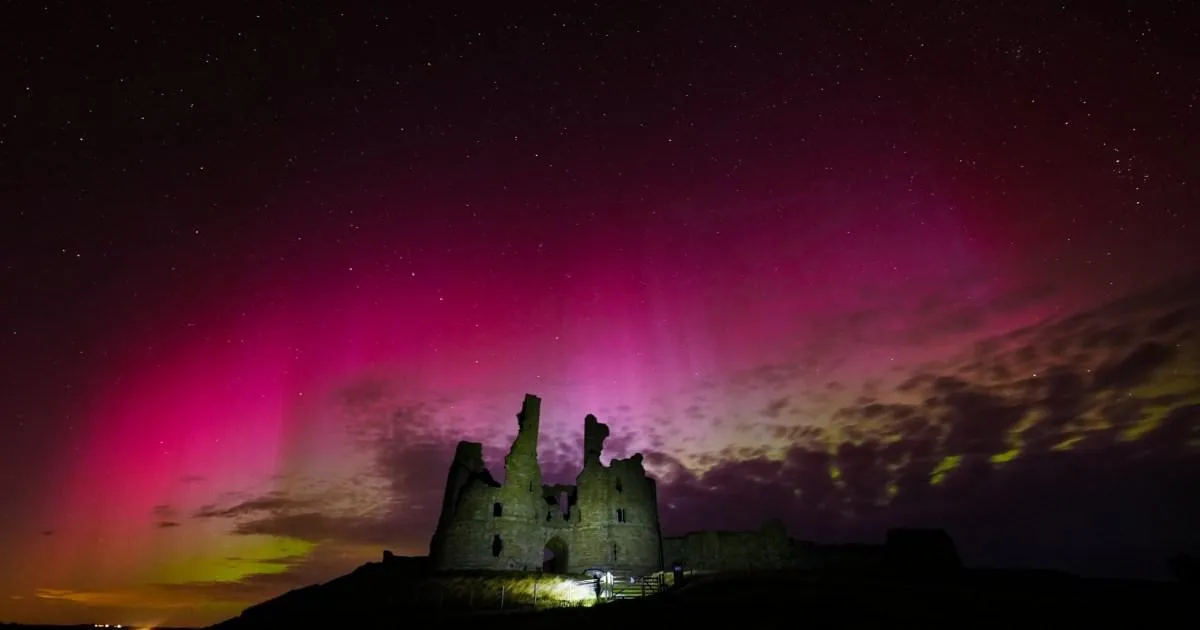
The sheer reach of this particular display made it feel like a shared national experience. People from all corners of the country stepped outside and looked up, and for a brief moment, the usual distractions of life faded away. Even in places where the light show was not immediately obvious to the naked eye, cameras caught glowing sweeps of colour that revealed just how much was happening above our heads. In Northumberland, photographers captured the aurora over the ruins of Dunstanburgh Castle, creating an image that felt ancient and timeless, as if the ruins and the sky belonged together in some old story. The fact that this kind of display is normally only seen in northern Scotland made it even more special. Normally, you would have to travel hundreds of miles north, brave cold winds, and hope for clear skies to have any chance of seeing the aurora. But on this night, the sky came to the people. It was a reminder that nature does not follow our rules or expectations, and that sometimes, the most unforgettable moments happen when we least expect them. For those who missed it, there is still reason to hope. The Met Office has said that sightings could continue until Tuesday, meaning there are still plenty of opportunities to catch the lights if you know where to look and when to step outside. The key is to stay patient, keep an eye on the forecast, and be ready to step out into the dark when the conditions are right.
To understand why this happened, it helps to know a little bit about what causes the Northern Lights. It all starts with the Sun, which is far more active than we often realise. The Sun constantly releases streams of charged particles, and sometimes, during what are known as coronal mass ejections, it launches large bursts of these particles into space. When those particles travel toward Earth and interact with our planet’s magnetic field, they are drawn into the atmosphere near the poles. There, they collide with oxygen and nitrogen particles in the air. These collisions release energy in the form of light, creating the glowing, dancing colours we call the aurora. Oxygen tends to produce greens and reds, while nitrogen can create blues and purples. It is a beautiful, cosmic physics lesson happening right before our eyes. The Sun unleashed a series of these coronal mass ejections toward Earth at the end of last week, setting the stage for the incredible display over the weekend. The whole process is a reminder that, despite how solid and stable our world may feel, we are constantly surrounded by invisible forces and charged particles from billions of miles away. The light show we witnessed is not just a beautiful sight; it is a physical connection between our planet and our star, a visible trace of the Sun’s energy reaching us across space.
If you are disappointed that you missed it, do not give up just yet. The conditions that made this display possible may linger for a few more nights. According to the Met Office, sightings could continue until Tuesday, meaning there is still a real possibility of catching another glimpse. Of course, a lot depends on where you are and how clear the sky is. Clouds can easily ruin a promising night, as can light pollution from towns and cities. But even with those challenges, the aurora has a way of surprising people. If you can, find a spot with an unobstructed view to the north, away from streetlights and buildings, and give your eyes time to adjust to the darkness. And if the sky does oblige, you might be rewarded with one of the most unforgettable sights of your life. Beyond this week, there are even bigger reasons to be excited. Experts have previously predicted that 2026 will be a particularly good year for spotting the Northern Lights. This is because the Sun’s activity follows a natural cycle that spans roughly eleven years, and the coming period is expected to bring increased solar activity. That means more chances for the aurora to push further south and put on spectacular shows for people who are not used to seeing them. It is a hopeful thought for anyone who has ever dreamed of seeing the Northern Lights but never had the chance to travel to the Arctic.
If you do want to try spotting them, there are a few simple things you should know. First, distance yourself from bright lights as much as possible. Streetlights and house lights can wash out the faint glow of the aurora, so the darker your surroundings, the better your chances. Look toward the northern horizon, because that is where the lights are most likely to appear. One of the most surprising tips, though, is to use your phone camera. You might not be able to see the full spectacle with your naked eye, but your phone might be able to capture it clearly. This is because of how our eyes work in low light. At night, in dim conditions, our eyes rely on rod cells, which are excellent at helping us see in the dark but do not perceive colour very well. This is why, in low light, we tend to see things in shades of black and white. The aurora may therefore look like a faint, greyish cloud to you, even when it is actually glowing with vivid greens and reds. Cameras, on the other hand, can gather light over a longer exposure and pick up colours that our eyes cannot easily see. So if you want to know what the sky truly looks like, point your phone at it and take a picture. You may be surprised by what appears on your screen. It is a strange and wonderful thought: sometimes, technology can show us a world that is hidden from our own eyes.
In the end, the excitement over the Northern Lights is about more than just pretty pictures. It is about the sense of wonder that comes from looking up at the night sky and feeling connected to something bigger than ourselves. For a few hours on Saturday, people across the UK—from Scotland to the south coast—shared the same experience, even if they were miles apart. Strangers posted their photos online, neighbours probably told each other to look outside, and families gathered in gardens and parks, craning their necks toward the heavens. In a world that is often busy, loud, and overwhelming, moments like these are precious. They remind us that beauty can appear suddenly, without warning, and that we are all living under the same sky. Whether you managed to see the lights last night, are hoping to catch them tonight, or are already dreaming about what 2026 might bring, the most important thing is to keep looking up. You never know when the universe might decide to put on a show just for you. And even if you see nothing but stars, there is still something wonderful about taking a moment to pause, breathe, and appreciate the vast, mysterious and beautiful world we are so lucky to call home.