

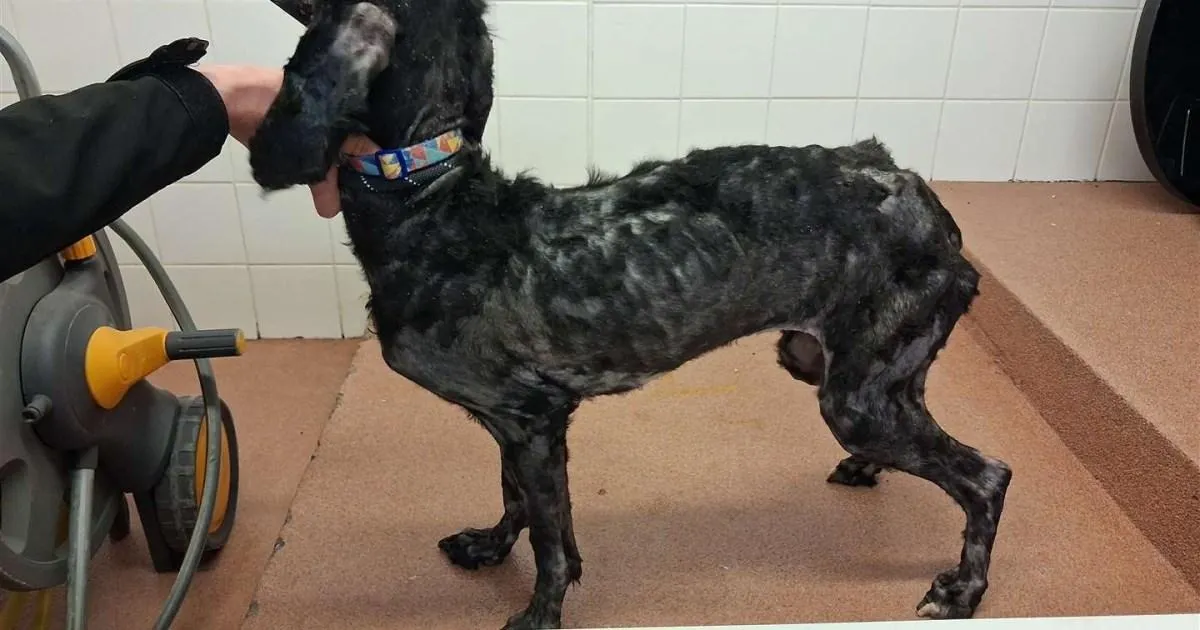
There are moments in animal rescue that leave even seasoned professionals shaken, and the case of Nancy the Cockapoo is one of them. When police officers entered a spare room at a home in Silk Court, Forres, on March 1, 2026, they were met by a scene of profound neglect. The air was thick with the stench of urine and faeces, and in the corner, a small black dog sat covered in her own waste. Her fur was so severely matted that her eyes and ears were completely hidden, and her bones jutted out from beneath a coat that had clearly not been cared for in a very long time. There was no food in the room, and the water bowl was coated in mould. Clumps of fur lay scattered across the floor, and bald patches on her hind legs showed where she had been chewing at herself in distress. Nancy weighed just 8.2kg—around 18 pounds—when she should have weighed at least 12kg. For a two-year-old dog, this was not a momentary lapse in care; it was the visible result of weeks, if not months, of starvation and isolation. The officers had come after receiving a call expressing concern for her welfare, but nothing could have prepared them for the reality of Nancy’s condition. She was, as one inspector later put it, a “bag of bones”—a living skeleton who had somehow survived in a room that had become her prison. The initial discovery was just the beginning of a case that would expose a prolonged period of neglect and force a young woman to face the consequences of her inaction.
The full extent of Nancy’s suffering emerged in the days that followed. A Scottish SPCA inspector collected her from a friend of her owner, who had temporarily taken her in, and rushed her to Vets Now in Aberdeen. There, a veterinary surgeon found that Nancy’s matted coat was embedded with faeces from head to toe. In some places, the matting was so dense that her skin was completely invisible. The vet determined that she had likely been lying on a hard, flat surface in her own waste for a considerable time, with little or no opportunity to go outside. Her body condition score was 1 out of 9—the lowest possible, indicating emaciation and severe underweight. The inspector, who had 18 years of service, said Nancy was one of the thinnest dogs they had ever seen; they could wrap their hands around her neck with overlap, and do the same around her waist. The matting was so severe that removing it while Nancy was conscious was impossible, so she was anaesthetised for the process. Further examinations revealed she was anaemic and suffering from fleas, ear mites and periodontal disease—a bacterial infection that damages the gums, ligaments and bone supporting the teeth. The vet concluded that Nancy had experienced around three months of inadequate nutrition to reach such a state, and that her owner had failed to take any steps to prevent her suffering. The evidence painted a picture of a dog who had been slowly fading away in a room reeking of waste, with no food, no comfort, and no one to help her. The only explanation offered by her owner, Rebecca Ferguson, was that she had run out of food the previous day—a claim that investigators found impossible to believe given Nancy’s condition. The case was reported to the procurator fiscal, and Ferguson was cautioned and charged on March 23.
In court, the details were laid bare. Rebecca Ferguson, 24, appeared at Elgin Sheriff Court and admitted responsibility for causing unnecessary suffering to Nancy. Procurator fiscal Shameila Ghafar described how police had attended Ferguson’s home after receiving a call expressing concern for her welfare. Inside, they found Nancy in a spare room, the smell of urine and faeces overwhelming. There was no dog food anywhere in the property. Ferguson told police she had run out of food the previous day, but officers concluded that Nancy had likely not been fed for weeks. The court heard that the neglect had been “prolonged” and that Nancy’s suffering was not the result of a single bad day, but of a sustained failure to provide even the most basic care. The dog’s fur was severely matted, her bones were protruding, and she had been chewing at her own hind legs out of desperation. The vet’s findings were harrowing: matting from head to toe, faeces embedded throughout, anaemia, fleas, ear mites, and periodontal disease. The condition of her coat was so severe that the dematting process could not be carried out while she was conscious. The vet concluded that Nancy had experienced around three months of inadequate nutrition. The court also heard that Nancy’s eyes and ears could not be seen beneath the dense matting, and that she had likely been lying in her own faeces for some time on a hard, flat surface, suggesting she had not been getting outside. The inspector who collected Nancy was “taken aback” by her condition, describing her as a “bag of bones” and “like a skeleton.” The case was a stark example of how neglect, not just active cruelty, can cause immense suffering, and it left everyone in the courtroom with a clear sense of the horror Nancy had endured.
When it came to sentencing, the court heard from Ferguson’s defence solicitor, Megan Lee, who offered no excuses. “I have no words to mitigate the condition of this dog,” Lee said. She acknowledged that the case involved “failing to act” rather than intentional cruelty, but added that there was “little difference” in the outcome. Lee explained that Ferguson had been in the throes of a Class A addiction at the time of the offending. Since then, she had been sober for three months and had spent time reflecting on the suffering her former pet had endured. “This will haunt her for many years if not the rest of her life,” the solicitor said. Sheriff David Harvie was blunt in his assessment. “What this poor dog went through was horrific,” he said. “This is a case caused by incredible neglect. The neglect is really significant. Extreme.” He ordered Ferguson to carry out 120 hours of unpaid work and placed her under supervision for one year. She was also banned from owning any animals for 10 years. The sentence reflected the seriousness of the neglect, but it also acknowledged the human circumstances behind it. Addiction is a devastating illness that can impair judgment and erode a person’s ability to care for themselves, let alone a dependent animal. Yet the court’s message was clear: no matter how difficult a person’s own struggles may be, they do not absolve them of responsibility for the creatures in their care. Nancy had no choice in her circumstances; Ferguson did. The 10-year ban is a reminder that owning an animal is a privilege, not a right, and that the trust placed in us by our pets must never be taken lightly.
Amid the darkness of this case, there is a glimmer of hope. Nancy has since made a remarkable recovery. She now weighs a healthy 12.6kg, has been rehomed, and is described as “thriving.” The transformation from the emaciated, matted creature found in that spare room to a healthy, happy dog is a testament to the resilience of animals and the dedication of the people who refused to give up on her. The Scottish SPCA inspectors, the veterinary team at Vets Now, and the friend who initially took her in all played a part in giving Nancy a second chance at life. It is impossible to know what Nancy remembers of her ordeal, but dogs are remarkably forgiving creatures. They live in the present, and for Nancy, the present now includes a warm home, proper food, and people who love her. Her story is a powerful reminder of why animal welfare laws exist and why they must be enforced. It also highlights the importance of speaking up when you suspect an animal is suffering. The police were called because someone expressed concern for Nancy’s welfare. That single act of compassion set in motion the chain of events that saved her life. If you see something, say something—it can make all the difference. Nancy’s recovery is not just a happy ending; it is a call to action for all of us to be more vigilant, more compassionate, and more willing to intervene when we see signs of neglect.
The case of Nancy the Cockapoo is a sobering reminder of the responsibilities that come with caring for an animal. Pets are entirely dependent on their owners for food, water, shelter, and medical care. They cannot speak up when they are hungry or in pain, and they cannot escape the conditions in which they are kept. When that trust is broken, the consequences can be devastating. Nancy’s story is one of extreme neglect, but it is also a story of redemption—for her, and perhaps for her former owner, who is now sober and haunted by what she allowed to happen. The 10-year ban on owning animals is a significant punishment, but it is also an opportunity for reflection. It is our hope that Ferguson will use the coming years to rebuild her life and emerge from her addiction with a deeper understanding of the harm she caused. For the rest of us, Nancy’s story should inspire us to be better. Whether it is adopting a rescue animal, supporting animal welfare organisations, or simply keeping a watchful eye on the pets in our neighbourhoods, we all have a role to play in preventing cruelty. Nancy was one of the lucky ones. She was found in time, rescued, and given the chance to thrive. But there are countless other animals out there suffering in silence, waiting for someone to notice. Let her story be a reminder that every animal deserves a life free from fear and pain, and that we have a moral duty to ensure they get it. Nancy’s journey from a “bag of bones” to a thriving, healthy dog is a testament to the power of compassion—and a challenge to us all to do better.