


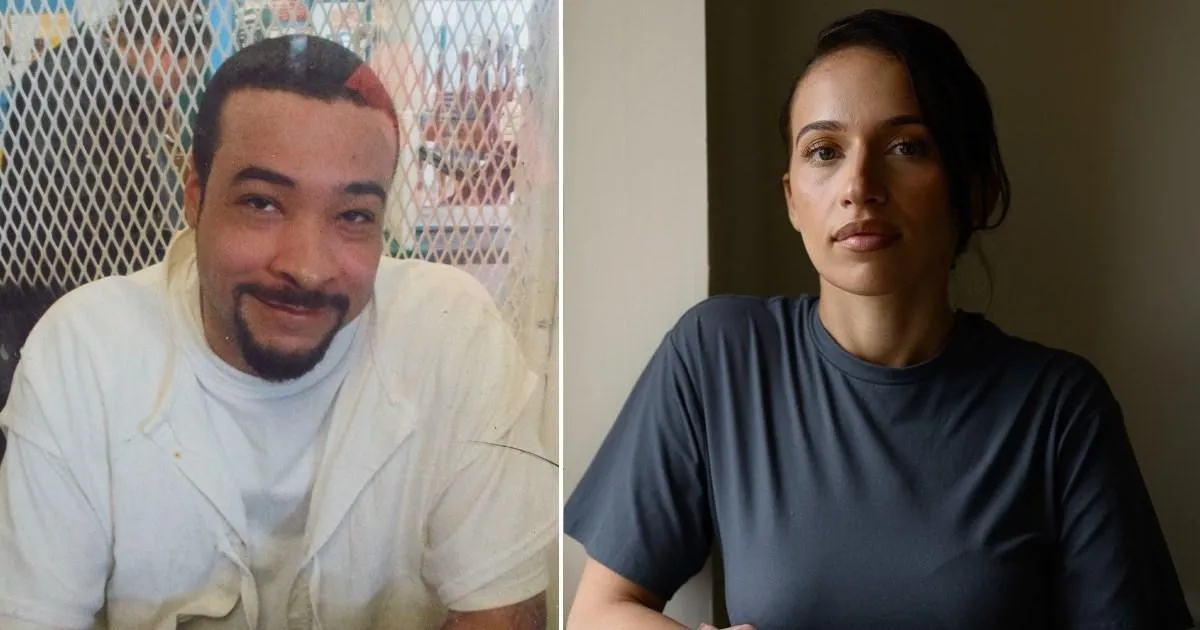
The story of Tiana Broadnax is a harrowing testament to the unseen human costs of capital punishment, stretching far beyond the walls of the death chamber. Tiana, a law student and mother from London, entered the life of James Broadnax through a simple, academic inquiry while researching her master’s dissertation on the Texas death row system. Though she had vowed to herself that she would never become one of the many women who fall in love with incarcerated men, the distance between London and Huntsville eventually dissolved through a heavy exchange of letters, long-distance phone calls, and an undeniable emotional tether. Their romance was one constructed entirely of barriers—glass partitions, six-hour time zone differences, and the rigid, unnatural rules of the prison system.
The relationship was defined by a haunting lack of physical intimacy, yet it was profound enough to sustain both of them until the state-mandated end. Tiana spent months navigating the dual reality of her life in Lewisham and the restrictive, clockwork schedule of the Texas facility, where phone calls were aggressively capped at 30 minutes. She describes a strange, secondary imprisonment, noting how she internalized the prison’s protocols in her daily life, such as automatically lifting her arms at airport security or compulsively checking the clock during calls. When the execution date for April 30 was finalized in late 2024, the surreal nature of their connection turned lethal, leaving them with only months to fight a legal system that had already deemed James’s life expendable.
Their final months were marked by a frantic struggle against the cold machinery of justice, though they managed to marry two weeks before the execution—a ceremony held through glass that granted them a fleeting 45 minutes of proximity. James had been convicted for his role in a double murder eighteen years prior; however, the case was marred by significant controversy, including the systematic removal of all Black jurors during his trial and a later confession by his co-defendant, Demarius Cummings, stating that he—not James—had fired the fatal shots. Despite the mounting evidence and the desperate appeals lodged by Tiana, the Governor’s office and the courts refused to intervene, cementing the state’s decision to follow through with the lethal injection.
The actual execution was a moment of profound, clinical brutality. Forced to watch from behind a glass screen, Tiana endured 40 agonizing minutes as the lethal dose took effect. The finality of the process was emphasized by a cruel irony: only after the state had successfully ended his life was Tiana permitted to touch her husband’s body. Even then, the intimacy was restricted by a chaplain’s warning to avoid the area below the chest, a grim reminder that even in death, the toxic chemical legacy of the state continued to police the boundaries of their relationship. The trauma of the experience triggered a dissociative break in Tiana, who suffered vivid hallucinations of James outside the prison walls; she describes this period as a descent into a psychotic state, a direct reaction to the systematic destruction of her partner.
Returning to London, Tiana has been left to piece together a life that feels vastly emptier, unable to reconcile her past responsibilities as his advocate, therapist, and wife with the sudden vacuum he left behind. The psychological weight of her experience has permeated her domestic life, where she struggles with a paralyzing fear of leaving her home, feeling as though she remains tethered to that sterile room in Texas where he died. Her narrative serves as a stark reminder that the death penalty is not merely a terminal sentence for the convicted, but a recurring, lifelong trauma for the loved ones caught in its wake. It is a reality that remains largely invisible to the public, shielded by the sanitized distance of legal reporting.
Looking ahead, Tiana has committed her grief to fuel a broader fight. As political discourse in the UK flirts with the potential reinstatement of capital punishment, she stands as a witness to the reality that theory often masks. She has attempted to engage with politicians pushing for the return of the death penalty, hoping to shift the abstract policy debates back toward the irreparable human destruction she witnessed. Her voice is now a conduit for those who have been erased by the state, aiming to ensure that the cold, clinical finality she experienced is never normalized under the guise of justice. For Tiana, the crusade against the death penalty is not just an academic endeavor; it is the final, necessary way to honor the man she lost.