


The historic streets of Oxford have become a flashpoint for a deeply polarized debate, as the Oxford Union prepares to host Stephen Yaxley-Lennon—far better known as the controversial activist Tommy Robinson. His scheduled appearance, where he is set to argue that the West is “right to be suspicious of Islam,” has effectively shuttered parts of the city center. In anticipation of clashes between his followers and those deeply opposed to his rhetoric, local businesses and pubs have taken the precautionary measure of boarding up their windows. The atmosphere is heavy with tension, transforming a city usually synonymous with academic inquiry into a scene of heavy security cordons and barricades, signaling the intense public anger surrounding a platform being offered to a figure known for radical views.
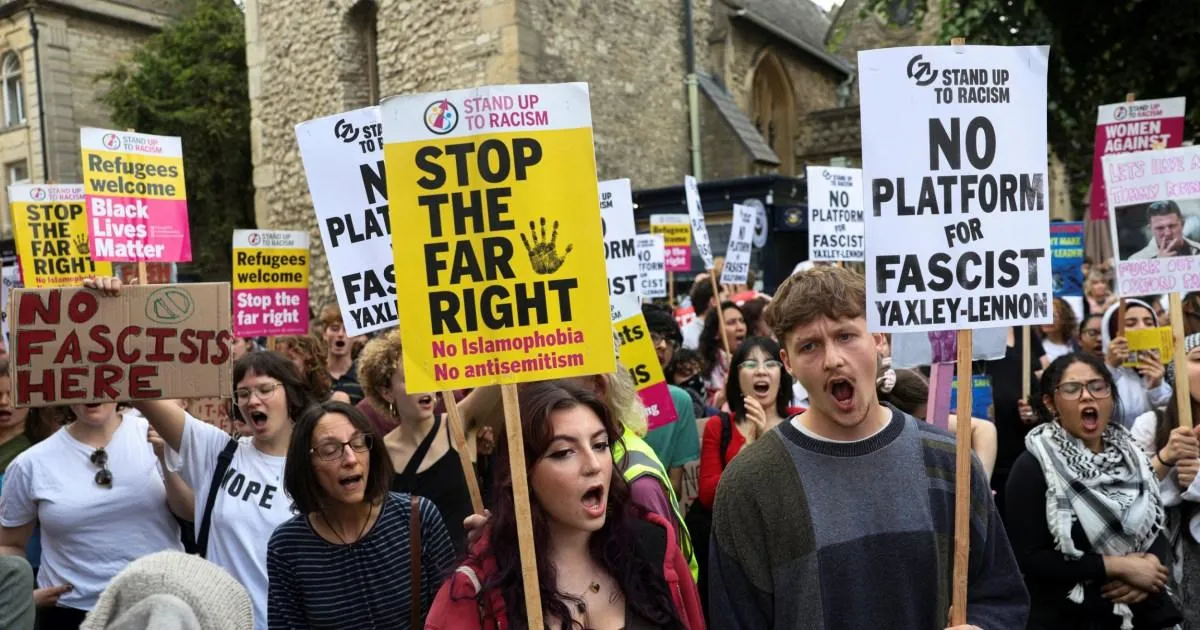
For many residents and local leaders, this isn’t just about an invited speaker; it’s a direct challenge to the community’s identity. The protests, spearheaded by groups like Stand Up to Racism, have surged into the streets with chants of “Oxford is anti-fascist,” reflecting a widespread belief that hosting Robinson serves only to embolden far-right sentiment and deepen social fissures. The scene is one of stark contrast: anti-racist protesters carrying slogans against Islamophobia and antisemitism find themselves separated by thin lines of private security from Robinson’s supporters, who arrive draped in Union Jack and St George’s flags. As the two factions press against the barriers, the shouting of insults highlights the breakdown of civil discourse, replacing traditional debate with raw, visceral confrontation.
The presence of figures like Laurence Fox, alongside Robinson, has turned the Oxford Union into an epicenter of a much larger national debate over free speech versus the normalization of hate. While critics argue that the Union is essentially handing a megaphone to someone who thrives on stoking division, supporters of the event argue that such controversy is the very essence of academic freedom. Alex Hernandez, a law student preparing to attend the debate, articulates this friction perfectly; he believes that even the most difficult ideas should be aired, arguing that the danger lies in silencing voices rather than challenging them in a public forum. Yet, for many others, the “platforming” of such individuals is an unacceptable bridge too far, seen as an endorsement of harmful ideologies that cannot be reconciled with a modern, inclusive society.
Political leaders have been quick to weigh in, with Anneliese Dodds, the MP for Oxford East, delivering a scathing critique of the Union’s decision. She echoed the sentiments of many who feel the invitation is a blatant act of provocation rather than a constructive engagement with ideas. This sentiment was echoed firmly by Susan Brown, the leader of the Oxford City Council, who didn’t mince words regarding the burden placed on the public. She emphasized that while the city values the principle of open debate, it must be balanced against the safety and wellbeing of its residents. To her, the event is not merely an intellectual exercise but a potential source of intimidation, made even more frustrating by the massive, costly police operation required to keep the peace.
Perhaps the most practical aspect of this discord is the financial weight landing on the taxpayer. Council leader Susan Brown has made it clear that the Oxford Union should be held accountable for the security costs, arguing that the disruption to local trade and the heavy drain on police resources is a direct consequence of a decision the Union alone initiated. The reality is that the logistical footprint of this event—road closures, added police patrols, and the resulting apprehension among local businesses—has turned the debate into a significant burden on the city. It raises a poignant question about the responsibility of institutions: when an organization invites a figurehead of division, who should pay for the cleanup or the chaos that inevitably follows?
As the sun sets on the spires of Oxford, the city remains braced for further confrontation, capturing a snapshot of a country struggling to navigate the limits of tolerance. The impasse between the need to maintain an open marketplace of ideas and the duty to protect a community from harassment remains unresolved. Whether or not the debate itself achieves any intellectual depth is increasingly irrelevant compared to the social shockwaves it has generated. In this clash, the message is clear: Oxford may be a place of prestige and learning, but it is also a living community that is deeply uncomfortable with the idea that any voice, regardless of the hate it may stir, is entitled to a stage at the expense of local harmony and public peace.