



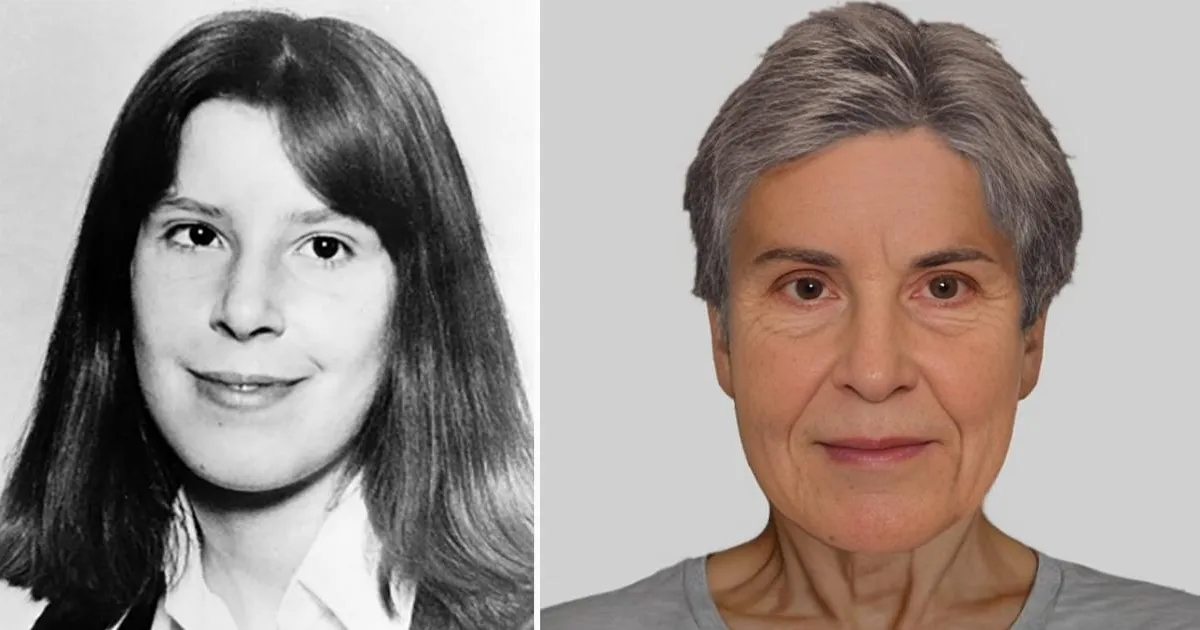
The mystery of 14-year-old Suzanne Lawrence is a haunting echo from the summer of 1979, a time when a simple trip into London turned into a permanent, painful void. Suzanne and her 13-year-old sister, Michelle, left their home in Harold Hill, east London, with a plan that was typical for teenagers seeking independence—they told their mother they were heading to stay with friends in Dagenham. Instead, the girls embarked on a journey that would lead them to a fair in Highbury Fields, north London. It was there that they encountered a group of three boys, aged between 14 and 17, an introduction that would ultimately separate the sisters forever. For decades, the details of those few days in a squat near Highbury Stadium have remained frozen in time, leaving a family anchored to a moment of confusion that never found its resolution.
The tragedy took a definitive turn when a disagreement sparked between the sisters during their stay at the squat. Michelle, perhaps sensing the fragility of their situation or simply pushed to her limit by the argument, decided to return home after two nights. She left Suzanne behind, fully expecting that her older sister would follow her back to Harold Hill within twenty-four hours. However, those twenty-four hours stretched into weeks, then months, and eventually forty-five years. While authorities originally leaned toward the theory that Suzanne had simply run off to join the travelling fair circuit—a common assumption in missing persons cases of that era—that explanation has withered away, replaced by the grim realization that she may have met with foul play.
For Michelle, the burden of being the last person to see her sister alive is a weight that has never lightened. Reflecting on that fateful summer, she speaks with a raw, enduring heartache, acknowledging that they were both just children trying to navigate a world that proved far more dangerous than they realized. “Many years have passed, but not a day goes by without wondering what happened to her,” Michelle shared. Her plea is not just for closure, but for the basic human right to know the truth. Her aging mother, who has carried the silent, agonizing weight of an empty chair at the table for over four decades, serves as a painful reminder that the passage of time does not heal the grief of a parent who never received an answer.
The police investigation, now led by Detective Chief Inspector Kam Sodhi, is a desperate effort to piece together the fragments of a cold case that has been neglected for too long. The inquiry is focusing on the girls’ movements on July 27, 1979, when they departed from Neave Comprehensive School, took a bus to Romford station, and traveled into the heart of London. By reaching out to the public, the police hope to trigger long-dormant memories. They are particularly interested in anyone who might have seen Suzanne on public transport or encountered the group of teenagers at the fair or the squat near Highbury Stadium. Every small detail, no matter how insignificant it may have seemed in 1979, is now a vital piece of a puzzle that the Metropolitan Police are determined to solve.
The humanity of this story lies in the disparity between the girl Suzanne was and the ghost she has become. The police have released an e-fit of what Suzanne might look like today, a sobering visual prompt that serves to humanize a case that could easily be reduced to a file number. It is a reminder that Suzanne was not just a runaway statistic; she was a sister, a daughter, and a young woman with a future that was snatched away. The detective’s plea is direct and urgent: this isn’t just about police work; it’s about answering the fundamental questions that have haunted a family for two generations. They are asking the public to look back into their own histories, to consider if they knew these girls or the boys they were with, and to finally provide the missing pieces of a life interrupted.
Ultimately, the search for Suzanne Lawrence is a testament to the fact that no one is truly forgotten so long as someone, somewhere, is still looking for them. Whether she is alive and unaware of the search for her, or whether she is a victim of a decades-old crime, the silence that has surrounded her disappearance is finally being challenged. As the authorities push for information, the story serves as a poignant reflection on how easily a life can be erased by time, and how deeply a family’s love persists through the decades of “not knowing.” For Michelle and her mother, this appeal is more than a search for evidence; it is a final, desperate attempt to reclaim a memory and to ensure that, after nearly half a century, Suzanne’s story is finally allowed to reach its conclusion.