


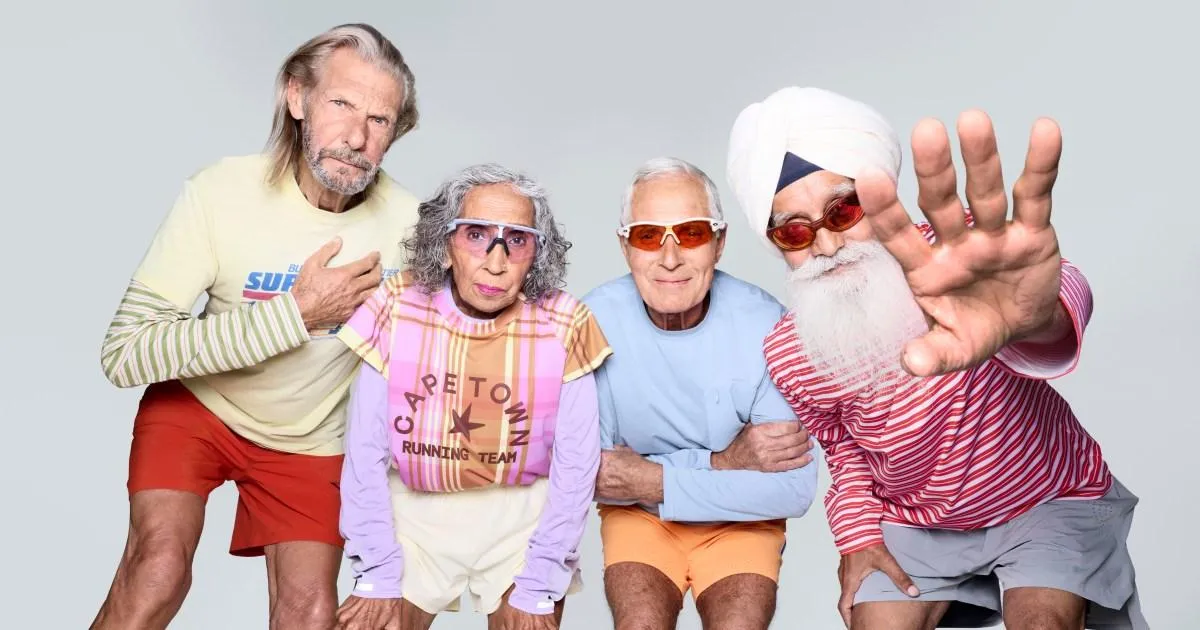
For most runners, the finish line is a signal to reach for a protein shake, a banana, or maybe an ice bath. For Peter Giles, it is a cue for something far more personal: a coffee and a cigar. At 82 years old, Giles is not your typical athlete, and he has no interest in pretending otherwise. A former carpenter and bass guitarist, he only began competitive running in his mid-forties, long after most people have resigned themselves to a quieter life. Yet last year, at the World Masters Athletics Championships in Sweden, he won five gold medals. In December, he broke the British 5km road record for his age group, crossing the line in 22 minutes and 29 seconds. He is one of four members of Britain’s oldest running team, assembled by the sports brand Altra, with a combined age of 321. The group, called The Legacy Team, was photographed by Rankin and is designed to challenge the way we think about ageing and endurance. But perhaps the most striking thing about Giles is not his medals or records; it is the way he carries himself. He does not seem obsessed with times or splits. He seems genuinely at ease, a man who found his passion late in life and has spent decades proving that it is never too late to begin. His post-race ritual of coffee and a cigar says everything: he runs on his own terms, and he celebrates in his own way. There is something quietly rebellious about that in a world of hyper-optimised athletes and strict nutrition plans. Giles is a reminder that running can be a lifelong joy, not a chore to be endured or a performance to be perfected. He does not run because he has to. He runs because he loves it, and that love has carried him across finish lines all over the world, long after many of his contemporaries have hung up their trainers for good.
Giles’s training philosophy is refreshingly uncomplicated. He runs around 30 miles a week, avoids the gym, and takes only vitamin D supplements. There are no gruelling interval sessions, no expensive gadgets strapped to his wrist, no complicated carb-loading strategies. After a race, he celebrates with his customary coffee and cigar, a routine that would make most sports nutritionists wince but one that clearly works for him. “Most runners overtrain and over-complicate everything. The older I get, the simpler it all becomes,” he said. There is a profound wisdom in that statement, especially in an era where running has become increasingly data-driven and commercialised. People obsess over pace zones, heart rate variability, recovery metrics, and the latest super shoes. Giles, by contrast, has stripped the sport back to its essentials: put one foot in front of the other, enjoy the feeling, and don’t take yourself too seriously. He has outlived and outperformed runners who were once faster and fitter than him, not because he trained harder, but because he stayed consistent. He avoided the burnout that comes from pushing too hard too quickly. He listened to his body. He allowed himself to rest when needed, and he never let a bad race define him. His approach is a masterclass in sustainability. In a culture that celebrates intensity and instant results, Giles represents the quiet power of patience. He did not start running until his forties, which means he has only been a competitive runner for about half his life. Yet in that time, he has achieved more than most athletes do in a lifetime. His story suggests that the secret to a long running career is not talent or genetics, but mindset. It is about showing up, again and again, with curiosity and joy, rather than treating every run as a test of willpower.
The broader context makes Giles’s achievements even more remarkable. New research commissioned by Altra found that around seven million people took to the streets of England to run last year, yet the average British runner gives up the sport at the age of 39. That is a sobering statistic. Running is often described as the most accessible sport in the world; you need no equipment, no membership, no special skills. And yet, for so many people, it is something they abandon in their thirties, just as they might be hitting their stride. The reasons are familiar. One in three runners who quit do so because of injury. More than half of those surveyed said they had suffered a setback serious enough to stop them running for three months or longer, and one in six of that group said they had never fully recovered. Nearly a quarter said life simply got in the way. We all understand that feeling. Work gets busy, children need attention, energy levels drop, and the sofa becomes more appealing than the pavement. Running, which once felt like freedom, starts to feel like another obligation. The research paints a picture of a nation of runners who start with enthusiasm and slowly lose their way, often through no fault of their own. But it also highlights something important: the people who keep running into their seventies and eighties are not necessarily the fastest or the most gifted. They are the ones who found a way to make running fit their lives, rather than the other way around. They adapted. They recovered. They learned to run for joy, not just for results. Peter Giles is a perfect example, but he is not alone. He is part of a small but mighty group of runners who are proving that age is not a barrier, and that the habits we build today can carry us for decades.
That group is The Legacy Team, and each member has a story worth telling. Alongside Giles is 79-year-old Rajinder Singh MBE, who has completed marathons around the world and is recognised as one of the oldest runners in the Sikh community. For Rajinder, running is not just a personal pursuit; it is a way of connecting with his heritage and inspiring others. He has become a symbol of dedication and faith, showing that you can be deeply rooted in tradition while still pushing your physical limits. Then there is Laurence Cummings, 85, who holds 204 age-category parkrun records across England and Scotland. Parkrun, for those who know it, is a beloved Saturday morning ritual that brings communities together. To hold 204 records is almost incomprehensible. It means Laurence has spent years showing up, week after week, often in the rain and cold, to run a course he knows intimately. He is not chasing fame or fortune. He is simply doing what he loves, and in doing so, he has become a local legend. The final member is Pritpal Kaur, 75, who made history as the oldest British Asian woman to complete this year’s London Marathon. Her achievement is particularly powerful because it challenges stereotypes about age, gender, and ethnicity. She has opened doors for others who might have assumed that marathon running was not for them. Together, these four runners represent something far bigger than their individual accomplishments. They are proof that running can be a lifelong companion, a source of identity, and a way of staying connected to the world. They come from different backgrounds, different professions, and different starting points, but they share a common thread: they never stopped moving.
The inspiration for The Legacy Team came from a simple observation. Rob Herdman, marketing director at Altra, explained that the team spent a lot of time at races across the UK last year and kept finding themselves inspired by the same people. “Not necessarily the fastest runners or those standing on the podium, but the runners in their seventies and eighties who were still out there doing something they loved,” he said. “Every time we saw them, we’d say the same thing: ‘I want to be like that when I’m older. That simple thought became the inspiration for this campaign. The Legacy Team is a celebration of runners who show what’s possible and a reminder that the choices we make today can shape whether we’re still running thirty or forty years from now.” That sentiment is at the heart of everything. It is not about winning races or setting records. It is about building a relationship with running that can withstand the ups and downs of life. It is about choosing to go for a run even when you are tired, choosing to rest when you are injured, and choosing to come back even after a long break. The members of The Legacy Team are not superhuman. They have faced injuries, setbacks, and the inevitable challenges of getting older. But they have never let those obstacles define them. They have adapted their routines, adjusted their expectations, and found new ways to stay active. They understand that the goal is not to be the fastest runner in the room, but to be the one who is still running when everyone else has stopped.
What can the rest of us learn from Peter, Rajinder, Laurence, and Pritpal? Perhaps the most important lesson is that it is never too late to start, and it is never too late to start again. Peter began running in his forties. Pritpal ran her first marathon at an age when many people are told to slow down. Laurence has spent his eighties collecting records that most younger runners could only dream of. They all share a willingness to embrace the present moment and a refusal to be limited by expectations. They also remind us that running does not have to be perfect to be meaningful. You do not need the best shoes, the most advanced watch, or a meticulously planned training schedule. You just need to move, to breathe, and to find joy in the simple act of going outside. The coffee and cigar might not be the healthiest choice, but they are a reminder that life is about more than optimisation. It is about pleasure, ritual, and the small rewards that make the hard work worthwhile. The Legacy Team’s combined age of 321 is not just a number. It is a testament to the power of persistence, the value of community, and the beauty of a life lived in motion. So the next time you lace up your trainers, think of Peter Giles and his coffee and cigar. Think of Laurence Cummings and his 204 parkrun records. Think of Pritpal Kaur crossing the London Marathon finish line, and Rajinder Singh running through the streets of his ancestors. They are not just runners. They are proof that the human spirit, when nourished with consistency and love, can keep going far longer than anyone expects. The best time to start was yesterday. The next best time is now. And if you keep going, you might just find yourself, at 80 or 90, still chasing the horizon, still smiling, and still celebrating your own strange and wonderful rituals.