



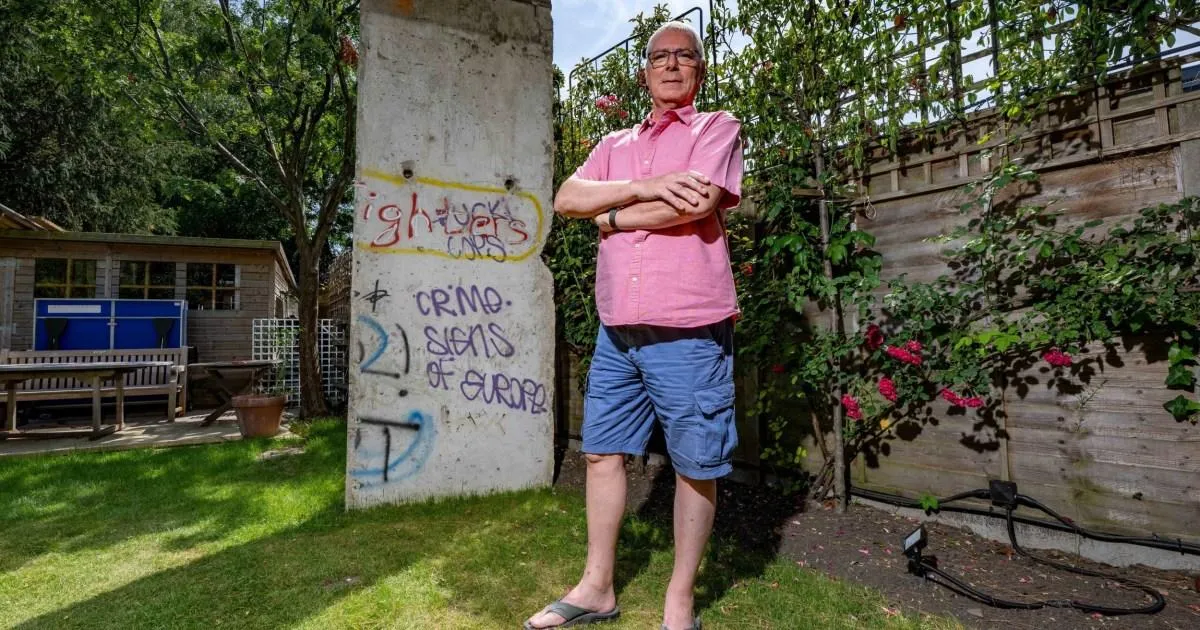
In the quiet residential neighborhood of Herne Hill, a peculiar dispute has erupted that pits the cold, hard history of the Cold War against the rigid bylaws of local permit offices. Steven Thorpe, a 65-year-old property developer with a penchant for history, recently invested in a unique piece of human heritage: a 3.6-metre-tall, two-tonne slab of the original Berlin Wall. He successfully transported the monolith from a German farmer’s field to his own back garden, intending for it to stand as a meaningful historical artefact. However, what Mr. Thorpe views as a preserved relic of human resilience, Southwark Council and his neighbors perceive as a looming, industrial eyesore that disrupts the peaceful aesthetic of their suburban street.
The conflict officially reached a boiling point early this July when Mr. Thorpe received a formal letter from the local planning department. The council has labeled the installation an “unacceptable” structure, citing a failure to adhere to the standard two-metre height limit for walls and fences. According to the planning officer, the concrete slab is “oppressive,” creating an overbearing sense of enclosure that negatively impacts the neighbors’ quality of life. The council warned that unless Mr. Thorpe voluntarily relocates or removes the segment, he faces a mandatory enforcement notice that carries with it the threat of a criminal conviction and a fine of up to £20,000.
Deeply frustrated by the bureaucratic rigidity, Mr. Thorpe is preparing an appeal, arguing that the council has fundamentally misunderstood the nature of his property. He contests the planning department’s measurements, claiming the installed height is actually 3.1 metres, not 3.6, and that it sits nearly a metre away from his boundary line rather than the 60 centimetres alleged by officials. More importantly, he disputes the classification of the item itself. To Mr. Thorpe, calling this a “wall” or an “enclosure” that needs regulation is a category error; he contends that it is a piece of art and a historical monument that should be granted protections and considerations far beyond those of a standard residential privacy screen.
The human element of this standoff is perhaps the most contentious point, as Mr. Thorpe insists that his neighbors’ complaints are largely overstated. To mitigate the “stark industrial appearance,” he has already planted Red Robin shrubs along his fence line, which he claims effectively obscures the view from neighboring properties. He finds the council’s lack of a site visit particularly galling, believing they based their decision on hearsay and broad municipal rules rather than the reality of the garden’s layout. For him, the council’s refusal to acknowledge the distinction between a garden fence and a piece of world history is proof of a “computer-says-no” mentality that ignores the cultural value of the objects citizens choose to maintain.
Southwark Council, for its part, remains unmoved by the historical significance of the concrete. Their official stance is that they are simply upholding the national planning process, which serves to protect residents from unauthorized developments that create an “oppressive” environment. While they have theoretically left the door ajar for an application to move the wall to a different, less intrusive location within the garden, they have made it clear that without a formal proposal to relocate it, the default path is a strict enforcement action. They maintain that the environmental and aesthetic harmony of the neighborhood must take precedence, regardless of the historical weight of the materials used in the garden’s construction.
As the situation stands, the fate of the Berlin Wall segment remains caught in a tug-of-war between the personal right to own history and the collective right to maintain a uniform living environment. Mr. Thorpe is currently seeking professional planning advice, vowing to fight the label of “unauthorized structure” while remaining open to compromise if absolutely necessary. It is a classic tale of modern life: where the grand, heavy, and tragic legacy of the 20th century collides with the fine-print, light-touch bureaucracy of the 21st, leaving a man—and his piece of the Wall—waiting to see if he will be allowed to hold onto his slice of history or be forced to break it down.