

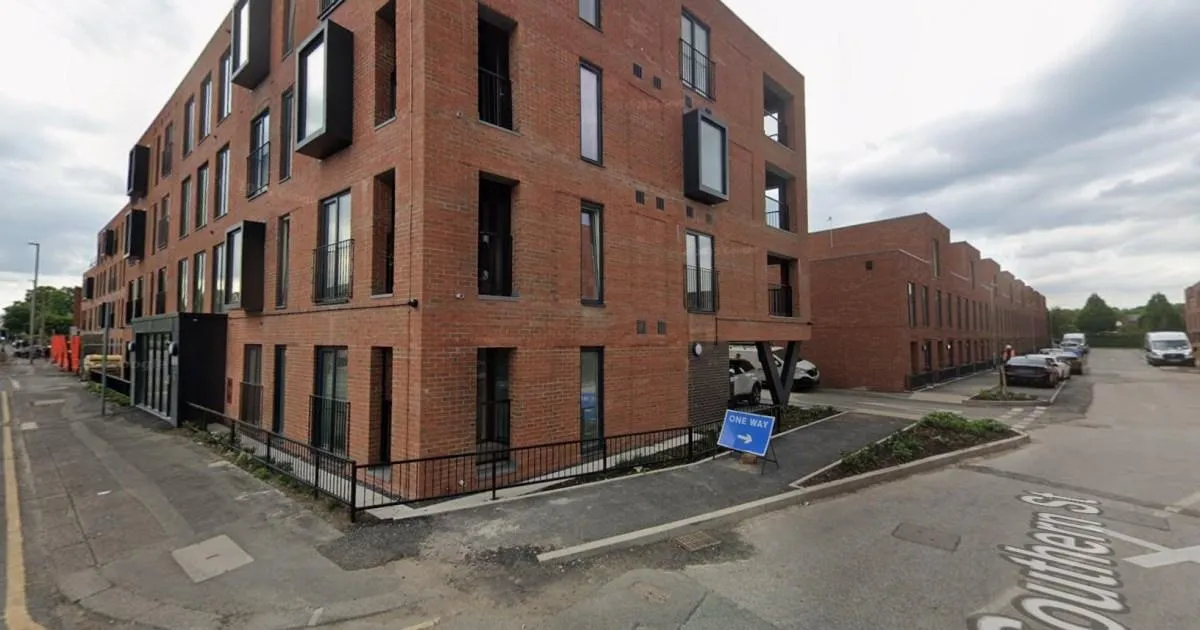
It began just after midnight on a quiet Saturday in Salford, when the usual stillness of a residential street was shattered by something no one could have expected. Police were called to reports that a man had fallen from a balcony at a block of flats close to the junction of Liverpool Street and Southern Street. Greater Manchester Police responded quickly, along with paramedics and other emergency services, and found a man with injuries so severe that he was immediately rushed to hospital. There, doctors would describe his condition as life-threatening, and as the hours passed, it became clear that the young man was fighting not just for recovery, but for his very life. What should have been an ordinary start to the weekend had transformed into a crisis in a matter of moments. Within that narrow window of time, a neighbourhood that had been silent was flooded with sirens, flashing blue lights, and the urgent movements of people whose job it was to save him. The fallen man was taken into trauma care, where he remains in a critical condition. The shock of the incident has rippled far beyond the immediate scene, leaving family, friends, and local residents struggling to understand how something so devastating could happen just a few feet from their own front doors. The emergency response was frantic but professional, yet for the man at the centre of it all, the coming days will be a struggle measured in intensive care machines, hospital corridors, and quiet prayers.
As news of the incident began to spread, Greater Manchester Police confirmed that a second man, also in his twenties, had been arrested on suspicion of attempted murder. The charge is one that carries enormous weight. It transforms the fall from what might have been mistaken for a terrible accident into something far more deliberate, sinister, and concerning. The arrested man was taken into police custody, where he remains while detectives carry out their investigation. For the victim, the phrase “attempted murder” means that the injuries he suffered are believed to be the result of someone else’s actions, and that the events leading up to his fall may have involved violence, aggression, or intention that the law now seeks to unpick. It is a deeply unsettling thought, especially for those who live in the block of flats and who now look at their balconies and corridors with a sense of unease. The investigation is still in its early stages, and officers have not confirmed the exact relationship between the two men, nor what may have happened in the moments before the fall. What is clear is that this was not simply a case of someone losing their footing in the dark. GMP’s detectives are working carefully, gathering evidence, speaking to witnesses, and trying to piece together a timeline that will explain how a man ended up broken on the pavement below and another in a police cell.
Perhaps the most difficult element of this case is the revelation that the two men had contact with police earlier in the evening, before the fall occurred. Because of this prior contact, the incident has been referred to the Independent Office for Police Conduct, a step that is standard practice in certain circumstances but which always adds another layer of complexity to an already painful situation. This referral does not mean that police officers are accused of wrongdoing; rather, it is a transparency measure designed to ensure that every aspect of the incident is scrutinised independently. But for the public, it raises troubling questions. What did that earlier contact involve? Could anything have been done differently? Was there a moment when officers had the chance to intervene, and if so, why did it slip away? These are questions that may take weeks or even months to answer, and they are made all the more urgent by the fact that a man’s life now hangs in the balance. In cases like this, the police are not only investigators but also public servants who must account for their own actions. The Independent Office for Police Conduct will examine the circumstances surrounding the earlier police interaction, and their findings will form an important part of the broader investigation. Until then, there is an uncomfortable gap between what neighbours witnessed and what the authorities can openly say, and that gap is filled with rumour, fear, and painful uncertainty.
In the meantime, the human cost of the incident is visible for all to see in the streets around the flats. A blue forensic tent has been erected on a corner near the building, a silent marker of the tragedy that unfolded there. It stands as a symbol of the police work still taking place, the search for evidence and answers. Members of the public, many of whom had been asleep minutes earlier, rushed to help the injured man before the emergency services arrived. Their actions speak to the decency of ordinary people in extraordinary circumstances, people who did not hesitate to try to save a stranger’s life. One local resident, who did not wish to be named, described waking to the sound of sirens and later seeing footage of the aftermath being live-streamed on social media. She said: “I heard all the sirens, but I keep myself to myself so I didn’t go out. I’ve seen it’s all cordoned off and there’s a blue forensics tent. It’s sad, it’s really sad. It’s a bit close to home.” Her words capture the strange, unsettling atmosphere that now hangs over the neighbourhood, a mixture of sorrow, caution, and disbelief. The fact that the aftermath was being broadcast online only adds to the feeling that this private tragedy has become public property, viewed by strangers who may never know the victim’s name but who will form their own opinions about what happened.
Chief Inspector Lee Gridley of GMP’s Salford district has sought to reassure the community while also acknowledging the seriousness of what has occurred. In a statement, he confirmed that a man has been arrested on suspicion of attempted murder and is currently being questioned in custody. He added: “Our officers are working at pace to establish the full circumstances, and a scene will remain in place whilst the investigation continues. We understand that incidents of this nature may cause concern within the community, however we believe this is an isolated incident and that there is no wider risk to the public.” These words are carefully chosen, meant to offer comfort without making promises. They tell residents that what happened was contained, that there is no lingering threat to those who live nearby, and that the authorities are doing everything they can. But for those who witnessed the aftermath, the sight of the forensic tent and the police cordon will not be easily forgotten. The phrase “isolated incident” may be officially accurate, yet it cannot erase the image of a man being carried away on a stretcher, or the knowledge that someone, somewhere, now has to live with the consequences of what happened. The investigation will continue for some time, and the answers it produces will determine not only the legal outcome for the arrested man but also the community’s ability to move forward.
As the story continues to develop, it is worth pausing to remember that beyond the police statements, the forensic evidence, and the legal processes, there is a human being lying in a hospital bed, surrounded by medical staff who are doing everything they can to keep him alive. There is also a family, likely torn between hope and despair, waiting for news that could change their lives forever. In the end, this is not simply a crime or a news item; it is a tragedy that has engulfed a group of people who never asked to become part of it. The arrested man, too, now faces a long journey through the criminal justice system, and the courts will eventually decide what happened and why. But at this moment, the focus must be on the injured man and his recovery, on the hope that he will survive and one day be able to tell his side of the story. The community in Salford has been shaken, but it has also shown its strength, with neighbours coming forward to help and police working tirelessly to find the truth. For everyone affected, there is a long road ahead, one that will require compassion, patience, and unity. Until then, the blue tent remains, the detectives continue their work, and a city waits, hoping for a miracle.