
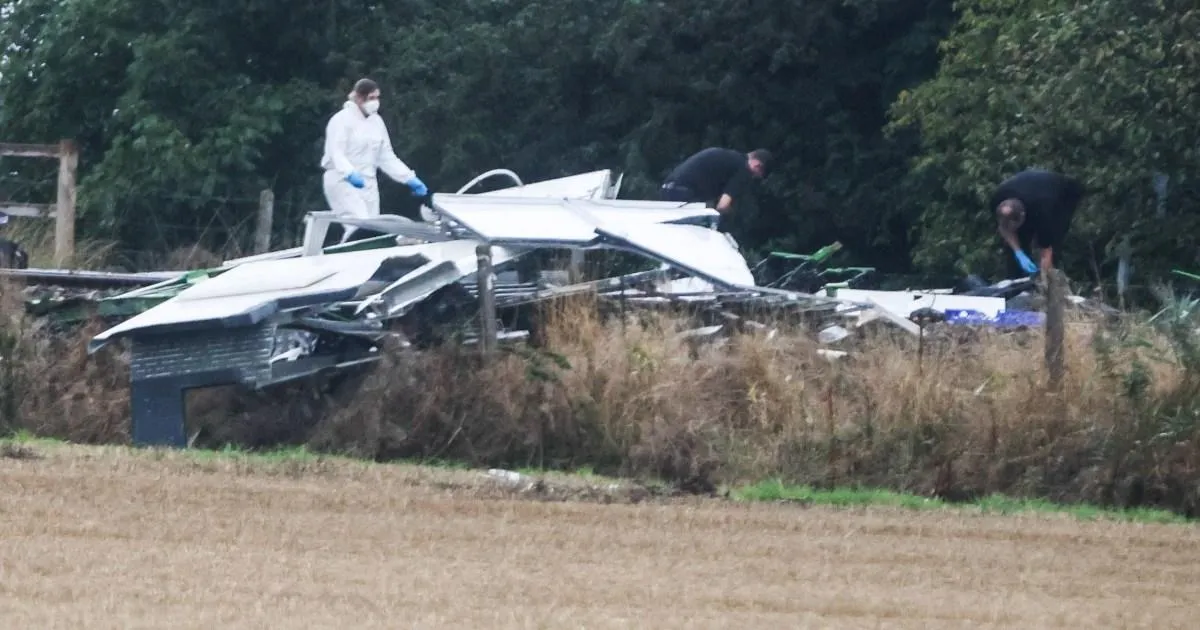
It began as an ordinary morning in the quiet Lancashire countryside, the kind of morning when the fields around Burscough are still soft with dew and the trains run on time. Then, suddenly, the peace was shattered. Police, ambulance and fire crews were called to the scene of a serious incident involving a van and a train, a collision that would leave a family devastated and a community stunned. The emergency response was swift, with blue lights cutting through the rural roads and the air filled with the urgency of sirens. What had been a normal stretch of railway, a route familiar to commuters and locals alike, became a cordoned-off scene of tragedy. According to officials, one person was in the van at the time of the collision, and sadly, a man was pronounced dead at the scene. The news spread quickly, through text messages and phone calls, across social media and from neighbour to neighbour, carrying with it the unmistakable weight of loss. For those who live in and around Burscough, the incident was not just another news headline; it was a reminder of how fragile life is, how quickly the ordinary can turn to the extraordinary, and how a journey that began without worry could end in heartbreak. In the hours that followed, the focus rightly turned to the victim, the emergency workers who responded, and the passengers and train crew who suddenly found themselves caught up in a situation none of them could have anticipated.
The British Transport Police, who lead investigations into incidents on the railway, released a statement that confirmed the terrible reality of what had happened. “One person was in the van and sadly a man was pronounced dead at the scene,” the statement read. “Two people who were passengers on the train received treatment for minor injuries. The incident is not being treated as suspicious.” Those final words, perhaps, offered a small measure of clarity, but they did little to ease the pain of a loss. The statement continued with a plea for information: “Enquiries are ongoing to establish the full circumstances of what happened, any witnesses who haven’t already spoken to police are asked to text BTP on 61016 quoting the reference 373 of 29 August.” It was a request that would no doubt be met with a response, as people came forward to help piece together the final moments before the collision. But beyond the official language, beyond the reference numbers and the procedural details, there lay a human story of unimaginable sorrow. Somewhere, a family was being told that they would never see their loved one again. Somewhere, friends were grappling with the sudden absence of someone who had been part of their lives. And somewhere, passengers who had boarded the train expecting a routine journey were being comforted, checked for injuries, and left to process the shock of what they had witnessed.
Train operator Northern, which runs the Wigan Wallgate and Southport route, was quick to respond to the disruption caused by the incident. The company issued a warning to travellers that the route would remain closed throughout Sunday, with services delayed or cancelled as emergency services worked at the scene. In a post on X, formerly known as Twitter, Northern explained the situation clearly: “Due to emergency services dealing with an incident between Wigan Wallgate and Southport the line is blocked. Services running to and from these stations will be delayed or cancelled. Disruption is expected until the end of the day.” For regular commuters, the news was frustrating, but for those who understood the gravity of the situation, the inconvenience of a delayed journey was nothing compared to the tragedy that had unfolded. People were left to find alternative routes, to wait on platforms, to rearrange plans, while behind the barriers and in the quiet aftermath of the accident, investigators continued their work. The closure of a railway line is always a logistical challenge, but it is also a sign of respect, a recognition that a life was lost and that the community deserves answers. As the day wore on, the disruption rippled outwards, affecting not just those travelling on the Southport line but also connecting services, buses, taxis, and the countless personal schedules that depend on the reliable movement of trains. Yet, amid the inconvenience, there was an underlying current of empathy, as passengers and railway staff alike understood that something far more important than punctuality was at stake.
This tragedy, unfortunately, is not an isolated event in the broader story of Britain’s railways. Every year, there are incidents on level crossings and tracks where vehicles and trains collide, often with devastating consequences. The railway system is vast and complex, running through remote areas, small towns, and bustling cities, and at the points where it crosses roads, there is always a potential for danger. Level crossings are designed with safety in mind, with barriers, lights, and warning signals, but human error, misjudgement, or a simple moment of distraction can all lead to catastrophe. For the people of Burscough, a village and civil parish in West Lancashire, the railway is part of the landscape, a constant presence that brings connections to Wigan, Southport, Preston, and beyond. The line is used by hundreds, if not thousands, of people every day, and the sight of a train passing through the countryside is a familiar one. But on this day, that familiarity was broken. The emergency response, the police tape, the fire engines and ambulances, all served as a stark reminder that the railway is not just a convenience but also a place where tragedy can strike without warning. For the local community, the grief is shared, not only with the family and friends of the man who died but also with the train driver, the passengers, and the emergency workers who will carry the memory of this day with them for a long time.
In the aftermath of any such incident, the focus is always on establishing the full circumstances. Investigators from the British Transport Police would examine every detail: the condition of the crossing, the movements of the van and the train, the weather, the visibility, the sequence of events that led to the collision. They would speak to witnesses, review any available footage, and work with specialists to understand what happened and why. The statement that the incident was not being treated as suspicious suggests that there was no intent involved, but that does not make the loss any easier to bear. Accidents on this scale leave a lasting mark, and the process of investigation is also a process of closure, a way of providing answers to the family and to the public. Meanwhile, the two passengers who received treatment for minor injuries would have been taken to a place of safety, checked over by medics, and left to deal with the shock of being involved in such an event. Their physical injuries may have been minor, but the emotional impact of being on a train that hits a vehicle cannot be underestimated. They will likely relive the moment, the sound, the jolt, and the sudden realisation that something terrible had happened. Support services would have been offered, and the railway company would have done its best to ensure that everyone involved was looked after.
As the sun began to set over Burscough, the line remained closed, and the work of the investigators continued under the glow of floodlights. The village, a place of narrow lanes, old churches, and welcoming pubs, had been thrust into the national spotlight, not for a celebration or a festival, but for a tragedy. The people of the area, as they so often do, would have rallied together, offering support to the emergency services, sharing information, and looking out for one another. For the wider community, the incident is a reminder of the importance of safety, of paying attention at level crossings, of valuing every moment and every journey. But above all, it is a reminder of the human cost of accidents, of the lives that are changed in an instant, and of the need to be kind and compassionate in the face of loss. The family of the man who died will now begin the long and painful process of grieving, supported by friends, neighbours, and those who understand their pain. The police have asked anyone with information to come forward, and it is likely that they will hear from those who saw the collision or who witnessed the events leading up to it. In time, the rail line will reopen, the trains will run again, and the familiar rhythm of life in Burscough will slowly return. But the memory of what happened on that August day will not fade easily. It will remain in the hearts of those who lost a loved one, in the minds of those who were on the train, and in the collective consciousness of a community that came together in the face of tragedy. For now, there are more questions than answers, more sorrow than understanding, and more need for compassion than ever before. The investigation will find its answers, but the healing will take much longer. All that can be done in the immediate aftermath is to remember the man who died, to support those who are hurting, and to hope that such a tragedy will never happen again.