


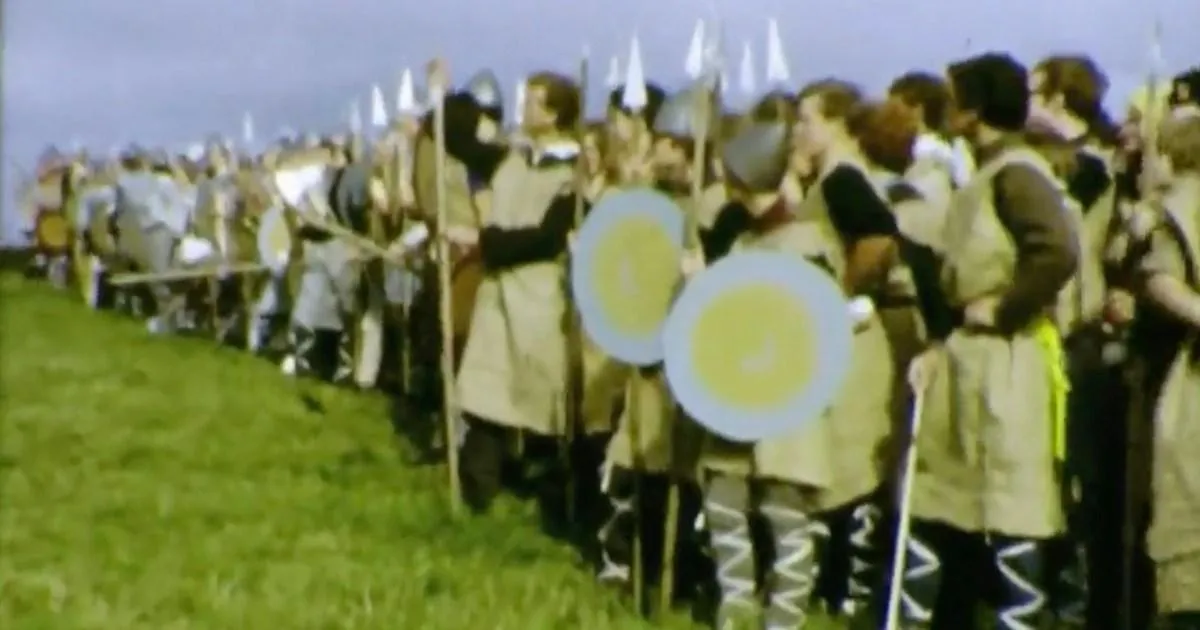
It begins as a story of dusty film reels and forgotten memories, and then slowly, like images developing in a chemical bath, it comes back to life. An extraordinary time capsule, capturing the very first Battle of Hastings re-enactment, has been unearthed, beautifully restored, and brought back into the light after nearly sixty years. The colour footage, shot in 1966 to mark the 900th anniversary of the most famous battle in English history, was recently handed over to English Heritage, the charity that now cares for the very ground where King Harold fell. What makes this film so special is not just its age, but what it reveals: a raw, chaotic, joyful snapshot of a pioneering attempt to drag history out of the textbooks and onto the open fields of East Sussex. In the grainy, vividly hued images, we see hundreds of rowdy re-enactors clashing with swords and axes, surging across the landscape with all the passion and enthusiasm of people who were inventing a tradition as they went along. There is a palpable sense of fun, but also a rather relaxed attitude towards health and safety that feels almost alien to modern audiences. The footage captures marching men, swirling banners, and the thunder of hooves, all set against the backdrop of the historic town of Hastings. For decades, this remarkable piece of local heritage sat unseen, waiting for someone to dust it off and share it with the world. Now, after meticulous restoration, it is finally set to be shown to the public for the very first time this weekend, offering a truly unique window into the past and the early days of an event that has since become an annual ritual for thousands of history lovers.
Behind this treasure is a deeply human story of family, ingenuity, and quiet pride. The original footage was captured by Alan Wootton, a man who ran an electronics business in Hastings, East Sussex, alongside his wife, Mary. They were a forward-thinking couple, always tinkering and innovating in the world of home entertainment. At a time when most home movies were silent, flickering affairs, Alan and Mary developed a groundbreaking method of adding synchronised sound to their film reels. It was this pioneering expertise that caught the attention of the local town council, who commissioned the couple to document the grand 900th anniversary celebrations. It was a huge undertaking, and Alan did not work alone. His young son Cliff, just twelve years old at the time, was drafted in to help, serving as a sound recordist right in the thick of the action. Cliff later recalled those days with immense fondness, remembering how his father pulled him into the heart of the chaos, giving him a front-row seat to history as it was being reinvented. The film he helped create is more than just a record of an event; it is a testament to a family’s passion for both technology and history. The Woottons were not simply documenting a battle re-enactment; they were preserving the atmosphere, the noise, the laughter, and the sheer eccentricity of a town throwing itself into a celebration almost a thousand years in the making.
What exactly does this remarkable footage show? It opens like a page torn from a 1960s holiday album, but then the past bursts into motion. Boisterous re-enactors, many with impressively hairy beards and distinctly unmodern haircuts, can be seen marching down Battle High Street, their wooden and metal weapons glinting in the autumn sunshine. There is a wonderful, almost chaotic energy to the scenes, with soldiers on foot getting dangerously close to the horses, their riders struggling to maintain order amidst the roar of the crowd. The original event was a far cry from the polished, carefully choreographed spectacles of today. In 1966, the focus was on raw excitement rather than historical precision. Shields clash, banners flutter, and the air is thick with the battle cries of men who are clearly having the time of their lives. It is likely to raise a few eyebrows amongst modern audiences, not just because of the questionable safety practices, but because of the sheer unvarnished nature of the proceedings. There are no barriers, no safety briefings, and very little separation between the fighters and the spectators. You get the sense that anyone could have walked right into the middle of the battle and joined in. This is re-enactment in its purest, most primal form, a time before health and safety risk assessments, when the biggest concern was simply ensuring the fighting looked exciting enough. The footage captures all of this beautifully, preserving the spirit of an era when historical re-enactment was still a new and slightly wild idea.
The journey of this film from a family attic to the public eye is a touching story of love and remembrance. After Alan Wootton passed away, his wife Mary was left with a vast collection of his life’s work, comprising some 300 reels of film. Rather than let them gather dust, she lovingly passed the entire archive to their son, Cliff. What followed was a labour of love. Over many months, Cliff carefully reviewed, processed, and digitally enhanced the footage, frame by painstaking frame. It was a way of reconnecting with his father, of hearing his voice and seeing the world through his lens once more. The project was clearly an emotional journey, but Cliff knew the footage was too important to keep to himself. In a generous act of preservation, he decided to release the original film to English Heritage, ensuring that it would be safeguarded, preserved, and shared with future generations. Cliff, now looking back on those boyhood memories, spoke with immense warmth about his parents’ achievements. He admitted that he was hugely proud of what his father and mother had accomplished with their homemade film and sound equipment, and expressed his delight that English Heritage would be showing the footage to so many other people who share an interest in this fantastic piece of British history. His father, a pioneering electronics enthusiast, could never have imagined that his playful experiment in home movie making would one day become an invaluable historical document, watched by thousands.
For English Heritage, the film is an absolute goldmine. James Witcombe, the charity’s site manager for Battle Abbey, was clearly thrilled by the discovery, describing the film as an incredible time capsule. For him, the footage does more than just document a battle; it captures the very atmosphere of an event that has grown and evolved over the decades, continuing to bring history to life for thousands of people almost a thousand years after the original conflict. He noted, with a knowing smile, that some of what is seen in Alan’s film serves as a reminder of just how much re-enactment, and indeed health and safety, has changed over the past sixty years. The contrast is stark. Today’s modern re-enactments are meticulously researched, professionally choreographed, and rigorously marshalled. Participants undergo safety briefings, wear protective gear, and perform carefully rehearsed combat sequences. In 1966, it was clearly more of a free-for-all, a wonderful, chaotic celebration where enthusiasm outweighed accuracy. The success of that first event was so profound that it led directly to the Norman and Saxon battle re-enactment becoming an annual tradition, now held each October at the historic site of Battle Abbey. This year marks the 60th anniversary of that very first event, and the charity is now on the hunt for any of the original re-enactors who took part all those years ago. They hope to invite these veterans of the pioneering spectacle back to the abbey to witness how the event they helped to create has blossomed into a major national attraction, cementing their place in the history of living history.
Ultimately, this rediscovered film is far more than a piece of nostalgic footage. It is a bridge between two centuries, a tangible link between the brave, messy, and joyous beginnings of a tradition and the polished, professional world of modern heritage. It reminds us of the power of human curiosity and the simple desire to connect with our past, not through dusty books, but through action, sound, and shared experience. The Wootton family’s homemade film gives us a precious glimpse of a moment when the people of Hastings came together to honour a battle that changed the course of the nation. It is a story about a father and his young son, working side by side, unknowingly creating a legacy that would outlast them. It is a story about a community finding its identity and a new way to celebrate its heritage. The re-enactment of the Battle of Hastings will be held at Battle Abbey on October 10 and 11, a ceremony that now draws spectators from around the world. But when they gather to watch the swords clash and the horses charge, there will be an added layer of meaning this year, thanks to the discovery of this extraordinary film. The past, as they say, is never truly dead. Sometimes it just needs a little patience, and a loving hand, to be brought back to life. And in this case, a sixty-year-old reel of colour film has reminded us that history, in all its glorious imperfection, is always worth remembering.