


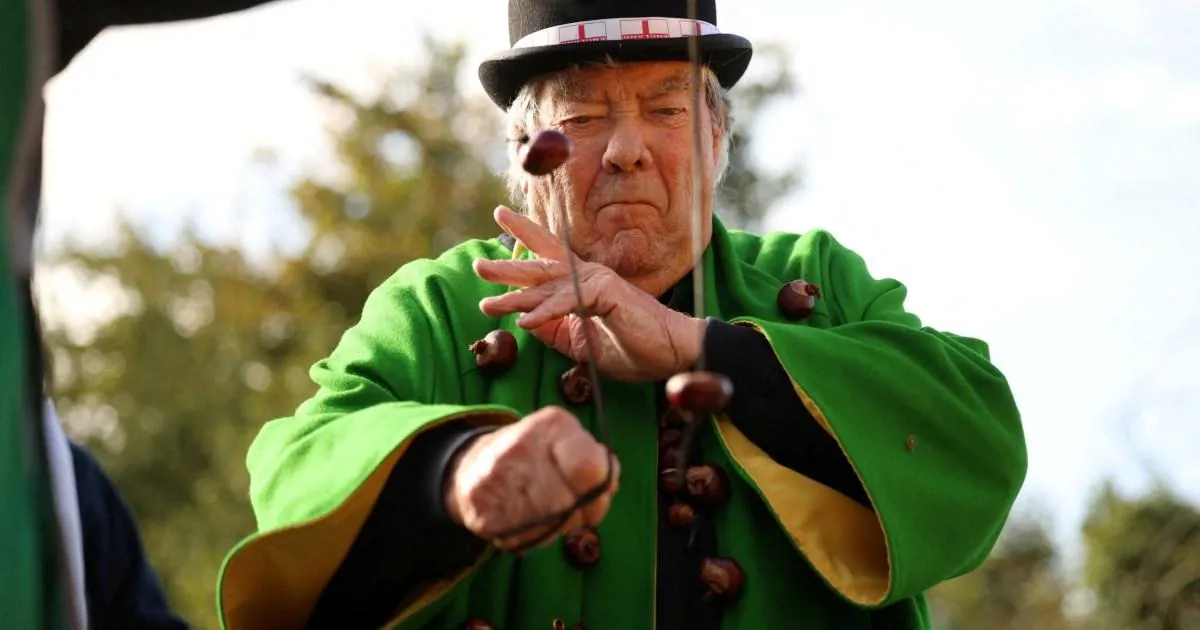
At the heart of one of Britain’s most delightfully eccentric sporting traditions, a familiar and beloved figure is preparing to bow out. David Jakins, the 84-year-old man known around the world as King Conker, has announced that he is retiring from his role as the official mascot of the World Conker Championships after two decades of loyal service. For twenty years, Jakins has embodied the unique spirit of this wonderfully odd contest, in which grown adults and children alike face off with horse-chestnut seeds threaded onto strings, each trying to smash their opponent’s prized conker into pieces with a satisfying crack. What began as a simple village pastime has grown into an international event, drawing competitors from all corners of the globe to the small Northamptonshire village of Southwick, where the championships are held each year. The event carries with it a deep sense of nostalgia, conjuring images of autumn afternoons in English schoolyards, pockets bulging with shiny brown conkers and the laughter of children echoing through the playground. For Jakins, however, his final years in the role have been anything but simple. He leaves behind a legacy that is equal parts joy and controversy, a strange cocktail of sporting glory and outright scandal. Yet, as he prepares to hand the crown to his daughter, Fee Aylmore, and to Jim Packer, the event’s chairman, there is a palpable sense that he is doing so with dignity, warmth, and a quiet determination to see his beloved event continue to thrive long after he is gone.
The controversy that would come to define the final act of Jakins’s reign erupted two years ago, when he finally captured his first World Conker Championship title. It was a moment he had been chasing for four decades, and the victory should have been the crowning achievement of his long association with the event. Instead, celebrations were cut short when organisers discovered a steel conker, a perfectly polished metal replica, tucked away in his pocket. The implications were immediate and devastating. Accusations began to swirl that Jakins had secretly swapped his real conker for the metal replacement during a crucial moment in the competition, using a tool that belonged more in a mechanics workshop than on a village green. The story was irresistible to the world’s media. Headlines screamed of cheating at the World Conker Championships, and what should have been a lighthearted tale of autumn tradition suddenly became a tabloid sensation. Jakins, who had spent years charming audiences with his wit and playful eccentricity, found himself at the centre of a storm he could never have imagined. He denied any wrongdoing, insisting that the steel conker was simply an old prop, perhaps left over from a previous demonstration or stunt. After a tense and draining investigation, he was formally cleared of cheating, but the damage had already been done. The glory of his victory had been tarnished, and the event itself was left with a lingering air of suspicion.
It is perhaps no surprise that the organisers adopted what were described as airport-style security checks at the following year’s event, a surreal precaution that seemed entirely out of place at a gathering devoted to children’s games and village camaraderie. Competitors were reportedly checked for metal objects, and the atmosphere, once so carefree and innocent, became a little more guarded. For Jakins, the scandal was unquestionably a difficult chapter in his long public life, but those who know him best insist that it was not the reason for his departure. Instead, the decision to step down has been forced by the far less dramatic but equally unrelenting realities of growing older. Arthritis has settled into his knees, leaving him with reduced mobility and making it increasingly difficult to compete at the highest level and to perform the physical aspects of his mascot role. The man who once bounded around the grounds, entertaining crowds and clowning for the cameras, now finds that his body will no longer cooperate with the spirit of mischief that still burns inside him. In his own words, he is stepping down “with great sadness,” a phrase that carries echoes of countless athletes before him who have had to concede that time, rather than talent or desire, has finally caught up with them.
There is something deeply touching about the way Jakins has chosen to announce his retirement. Rather than dwell on the scandal that cast such a long shadow over his final years in office, he has focused on the future and on the people who will carry the conker torch forward. His daughter, Fee Aylmore, will become the new Queen Conker, and Jim Packer, the competition’s chairman, will take on the role of King Conker alongside her. Jakins spoke warmly of the handover, expressing his joy at passing the role to someone he clearly adores. “It is with great sadness that I step down from my role as King Conker after 20 wonderful years,” he said. “However, I am extremely pleased to pass this role onto my daughter, Fee, who will be a wonderful Queen Conker, supported admirably by Jim, who will be supporting her as a new King Conker.” The fact that he called the years “wonderful” twice says everything about his true feelings. Despite the accusations and the whispers, despite the steel conker and the airport-style security, his love for the event has remained unshaken. That is the mark of a man who understands that a single controversy cannot erase two decades of joy, laughter, and the simple pleasure of watching people hit nuts with other nuts in a field. The crown may be passing to new heads, but the heart of the event remains his.
Organiser John Burkett was quick to pay tribute to Jakins while also acknowledging the strange circumstances under which he leaves. “It will be sad to see David go as he has served his role admirably. He is struggling with his mobility due to arthritis in his knees, so he feels now is the right time,” Burkett said. He also insisted that the cheating scandal had not played a significant role in Jakins’s decision, noting that the former King Conker feels he has already cleared his name. Yet the shadow of that famous steel conker is not easily forgotten. In what can only be described as a wonderfully bizarre decision, the metal conker has been preserved in a perspex display box and is now shown at the event as both a curiosity and a warning. Burkett explained that the display ensures there will be “no repeat of the events of 2024.” The image of a steel conker mounted behind glass like a museum artefact is, in many ways, the perfect symbol of this entire saga: a strange, harmless object that somehow became the centre of the world’s attention and will now be remembered forever. It is impossible to say whether Jakins finds this tribute amusing or mortifying, but given his reputation for a wry, mischievous sense of humour, it would not be surprising if he secretly enjoys it.
The new King Conker, Jim Packer, has spoken fondly about his predecessor, admitting that Jakins was always something of a mystery. “David was such a character, and always had that wry sense of humour, so you were never sure if what he was telling you was right,” Packer said. “He never let on about the steel conker, even to me. I hope I’m up to the job.” There is a warmth in those words, a genuine affection that speaks to the bond forged over years of shared tradition. As for the future, the organisers are busy preparing for this year’s championships, which will take place in Southwick, Northamptonshire, on October 11. They are also asking the public for help in finding new names for the two mascots, since the titles King and Queen Conker can easily be confused with the actual winners crowned each year. The obvious suggestion, “Conkey McConkface,” has already been dismissed as too predictable, and the organisers are hoping for something with a bit more imagination. The new names, they say, should be alliterative, suitable for both a man and a woman, and should capture the honorary nature of the role. It is a delightfully British problem to have, and one that perfectly encapsulates the spirit of an event where tradition, absurdity, and community all come together in a tangle of string and horse-chestnuts. As David Jakins steps away from the spotlight, he can rest assured that he has left behind a legacy unlike any other, one that will be remembered, debated, and celebrated for many years to come.