

For over five decades, photographer Ian Watts has dedicated his lens to a singular, vibrant subject: the Notting Hill Carnival. His journey began in 1976, and now, as the festival marks its monumental 60th anniversary, his extensive archive is being celebrated in a new exhibition. This showcase, titled “Carnival 60: Ian Watts at Outernet,” will project his images onto the massive screens of the Outernet venue in central London, offering a breathtaking retrospective of one of the world’s most iconic street parties through one man’s unwavering gaze. Watts’s story is not merely one of professional documentation, but of a lifelong, personal love affair with an event that has evolved alongside the city it calls home, transforming from a tense and challenging gathering into the global, three-million-person spectacle it is today.
The photographer’s journey to the carnival was as raw and unpolished as the event itself in its early years. Living as a teenager in a youth hostel in Kensal Green, Watts first picked up his camera—a Praktica that cost him £36—and set out on what he didn’t know would be a life-defining adventure. That first foray in 1976 was far from the joyful celebration he would later come to know and adore. Immersed in an atmosphere of racial tension, he found himself caught in the middle of violent clashes between factions of the crowd and the police. Rather than retreating, he instinctively understood, from the perspective of an observer, that he needed to record the events unfolding around him. Swept along by the frantic energy of the skirmish, Watts took his chances, capturing images of the conflict as the chaos swelled, all while remaining wedded to his fearlessness. With no digital buffer to review his shots, he had no choice but to wait until the film was developed to witness what he had been able to seize, the results being a testament to his keen-eye and courage, and his images from that day have solidified their place in historical photographic record.
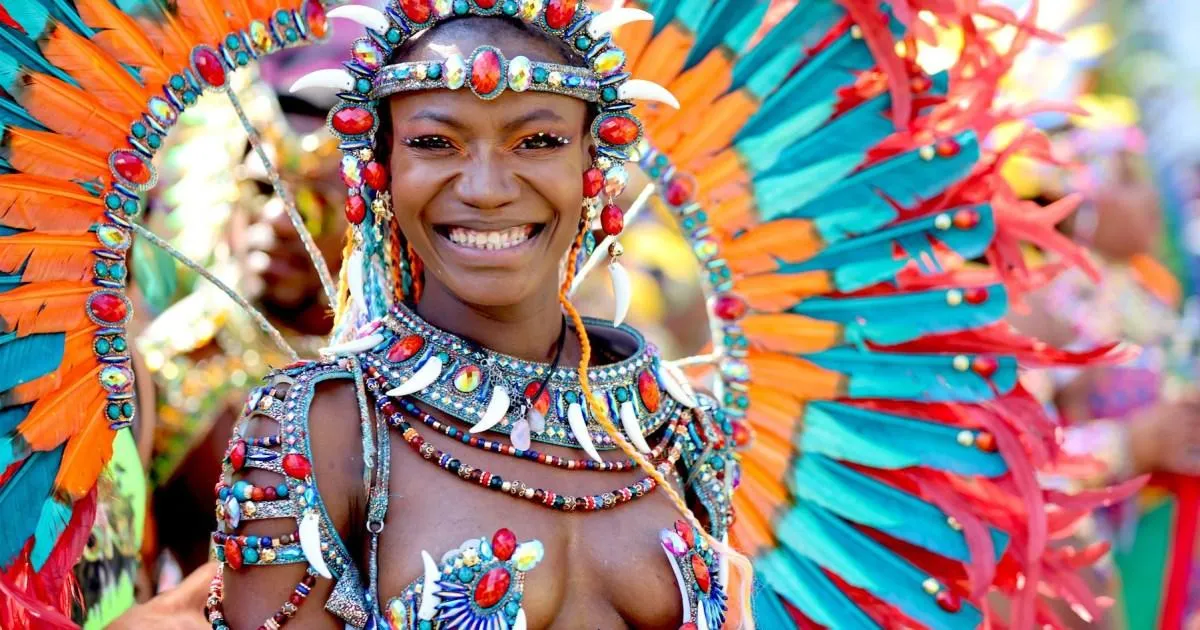
Despite this harrowing introduction, Watts’s archive is far from a catalog of conflict. Instead, the overwhelming majority of his work paints a portrait of the carnival’s soul—a celebration steeped in joy, music, and family. His lens has documented the beating heart of the event, capturing the elaborate feathered costumes, the rhythmic movement of the dancers, the intricate designs of the mas bands, and the irresistible sound pouring from every sound system. While the carnival has undeniably transformed over the years, expanding from a neighborhood gathering into a global festival that draws visitors from every corner of the Earth, the spirit he saw and fell in love with continues to be his guiding plot, the true through-line of his storytelling narrative feeling more like a family reunion than a simple public event.
Born from a familial connection to Jamaica, and growing up amongst the West Indies, its inherent culture feels personal to Watts, yet he insists that the carnival is a collective, unifying experience. It represents a true melting pot, an event that belongs to no single group and welcomes everyone with open arms. As his confidence grew, so did his ability to appreciate its nuances. The shift from analogue to digital photography has made his process easier, freeing him from the constraints of limited frames and allowing him to capture the sheer, boundless energy of the event with even greater freedom, but the essence of what he is looking for remains the same. His images are a testament to the fact that the only way to understand the carnival is to surrender to the rhythm of the crowd, an experience he has chronicled with a knowing touch, his own love for the music having become a constant companion in his work.
This exhibition is the culmination of a long, personal, and deeply meaningful photographic journey. Showing a collection that spans the humble analogue cameras of the 1970s, with their limitations and film boxes, all the way to his crisp, modern digital captures, is a true demonstration of the evolution of technology and the constancy of human expression. The people, the energy, and the creative spark of the carnival is what string these generations of images together, creating a cohesive narrative in spite of the shifting times. To Watts, these photographs do not just serve as a historical record of a community and a culture, but also as a map of a changing London. As the city has transformed around the event, the crowd has always brought its own version of the capital back to the streets, making it increasingly international—a large draw that he believes should be allowed to spread and expand further to accommodate its massive popularity.
His first experience had left him shaken, but the project began to define him. The initial violent encounter of the late ’70s stands in stark contrast to the familial, multicultural embrace he has captured for the last half-century. The exhibition is as much about his personal journey as it is about the carnival’s. It is a testament to his own grit and his belief in the event’s importance, born from a time when documenting was not a mere hobby but an act of bearing witness. For him, the archive is a record of a community and a culture, a journey that began with a simple second-hand camera and created a lifetime of visual storytelling spanning the entire lifespan of the Carnival, in the grandest form. It has become his life story, and in the process, he has given the world a vibrant, historic, and deeply human history of one of its most cherished traditions.
This exhibition is a continuation of his life work and central token of it will be its showing at Outernet, its huge digital screens a proper honor for the six- decade chronicle. The free show, running from August 27th to September 2nd, will bring a strong visual narrative to a new audience, seamlessly connecting his early clashes to the ongoing joy of the carnival. “Carnival 60: Ian Watts at Outernet” is not merely a display of pictures; it is an immersive experience, a time capsule, and a heartfelt tribute to the spirit of Notting Hill. As the cameras and costumers get ready to take over the streets once more, Watts’s images stand both a beautiful document of what has come before and a hopeful, vibrant portrait of what continues to be. He has waited too long to see exhibit all these memories, and his exhibition serves to pass the torch to a new generation, inviting them to add their own chapters to a story that is far from over, proving that he is more than a photographer; he is a guardian of the carnival’s memory.