


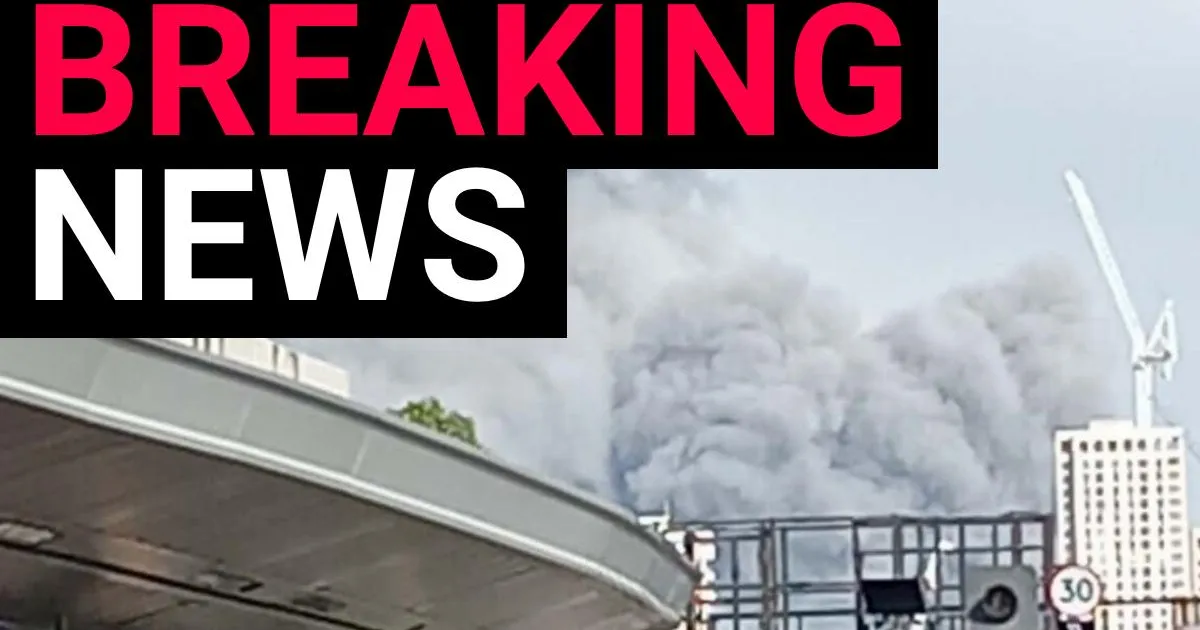
The evening commute through South London was thrown into complete disarray this past Monday after a massive fire broke out at a recycling center in Bermondsey. As rush hour hit its peak around 5:30 p.m., thick, volatile plumes of black smoke began billowing into the sky, visible to residents and travelers for miles around. What started as an ordinary travel day quickly became a scene of chaos and concern, with the sheer scale of the blaze forcing authorities to halt all train services between London Bridge and Dartford, leaving thousands of commuters stranded and searching for alternative routes home.
For those trapped in the middle of the disruption, the atmosphere was thick with tension and the heavy, unmistakable scent of burning plastic and refuse. Passengers passing through the affected area reported seeing towering flames while peering out of their train windows, providing a stark reminder of the danger unfolding just feet from the tracks. One traveler, Grace Greenwood, shared that while those inside the carriages were mostly protected from the fumes, the sight of firefighters desperately battling the inferno from above with turntable ladders was a sobering spectacle that gripped the attention of everyone on board.
The emergency response was immediate and immense, with around 100 firefighters mobilized from stations across Deptford, Old Kent Road, and Greenwich. Crews worked tirelessly through the evening, utilizing specialized 32-meter turntable ladders to spray water from above in an attempt to contain the wreckage before the flames could spread further. Meanwhile, the London Fire Brigade issued a stern warning to nearby residents, urging them to keep their doors and windows sealed tight to protect themselves from the toxic, soot-heavy air drifting across the neighborhood.
Behind the scenes at the transit hubs, the situation was equally frantic. As the fire raged near the railway artery, service providers were forced to implement a total shutdown of all lines between London Bridge and Dartford. The ripple effects were felt across the entire city, with the Windrush line facing significant service gaps and major delays. Many commuters found their journeys completely redirected toward London Victoria, while others saw their trains terminated mid-journey, turning a standard evening trip into a logistical nightmare that was expected to persist until well into the night.
Beyond the immediate frustration of lost time and crowded platforms, the incident serves as a poignant illustration of how vulnerable a city’s infrastructure truly is. A single industrial emergency at a scrap facility doesn’t just damage a property; it ripples through the lives of thousands, reminding us of the interconnected nature of urban life. As the flames were eventually brought under control, the focus shifted from the immediate panic of the evacuation to the broader implications for the neighborhood, leaving those who lived and worked in the area to wonder about the safety protocols in place at such high-risk industrial sites.
Ultimately, while the disruption dominated headlines and Twitter feeds for several hours, the most important takeaway was the safety of those on the ground. As emergency crews continued their dampening-down operations, the city eventually began to find a rhythm again, though the memory of the black smoke blanketing the South London skyline remained a vivid reminder of the evening’s events. For the thousands who were finally able to make it home late that night, the incident served as a stark, humanizing moment—a shared struggle against the unexpected that briefly brought a city of strangers together in a mutual display of patience and concern.