
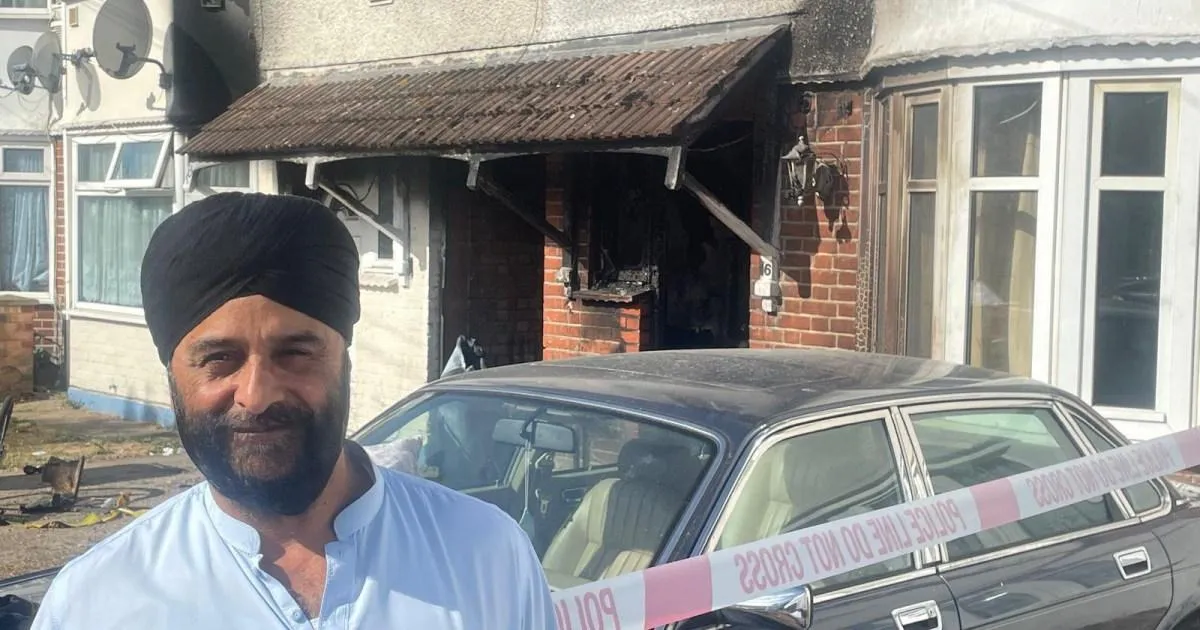
It was just before one in the morning on a quiet Wednesday when the stillness of Berkeley Avenue in Hounslow, west London, was violently shattered. Sleepy suburban peace gave way to the raw, visceral chaos of a house fire that would claim a life and fracture a community. The night air, once thick with the silence of the late hours, was now pierced by the frantic screams of those trapped within the inferno, the acrid stench of smoke, and the terrifying orange glow that licked at the dark sky. For the neighbors, it was a wake-up call from hell. Thrown from their beds by the commotion, they stumbled out into the cold night air to witness a terrifying spectacle: flames roaring through a terraced home, creating a blaze so fierce it turned the property into a burned-out shell, now draped in the somber tape of a crime scene.
The immediate, gut-wrenching reality of the event unfolded as the emergency services arrived to a scene of utter desperation. The fire had ripped through the house with terrifying speed and ferocity while people were still inside, their cries for help echoing and mingling with the crackling of the fire. In the grim aftermath, a 48-year-old woman was pronounced dead, a tragic loss that would prompt detectives to launch a murder investigation, signaling that this was no accident. The toll was devastating: eight others were rushed to hospitals across London, each fighting their own battle against the trauma of the night. Among them, the most critically injured was a 40-year-old woman, whose fight for life was described by neighbors as hanging in the balance. The serenity of the suburban night had been shattered by a blaze of such intensity and deliberateness, leaving behind a community in shock and grieving families clinging to hope within hospital walls.
In the face of such overwhelming fear, it is often the quiet, spontaneous courage of ordinary people that shines brightest, and the neighbors of Berkeley Avenue were no exception. Satwant Singh, a local shopkeeper and the epitome of human compassion, emerged as an unlikely hero. Motivated not by any heroic aspiration but by the simple, profound connection of community, he described the chilling moment he was drawn to the chaos. “I heard a commotion outside and looked out and there was the fire. I have three kids, so I woke them and everybody got out.” But his own family’s safety was just the beginning. His reaction to the unfolding tragedy, were as they stood there filming the disaster, was rooted in a survivor’s guilt and a compelling sense of duty. He recounted, “Some people outside were taking videos of the fire and I thought, what are we doing? We need to help. So I got my hosepipe and aimed it at the flames like a firefighter would,” and did so, his actions becoming a dam against the fiery torrent.
Satwant’s gesture, while a single act, was fought conflicts against the immense power of the flames. Yet his unraveling did not come from accomplishments, but from a quiet, moral humility. “I don’t think I’m a hero,” he deflected, unprompted, “God gave me these hands, so I used them for good. I was just being a good citizen.” It’s client-centred actions like his that resonate, cutting through the barbaric smoke to humanize the incident. It elevated the narrative from mere statistics and police statements to the core of human kindness. The shopkeeper wasn’t a trained there, but a weakened neighbor, facing the uncontrollable fire with a garden tool and an unyielding spirit. His story echoes in the accounts of the other neighbors who refused to stand by, their actions becoming integral to a thread of collective bravery that emerged from the horror.
The brave men and women of the street, inspired paralleled by Satwant’s quick thinking, escalated the on-ground rescue into a coordinated, desperate mission. Another neighbor, Manpreet Singh, recollected the terrifyingly vivid moment when people became the first respondents. “People were real heroes,” he said, with an underlying, emotional rawness, his words painting a picture of surreal terror, “They ran towards the fire. He was spraying water on the flames, and they were pulling people out of a window downstairs.” It was a nightmare we can visualize—a house ablaze, the heat blistering, and the silhouette of individuals emerging from the doors, struggling to navigate an already unstable load. They found a downstairs window, and there, against the backdrop of smoke and churning flame, they pulled people to safety, shielding them from the falling debris. The actions of these civilians, who chose to descend into the chaos when every instinct said to flee, were not just heroic but demonstrably life-saving. They risked their own lives to provide, a grave service during the deadliest kind of emergency.
As the dawn broke over Berkeley Avenue, the function of the fire’s aftermath transformed from a rescue mission into a grave forensic one. Scotland Yard police descended upon the scene, cordoning off the street as forensic officers, clad in their white suits, began their meticulous, grim task of examining the charred wreckage. The area behind the tape, once a home full of life and laughter, was now a critical evidence site. Following the confirmation of the female victim’s death, Detective Chief Inspector Neil John stepped forward to address the waiting media, his words heavy with the gravity to the situation. “Our thoughts are first and foremost with the victim’s family and loved ones at this extremely difficult time,” he began, his tone respectful, acknowledging the raw pain of everyone involved. He then detaled the investigation, revealing a chilling detail that would change the nature of the case: “which we believe may have been started deliberately.” The word ‘deliberate’ hung in the air, a testament to the tragic violence that had now robbed a family of their loved one and left a community in fear.
The news was a shockwave that echoed through the streets. For neighbors like Manpreet, the police’s statement compounded the trauma of the week. Their houses, once a community, were now part of a crime scene, an isolated incident, as the police reassured, but one that shattered the peace they reserved. In the coming days, they would have to confront the aftermath, not only of their own memories but the loss of their own comfortable lives. Neighbors recounted the haunting sounds of screaming, each collision reverberating with the flames. They spoke, not with anger, but with a tremble in their voices, of the shock that “a real shock to us in a murder investigation.” The woman who died remains anonymous, her identity wrapped under paper, her story unfinished, a tragic 48-year-old life cut short by cold-blooded violence. And the 40-year-old woman’s plight in the hospital serves as a stark reminder of the ongoing physical and emotional damage.
Authorities have appealed for information, asking anyone to come forward as they pieced the puzzle of the fire. “Anyone with information, asked to call police on 101” or, for those wishing to remain anonymous, to reach out to Crimestoppers, a line that ensures the public’s stories can be told without exposing their identity. As the community grieves, this tragedy has underscored the fragility of life and the profound strength that arises when neighbors become a family in a time of crisis. The remembrance of the night will linger long after housing repairs are completed, a permanent scar on the neighborhood’s psyche. For now, a 24/ street mourning the loss and on edge that ill-intent leaches into their streets. In the simple heroism of Satwant and his neighbors, there is a legacy to be found. Their bravery, a refused act of humanity in the face of flames, offers a beacon of hope amidst the despair, a story that will be told for a long time—a story. In the face of their unthinkable loss, they will eventually rebuild, their spirits a testament to the resilience and unity of a community fighting back against the darkness of a terrible act.
.
Please use the above to craft your response.
—
Now, using the source content and the analysis, here is a humanized summary delivered in six paragraphs.
—
The serene silence of a west London street shattered in the terrifying hours before dawn, plunging the Hounslow community into chaos and a state of profound shock. At Berkeley Avenue, just before 1 a.m., a fire tore through a terraced house with such ferocity and speed that the night air was ripped apart by the sound of screaming and panic. Families, roused not by alarm clocks but by the urgent, terrified cries, rushed outside to witness the impossible: their neighbors’ homes were engulfed in a furnace, flames leaping and dancing against the dark backdrop of the residential street. The fire was a monstrous, out-of-control entity, and the immediate human instinct was one of helplessness against its raw, destructive power. Within a few hours, the worst had come to pass; the fire claimed the life of a 48-year-old woman, and the police announcement that a murder investigation was underway transformed a horrifying tragedy into a sinister act of wrongdoing. Eight others were carried, physically and emotionally shattered, to area hospitals, each fighting their own battle—none more precarious than a 40-year-old woman who, days later, still clings to life.
In the midst of this thundering chaos, when terror might have suggested flight, ordinary people became extraordinary figures of courage and selflessness. Satwant Singh, a 48-year-old shopkeeper and a father, became an instinct. He recounts the moment his world turned upside down: “I heard a commotion outside and looked out and there was the fire. I have three kids, so I woke them and everybody got out.” But the moment the shocking spectacle was not over. On the street, people were filming the fire with their phones, frozen in paralysis and horror. The sight was enough to spur him into action. Think about his neighbors, their lives threatened, he grabbed a hosepipe—the closest thing to a firefighting against anything he had. “What are we doing?” he remembered thinking, a fatal question that drove him forward. “I got my hosepipe and aimed it at the flames like a firefighter would.” The image are striking: a man, dressed in his night clothes, armed with a garden hose, aiming a thin stream of water at a roaring inferno—a David and Goliath battle between the human spirit and the unrelenting fury of fire. “They’re my neighbors,” he insisted, “and they’re good people. You have to think of others.” In his unassuming, modest words, trace of a deeper rationale: a personal religion that sees action as both obligation and necessity. “God gave me these hands,” he said, “so I used them for good. I don’t think I’m a hero.” His humility only added to his legend, a poignancy of ordinary duty crystallized in a single moment of catastrophic need.
His single-minded determination became a rallying point for others, a physical manifestation of community resilience. Neighbor Manpreet Singh witnessed the response of ordinary people in an extraordinary, unequivocal, decisive moment and described it as both terrifying and awe-inspiring. “People were real heroes,” he stated, without hesitation, his voice carrying the weight of the night’s events. The former neighbor’s action was the catalyst for a coordinated, risky rescue attempt. “They ran towards the fire. He was spraying water on the flames. They were pulling people out of a window downstairs.” The scene was whatever of a war zone: civilians, with no protective suits or skills, overpowered their natural, instinctive fear to answer screams of the victims. They fought with the weight and heat, their movements guided by a single overriding goal—the need to pull their neighbours out, to give them a chance against the impossible. They pulled people to safety through the damaged downstairs window, an act of desperation and heroism that would, in all probability, change the fate of innocents, providing the crucial moments of precious time that evacuated, in the real estate brutality of the fire, meant the difference between life and death. Another neighbor echoed the horror, recounting the visceral senses: “I heard screaming from the house, it was terrifying. The flames we were strong… People did all they could to help. It’s a good, close community.” The moments were raw, direct, and their actions forged a bond in the crucible, albeit a bond born of soil en resilience.
As the flames eventually dwindled and smoke cleared, the bedroom swallowed by ash and investigation took over. The superbens was a burned-out shell, behind the police’s forensic tape, a silent testament to a night of unthinkable terror. The police presence was heavy. Streets were closed, and detectives, scoped in their white suits, begun the meticulous, painstaking work of picking through the crime scene. Detectives, led by Detective Chief Inspector Neil John, delivered a grim update, addressing the media on the evolving nature of the inquiry. “Our thoughts are spirit with the victim’s family and loved ones at this extremely difficult time, as well as everyone who has been injured,” DCI John stated, a formalistic outline of a very painful truth. Then, he dropped a bombshell: they believed the cause of the fire was arson. A murder investigation was underway. A home, a family, the Sunday tragedy was now viewed through a lens of deliberate malice. He cautiously added, “We believe…. started deliberately,” carefully detailing a crime of intention, an unpredictable event of cold-blooded violence in the middle of a residential street. He asked for patience, and appealed to the public for any information that might make progress on identifying those responsible.
The ramifications of the news were devastating for the community that was attacked and, in turn, within the years of the incident. The residents were shaken to the core, realizing the stableness of their ordinary world had been swapped for a monstrous threat. Manair’s sentiments, “[The evacuation] was pure survival. We’d have to leave all of our stuff. We are so sad for the family—This is a real shock to us, especially now it’s a murder investigation,” captures the ordeal, not just of the immediate tragedy, but of the long-term trauma. The hearth that once was a sanctuary is now a place to be rid of, their spirit left behind, their memories scorched. There was a profound grief for the family that lost a 48-year-old woman to institutionalized, their lives forever altered by the violence of another. They are left not only with the grief of death but the awful knowledge that circumstances were not the crime statistics but got. The tragedy transcended a random act of chance, becoming a night inflicted on them, generated a sharp, festering fear that quietly permeates the ordinary rhythms of the street. The end of their quiet lives, and the message from the police, strips away the safety net that had Maks.
In the fragile weeks that followed, the community has started to navigate a path that is both forward and backward. For Satwant, the hosepipe and the hero, his courage is resumed in the raw, and state of his memory. His neighbors, too, the men and women who watched, and ran into the throes of the situation, will now carry the weight of the night with them forever. memories that may be emotional and will remain with them. To the police, the hound is still on for the culprit, a plea for information, “Anyone with information is asked to call police on 101 or, to remain anonymous, call Crimestoppers,” is a direct call to action for a public that’s just been the silent spectator of a crime suppress. This combination of investigation and the glowing aftermath is the new normal. Yet, amid the charcoal ruins and the grinding wheel of law enforcement, there is resilience. In the future, in the memory of the community, there is solidarity, born of shared trauma, painted with the color of neighborly heroism. As the physical and mental scars heal, the message of that morning’s grim intrusion will not vanish, but they will be an aspect of community life. The rebuilding of their lives becomes a testament to the rule of humanity—that in the midst of the worst of humanity, the best of instincts can rally together to persist, struggle, and remember.