

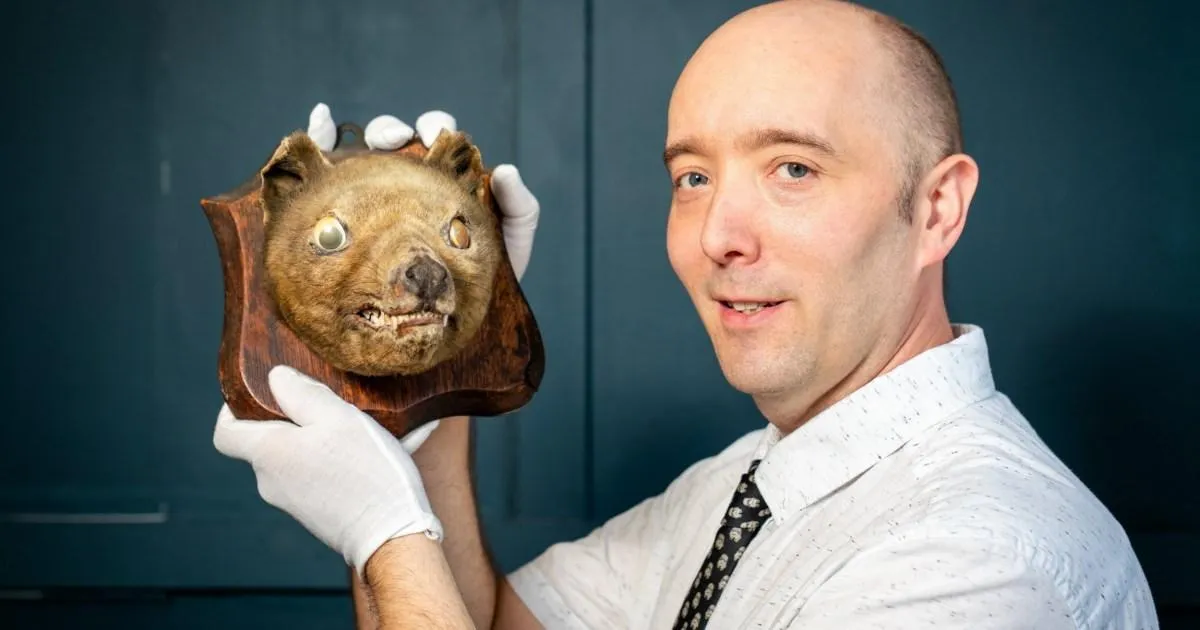
In the gritty, chaotic sprawl of a British market, amidst a cacophony of second-hand trinkets, weathered paperbacks, and forgotten household relics, a natural history enthusiast’s eye was caught by something profoundly strange. It was a taxidermy animal head, mounted on a simple wooden plaque, but it hardly looked like the majestic trophy one might imagine. Instead, it sported a pair of bizarre, cartoonish “googly eyes,” which gave the creature a perpetually startled and slightly comical expression, hovering somewhere between absurd and eerie. James Crawford, a man whose passion for the natural world bordered on obsession, found the piece utterly irresistible. The seller was asking just £50, and for James, the sheer oddity of the decorative eyes was enough to part with his cash on the spot. It was a whimsical purchase, a talking point to show friends, a peculiar addition to his collection of curiosities. Yet, as he lifted the heavy, preserved head from the dusty table, something deeper stirred within him. Beyond the silly glass eyes, the structural integrity of the skull, the unique curve of the jaw, and the distinctive texture of the fur seemed eerily familiar. A suppressed memory nagged at him, a recollection of an animal he had only ever seen in faded photographs and ancient textbooks. He couldn’t shake the feeling that this wasn’t just a deformed fox; it was something far more significant, a whisper from a time long gone, waiting patiently in the bustle of a weekend market to rewrite history.
Returning home, James placed the head on his workbench and began a meticulous investigation. Hours turned into days as he compared his new acquisition with reference materials, bone structure charts, and historical images. The initial curiosity transformed rapidly into a physical, gut-wrenching disbelief. This was not a fox; the dentition was entirely wrong. The teeth were too long, too sharp, and arranged in a specific pattern unique to a particular order of marsupials. The fur was not the typical russet red but a coarse, sandy grey, and upon closer inspection, James could swear he saw the faded remnants of dark, transverse stripes along the shoulders. The conclusion hit him like a freight train. He was holding the preserved head of a thylacine, the Tasmanian tiger, a creature declared extinct nearly a century ago. The realization was so profound that James found himself unable to sleep. He described the subsequent nights as a waking nightmare of euphoria and terror. “I woke up in the middle of the night with a cold sweat,” he recounted, “just thinking, it can’t be, this cannot be real.” The object sitting in his living room was not merely a piece of taxidermy; it was a ghost made flesh, a biological relic so rare that it could command a fortune and rewrite the known records of a lost species. He had gone from a casual £50 market spree to holding one of the most significant biological discoveries of his lifetime, a transition so jarring that it felt almost illicit to possess.
To truly grasp the magnitude of James’s find, one must understand the tragic history and immense rarity of the thylacine. Contrary to its nickname, the Tasmanian tiger was not a feline at all, but the largest carnivorous marsupial of modern times, bearing a passing resemblance to a wolf or a large dog, complete with a stiff tail and a series of distinct black stripes across its lower back. Once roaming the grasslands of Australia and New Guinea, the species vanished from the mainland thousands of years ago, likely due to competition with dingoes, but managed to cling on in the isolated island state of Tasmania. However, their survival ended abruptly upon the arrival of European settlers in the 19th century. Portrayed as a relentless sheep killer, the thylacine was subjected to government-backed bounty hunting, leading to a brutal and systematic eradication. The last known specimen, a solitary animal named Benjamin, died in captivity at the Hobart Zoo in 1936, effectively closing the chapter on their existence. Today, the total number of preserved specimens across the globe is staggeringly low—only a few hundred—and the vast majority of these are incomplete, consisting of tanned hides used as rugs or scattered bones. The fact that a complete, intact head, perfectly preserved, existed at all was simply unheard of. For natural history collectors, finding something even remotely resembling a thylacine part is a career-defining moment. For James, to find a full head in a Bristol market was, in his own words, “the find of multiple lifetimes… the holy grail,” a sentiment that underscores the sheer improbability and preciousness of his discovery.
Realizing the immense value and significance of his discovery, James decided to consign the head for auction, placing it in the hands of Auctioneum Ltd in Bristol, under the stewardship of auctioneer Andrew Stowe. The initial valuation was staggering, but the real drama was reserved for the auction room itself. James entered with a hopeful, almost cheeky bid of just £28 in his mind, anticipating that the unusual-looking piece might be overlooked by other bidders just as it had been at the market. He could not have been more wrong. As the bidding commenced, it quickly became apparent that someone else in the room shared his exact suspicion about the true nature of the taxidermy. A silent, tense duel erupted between James and a single, anonymous rival. The increments flew upward—hundreds, then thousands, then tens of thousands—until the hammer finally fell at an astonishing £50,000. With the buyer’s premium and additional fees adding £10,000 on top, the total cost of the “goofy fox head” came to a staggering £60,000. After the dust had settled, James encountered his rival in the car park. The exchange was laced with the unique camaraderie and frustration of the auction world. James laughed as he recalled the meeting: “I spoke to the other person in the car park and jokingly told him he cost me a lot of money!” The initial bargain had turned into a significant financial investment, yet for James, the monetary price was secondary to the sheer awe of possessing such a precious piece of natural history.
The story takes an even more wonderfully ironic turn when examining the original owner of the thylacine head. The vendor, who had consigned the item to Auctioneum, had purchased it entirely on a whim. They had been walking through the same or a similar market, spotted the head, and were utterly charmed by the ridiculous novelty “googly eyes” that someone had superglued onto it sometime in the past. For them, it was simply a quirky, laugh-inducing piece of decor that brought a smile to their face—nothing more than a bizarre conversation starter for their living room. When auctioneer Andrew Stowe received the consignment, he initially shared their light-hearted perspective. However, upon closer inspection and subsequent research, Stowe realized they were sitting on something monumentally special. When the news broke to the vendor that their £50 novelty had just sold for £50,000, the reaction was pure, unadulterated shock. Stowe recounted the emotional scene, noting that the vendor looked as if they were “about to pass out.” The sheer scale of the discovery and the financial windfall was simply too much for them to process in a single moment. Stowe, ever the professional, quickly offered them a chair to sit down. The irony was not lost on anyone—what had started as a joke, a piece of absurdist home décor, had transformed into a scientifically invaluable treasure, changing the fortunes of the vendor and cementing the auction house’s place in natural history lore.
Looking forward, James’s primary focus is not on the money he spent, but on the scientific potential locked within this incredible specimen. His immediate plan is to have the head officially authenticated and examined by leading experts in the field. After that, he intends to offer it to scientific institutions for research, understanding that the genetic material and morphological data contained within could provide invaluable insights into a species lost to time. The potential for DNA extraction, comparison with living marsupials, and learning more about their physiology is a prospect that excites him far more than the idea of merely displaying it as a trophy. He articulated this mission clearly, stating, “I just want everyone to know it exists so academics and scientists can contact me to study it. It will be invaluable to science and I want to make it available to institutions.” As he stands alongside his partner, Francesca Hatcher, one can see the mixture of pride and wonder in his expression. He is not just the owner of a rare object; he is the custodian of a piece of the past that was thought to be lost forever. Reflecting on the entire whirlwind journey—from a dusty market stall to the auctioneer’s gavel—Auctioneer Andrew Stowe perfectly encapsulated the surreal nature of the event. “We both agreed,” he said, “that we’d never look at a fox in the same way ever again.” For James Crawford, a keen eye, a willingness to whimsy, and a good dose of research has turned a bizarre market curiosity into a defining moment for the scientific community, proving that even in the modern age, the most extraordinary secrets can still be hiding in plain sight.