



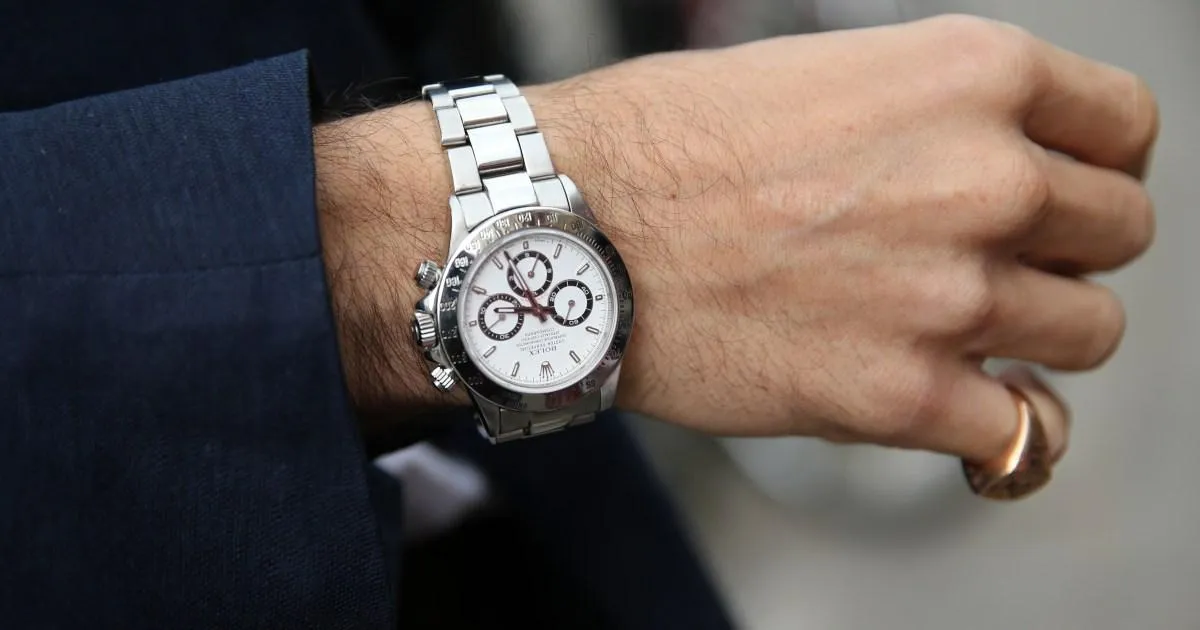
In the glittering heart of London, where the pavements of Mayfair and Knightsbridge are polished by the footsteps of the wealthy, a darker transaction has become alarmingly routine. For every elegant dinner at a private members’ club or late-night cocktail in Berkeley Square, there is now a real possibility that a gleaming watch—perhaps a Richard Mille, a Rolex, or a Patek Philippe—will be ripped from a wrist in seconds. Scotland Yard has revealed that around £1 million worth of luxury timepieces are stolen from Londoners and visitors every single month, an extraordinary tally that paints a troubling picture of crime in one of the world’s most visited cities. In the first six months of this year alone, the West End saw 97 watch robberies, including attempted thefts, with the total value of stolen property running into the millions. The figures emerged as three men were jailed for a particularly violent theft, but they also expose a broader wave of street crime: nearly 2,000 robberies were recorded across Hammersmith and Fulham, Kensington and Chelsea, and Westminster between January and June. The hotspots are predictable—Mayfair’s quiet, wealth-soaked streets and Knightsbridge’s luxury shopfronts—but the victims are not always celebrities or oligarchs; they are visitors, entrepreneurs, and residents who simply wore what they thought was a secure possession. Police are not just confronting theft; they are confronting violent, targeted ambushes that leave physical and emotional scars. These are not opportunistic pickpocketing or smash-and-grab raids. They are planned, brutal encounters in which victims are surrounded, threatened, and sometimes injured, all for the sake of carrying away a small, glittering object strapped to someone’s arm. The numbers paint a sobering reality: what was once a rare, headline-making crime is now a recurring danger that authorities are struggling to contain, and the human cost goes far beyond the price tag of the stolen watch.
Scotland Yard officers investigating the wave of thefts say many of the attacks are sickeningly violent. Victims have been punched, kicked, and left injured in the street. In one in five cases, the threat of a knife is used to force someone to hand over a watch that may have taken years to save for or was passed down through generations. The new figures and the sentencing of the three-man “ripper” gang underline how organised these criminals have become. They are called “rippers” not because they are particularly ghoulish, but because their method is to use a blade to slash through the rubber or leather strap of a watch, freeing it from the wearer’s wrist in a matter of seconds. The gang sentenced at Southwark Crown Court—Younes Djoudi, Ali Eldahouzze, and Abdel El Habchi—were involved in exactly this kind of ambush. Their target was Catalin Botezatu, a Romanian entrepreneur who was leaving the Latin American restaurant Amazonico in Berkeley Square just before midnight on January 28. Prosecutors said the muggers “lay in wait” and surrounded him before using a “sharp implement” to hack through the rubber strap of his diamond-encrusted Richard Mille, a timepiece worth £137,000. The watch was gone in moments, but the terror of the encounter stayed with the victim long after the thieves disappeared into the night. The case is a reminder that these robberies are not clean, victimless crimes; they happen in real time, on real streets, in front of ordinary people, and they often leave victims shaken, bleeding, and afraid to ever return to the city they once loved.
The emotional impact of the robbery was made painfully clear when Mr Botezatu stood in court and described what it felt like to be ambushed in one of London’s most exclusive neighbourhoods. He had just enjoyed a meal at a luxury restaurant, a place where he was a known client, and he never expected that stepping onto the pavement would put his life in danger. Speaking through the court, he said: “I couldn’t believe that something like this could happen in London, in front of a luxury restaurant where I was a client.” But it was not just the shock of losing a precious possession that haunted him. He revealed that he is a man living with serious health problems, having undergone cancer surgery and having five stents in his body. The slightest blow or cut, he explained, could have been fatal. “I feared for my life because of my cancer operation and because I have five stents and because the slightest blow or cut, God forbid, where I was operated, could have been fatal.” Those words strip away the glamour of the stolen Richard Mille and reveal the true stakes of these attacks: a fleeting moment of violence can have catastrophic consequences for someone whose health is already fragile. It is easy to read court reports and see only dollar signs, but Mr Botezatu’s testimony is a human reminder that behind every stolen watch is a person with a history, a body, and a life that can be irreparably damaged by a thief’s blade.
The three men who carried out the attack were eventually brought to justice, but their sentences have reignited a debate about whether London is doing enough to protect its residents and visitors. Djoudi, 34, was jailed for five years and nine months; El Habchi, 30, received five years and six months; and Eldahouzze, 22, was handed three years and six months. As they were led away to begin their prison terms, Judge Dafna Spiro made a powerful statement about what the crime meant for London’s reputation. She said that London ought to be a “safe city,” and that “we are privileged to attract people such as Catalin Botezatu.” She added: “It is a shame and a blight on our city that robberies of this kind occur and unsurprising that he has been deterred from returning as a result.” The judge went on to describe robberies of expensive watches as “an all too familiar feature” of criminality in London, warning that they “undermine public confidence and damage the reputation” of the city. Her words carry a weight that goes beyond the individual case. They speak to a wider anxiety about how London is perceived on the global stage—a city that welcomes the world with its culture, history, and commerce, but which also harbours small, vicious gangs willing to use violence to strip visitors of their most visible symbols of success. For a victim like Mr Botezatu, the sentence was a measure of justice, but it cannot undo the fear he experienced or the scar left on his memory of the city.
Police, for their part, admit that despite arrests and convictions, the problem is far from solved. Detective Sergeant Andy Swindells wrote in a statement referred to in court: “Despite all of our efforts, high value watch robbery remains a problem in the West End, and we average about £1 million stolen from the wrists of Londoners and visitors every month.” That single sentence says a great deal: the thieves are still out there, the demand for stolen luxury goods is still strong, and the supply of willing criminals to meet that demand has not dried up. Swindells also revealed that about a third of watch robberies have occurred “in the West End footprint,” and that they mainly centre around the night-time economy. Suspects are often “targeting various property from victims,” meaning that watches are not the only thing on their minds, but they are frequently the most valuable and easiest to carry away. The pattern is clear: as the clubs and restaurants fill up after dark, so do the streets with predators who study their targets, wait for the right moment, and strike before anyone can react. The police effort is visible, with increased patrols and investigations, but the sheer scale of the problem means that each conviction is a small victory in a much larger battle. For every gang that is jailed, another may be forming, watching from the shadows of the same exclusive streets, ready to take its place in the grim economy of stolen luxury.
The rise in high-value watch robberies is not just a crime statistic; it is a symptom of deeper social and economic tensions that have made London’s glamorous districts a stage for both wealth and desperation. On one side, there are people who can afford watches worth more than the average annual salary; on the other, there are criminals who see those watches as easy, lucrative targets. But what makes these crimes so unsettling is the casual violence and the sense of entitlement that accompanies them. A thief who is willing to cut a watch from a person’s wrist with a sharp object is not just stealing a possession; he is attacking that person’s bodily autonomy and safety. The victim may be a cancer survivor, a tourist on a dream trip, or a businessperson in town for a meeting—none of them deserves to be reduced to a target. The court cases and police statements reveal a clear and troubling trend: the West End is still a place of beauty and excitement, but it is also a hunting ground for those who believe that luxury can be taken at knifepoint. As London looks to the future, it must confront a difficult question: how can it remain one of the world’s great cities, open and welcoming, while also protecting the people who walk its streets? The answer is not simple, but it begins with acknowledging the human stories behind the statistics—the fear of a man recovering from cancer, the shock of a visitor who cannot believe what just happened, and the quiet, lingering damage done to a city’s reputation every time a watch is torn from a wrist. The thefts may be counted in millions of pounds, but the true cost is measured in trust, safety, and the feeling of being secure in your own skin, in your own city, on an ordinary night out.