


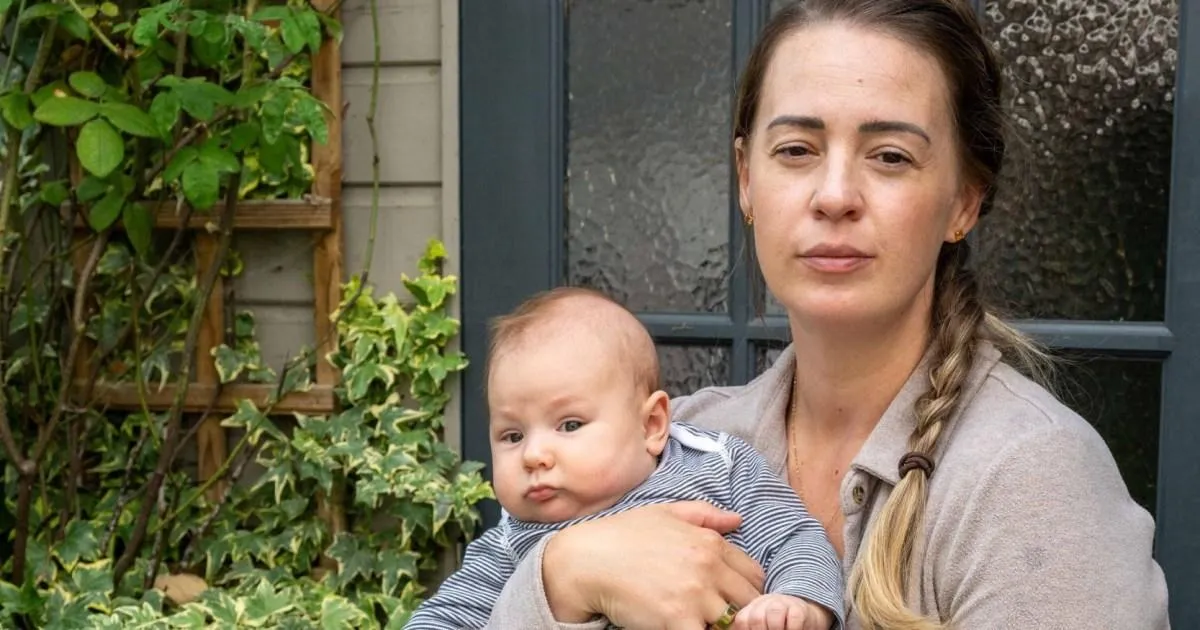
It was the dead of night when Carly Clarkson was jolted from a deep sleep by an unsettling sound—a strange, predatory sniffing that seemed far too close for comfort. In the hazy moments between sleep and consciousness, her mind raced to process what her ears were telling her. She was lying beside her three-month-old daughter, Josephine, in their home in Watford, Hertfordshire, the rest of the family slumbering peacefully around them. But as the fog of sleep lifted, a chilling realization dawned on her: that wasn’t the sound of a family pet. That was the sound of a wild animal. The frantic terror that followed would be a moment that would forever be etched into her memory, a narrative of a quiet British night shattered by an unexpected and terrifying intruder.
In that terrifying instant, Carly’s maternal instincts ignited. She found herself face-to-face with a fox that had somehow managed to get inside their home, its presence an impossible violation of their sanctuary. The creature had seemingly slipped in through an open door, and in the darkness, it had closed in on the most vulnerable member of the family. As her eyes adjusted, she saw the fox’s head dangerously near her infant daughter. Without a second thought, Carly let out a blood-curdling scream and leapt into action, her movements driven by pure adrenaline. She snatched little Josephine from the bed, clutching her tightly to her chest, while simultaneously trying to drive the intruding animal out of the room. It was only in the immediate aftermath of this chaotic scuffle that the true horror of the situation began to sink in—she could feel a sticky wetness on the baby’s head, and it was then that she realized her daughter had been bitten.
The scene that unfolded in the following moments was one of pure parental panic. After the fox retreated upstairs, Carly hurriedly turned on the lights, her heart hammering against her ribs as she carefully inspected her baby’s injuries. There, on Josephine’s tiny head, were four distinct puncture wounds, stark and angry against her soft skin. Her husband, roused by the commotion, immediately understood the gravity of the situation, and they knew they had no time to lose. Racing to Watford General Hospital in the middle of the night, Carly could only replay the terrifying attack in her mind, her thoughts a whirlwind of worry and guilt. The emergency room doctors, thankfully, were swift and reassuring. They examined the wounds, cleaned them thoroughly, and administered a series of tetanus shots as a precaution. While the bite was undoubtedly frightening and deeply upsetting for the family, the medical team delivered the news every parent prays for: Josephine was going to be perfectly fine.
Though the physical wounds would heal quickly, the emotional scars from that night ran deep. Carly describes the ordeal as a living nightmare, one that has fundamentally altered her perception of safety within her own home. She now speaks about the aftermath with a tangible tremor in her voice, recounting the sheer disbelief of it all—the act of waking up to find her child’s blood beside her, a sight no mother should ever have to witness. The memory of that stark, terrifying image is something that will stick with her for a long time. She poignantly described the injuries as looking like a dog had bitten a football, a visceral and heart-wrenching simile for such a small, innocent baby. In the days and weeks following the incident, she found herself paralyzed by a new, consuming anxiety, constantly checking on her daughters and hesitating to use their own garden, a space that used to be a source of joy but now felt like a potential hunting ground for the wild creatures that prowled their neighborhood.
The family didn’t just retreat into their fear, however. They took action to understand what had happened and to prevent it from ever happening again. Upon returning home from the hospital, their ordeal wasn’t quite over; as they were leaving the house, they spotted a fox loitering by their front door, seemingly emboldened and unafraid, which they believed to be the same animal responsible for the attack. CCTV footage later revealed the creature wandering around their property in the moments leading up to the invasion, a silent predator scouting the perimeter. In their quest to reclaim their home and their peace of mind, they installed a powerful scent-based repellent, a costly but necessary investment to keep the animals at bay. They also reported the terrifying incident to the Watford Borough Council, hoping that their story would serve as a stark warning to other families in the area who might be oblivious to the potential dangers lurking just beyond their backyards.
As the news of the attack spread through the community, it drew a response from a local wildlife expert, Trevor Williams, the founder of The Fox Project. His insights provided a crucial perspective, helping to demystify the creature’s baffling behavior. He theorized that the fox responsible was most likely a young, adolescent cub, roughly four and a half months old. According to Williams, this is the time of year when young foxes are dispersing from their family units and trying to find their own territory. Inexperienced and driven by hunger, they often lack the natural fear of humans that adults have, making them bolder and more likely to take risks. He was quick to reassure the public, stating that fully grown, experienced adult foxes would never deliberately enter a home and approach a sleeping human, as they are instinctively wary and avoid putting themselves in such vulnerable positions. He framed the attack not as a sign of an aggressive fox population, but as a rare and tragic accident of nature.
Carly’s story is a heart-stopping reminder of the fragile boundary between our civilized world and the wild, untamed one that exists just outside our doors. She has become a fervent advocate for vigilance in her own community, urging her neighbors to be mindful of their surroundings and to secure their homes, especially during the summer months when doors are often left open to catch a breeze. Her comments reveal a woman forever changed, one who now lives with a keen awareness of the potential danger. As her daughter heals, Carly continues to grapple with the lingering trauma, but her resolve is strong. She hopes that by sharing her experience, she can spare other families the same terror. Her voice, though shaken, carries a clear message: a warning about the unpredictability of wildlife, a call for awareness, and a profound testament to the fierce, unrelenting instinct of a mother to protect her children, no matter the cost. The Clarksons have reclaimed their home, but the memory of that night will forever serve as a haunting reminder of their fragile peace.