

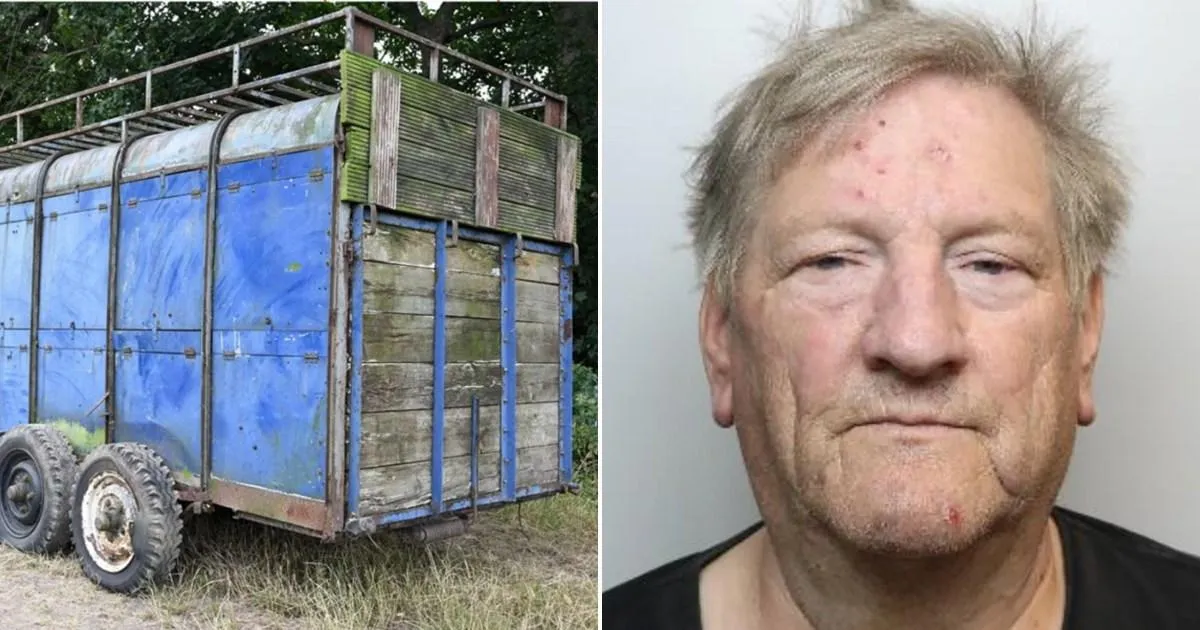
The tragic saga of Richard Dyson, a 55-year-old man who effectively vanished into thin air in 2019, has finally reached a grim conclusion, laying bare a narrative of cold-blooded betrayal and calculated cruelty. For years, Richard’s whereabouts remained a haunting mystery, leaving his daughter, Bethany Dainty, in a state of agonizing limbo. He had been living in his car on land owned by 73-year-old farmer Christopher Wright in Hoyland, Barnsley, doing odd jobs to get by. What began as a standard missing persons inquiry by South Yorkshire Police eventually spiraled into a harrowing murder investigation, culminating in the discovery of Richard’s remains encased in concrete within a blue barrel, stashed away on a trailer.
The breakdown of the relationship between Wright and Dyson serves as a chilling reminder of how quickly human connection can sour into violence. The two men, once collaborators in day-to-day labor, became embroiled in a bitter dispute when Wright—a man obsessed with his collection of antique firearms—accused Richard of stealing and selling his personal possessions. This accusation proved to be a death sentence. Wright, a man who possessed the specialized skills of a former butcher, turned his hands toward a horrific act of violence, shooting Richard in the arm and chest before engaging in a systematic and stomach-turning effort to dismember the body and hide the evidence of his crime.
The logistical coldness of Wright’s actions following the murder reveals a man who operated with chilling detachment. After dismembering the body, he purchased cement from a local merchant, sealed the remains into a barrel, and coerced an innocent, unsuspecting neighbor into storing the trailer that contained the grim container. Wright did not act entirely alone in his attempts to evade justice; his childhood friend, 72-year-old Karl Schwalbe, became a willing participant in the cover-up. Schwalbe’s decision to assist in concealing the crime was later described by his own legal counsel as an “error of Biblical proportions,” a failure of loyalty that ultimately led to his own three-year prison sentence.
The arrogance of the perpetrators was highlighted during the investigation, revealing a lack of remorse that bordered on the surreal. Unbeknownst to them, police were tracking their movements and recording their conversations. In one instance, Wright and Schwalbe were captured on camera in a police car park, audaciously discussing the CCTV footage that investigators had collected. Perhaps even more disturbing was the footage of Wright in a hotel room while police searched his land; he was filmed praying, not for the soul of the man he killed, but for “absolution from God” and a miracle that his illegal weapon collection would remain undiscovered.
Justice finally arrived at Sheffield Crown Court, where Mr. Justice Cotter sentenced Wright to life imprisonment with a minimum term of 35 years. The judge’s words cut through the silence of the courtroom, noting that Wright’s background as a butcher granted him the grotesque technical proficiency to carry out such a heinous act—a capability that most ordinary people would find impossible to even contemplate. Given his age and the length of the sentence, it is widely accepted that Christopher Wright will spend the remainder of his life behind bars, a fate that stands as a stark bookend to the life he violently stole from Richard Dyson.
For Bethany Dainty, the conclusion of this trial brings a hollow, painful form of closure. In her victim impact statement, she articulated the unique agony of losing a parent to a mystery, explaining how the lack of truth had paralyzed her ability to properly grieve. Outside the courtroom, Detective Chief Inspector Andy Knowles praised the resilience of the family, who were forced to endure a harrowing trial while the defendants continued to deny their guilt until the bitter end. The case serves as a dark testament to the “excellent police teamwork” required to peel back the layers of a long-concealed crime, ultimately ensuring that Richard Dyson is no longer just a missing person, but a victim who has finally received a measure of justice.