
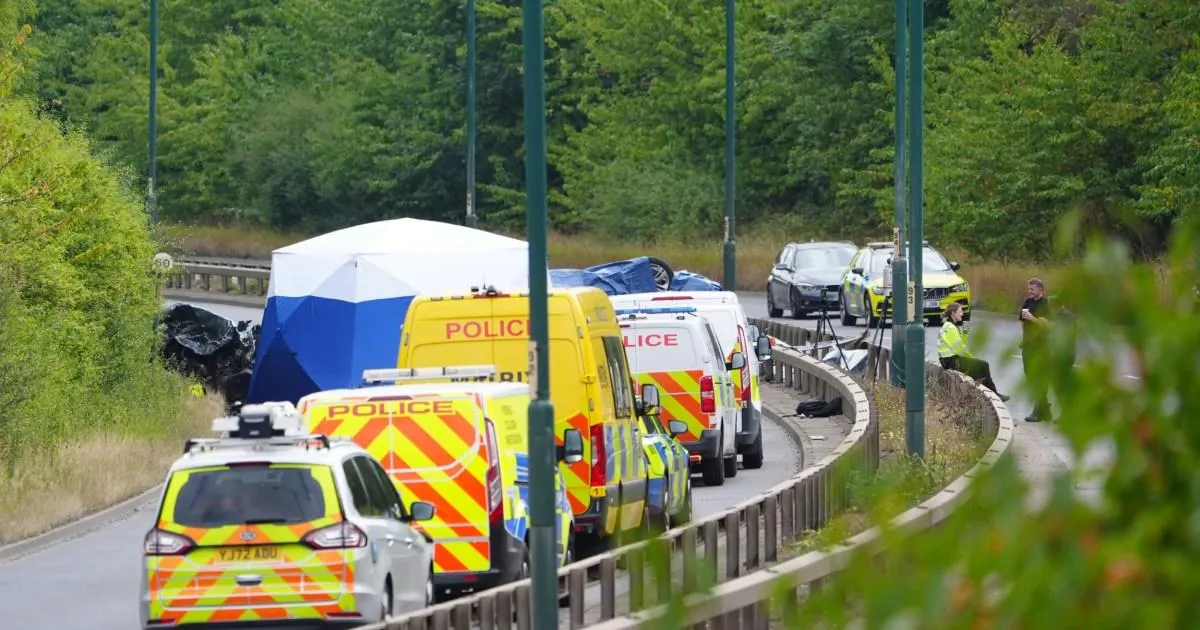
The devastating event that unfolded on a dual carriageway near Middlesbrough has left a community in profound mourning, as the full scale of the tragedy becomes clearer. What began as a routine Saturday morning was shattered by a high-speed, wrong-way collision that claimed the lives of seven people, including two serving police officers. The initial shock has now given way to a complex and sprawling investigation, which this week saw the arrest of five more individuals, bringing the total number of people detained in connection with the incident to seventeen. The sheer scale of the arrests points to a case that extends far beyond a simple traffic accident, suggesting a deep entanglement with serious and organised crime that police are now determined to dismantle.
The victims of the fatal crash were PC Matthew Blades, 37, and PC Tom Clough, 38, who were killed instantly when their marked armed response vehicle was struck by a Volkswagen Passat traveling the wrong way. The car, which had been the subject of a police pursuit, was carrying five young men who also died at the scene. They have been identified as Cole Robert Worthy, 17, Theo Rae, 17, Makai Saddington, 18, and 23-year-olds Michael Robert Cahill and Jacob Matusiak. The loss of the two officers has sent a wave of grief through the Cleveland Police force and the wider community. A GoFundMe appeal launched to support their families has become a powerful testament to the public’s respect and gratitude, raising over £850,000 in a matter of daysaint, a figure that speaks volumes about the high regard in which they were held and the collective sorrow over their untimely deaths.
As the investigation deepens, the picture is one of a fast-moving and highly complex inquiry with significant links to serious and organised criminal activity. Assistant Chief Constable Wayne Fox, who is leading the strategic response, has emphasized the force’s duty to thoroughly investigate the criminal activity that led to the fatal incident and to bring all those responsible to justice. The latest round of arrests includes a 16-year-old boy and two men, aged 18 and 21, on suspicion of participating in an organised crime group. A 55-year-old man has been arrested on suspicion of assisting an offender, and a 23-year-old man on suspicion of making threats to kill. These arrests, which follow the earlier detention of nine men and three women aged between 19 and 61 on a range of offences from possessing a firearm to organised crime, illustrate the depth and breadth of the police operation.
This tragedy has ignited a national conversation about a dangerous and disturbing trend among some young drivers: the baiting of police officers for social media notoriety. The Police Federation of England and Wales has spoken out, with acting deputy national chairman Paul Williams highlighting that officers are now facing not only the physical dangers of their job but also the threat of becoming unwilling stars of reckless online content. “Every day we can identify now numerous examples of young people sensationalising dangerous driving,” he said, adding that they are “baiting police officers who are out there to protect the public.” He described the situation as a real problem that is causing officers concern, emphasizing that they should not have to go to work wondering if they will return home, or if they will be plastered all over social media.
The role of platforms like TikTok has come under intense scrutiny, with critics accusing them of encouraging reckless behaviour by promoting high-speed police chase videos as thrilling or exciting. It has emerged that one of the victims, Makai Saddington, had a TikTok feed filled with videos of him seemingly involved in police chases. One clip, posted in May, shows him driving an Audi while being followed by a police car with flashing blue lights, all set to rap music. These online crazes, which include drivers filming their speedometers, inhaling nitrous oxide at the wheel, or speeding with their headlights off, are being shared for likes and views, with little regard for the potentially fatal consequences. The Prime Minister’s official spokesman confirmed that the government fully backs Ofcom to take tough action against platforms that fail to uphold the law, while Greater Manchester Mayor Andy Burnham described the sharing of such footage as “truly reprehensible.”
While the link between the A66 crash and social media has not yet been definitively established by police, the broader connection between such content and real-world tragedy is undeniable. The incident stands as a grim parallel to the deaths of five teenagers in a head-on collision on the M9 motorway in Ireland less than a week earlier, a crash which has been blamed on dangerous acts performed “for likes on social media.” These events together paint a stark picture of a culture where the pursuit of online fame can override basic safety and respect for life. For the families of PC Blades and PC Clough, the financial support raised is a small comfort in the face of their unimaginable losschery. For their colleagues, the hearse processions and tributes along the A66 are a stark reminder of the risks they take every day.
For the community of Cleveland, the investigation continues, and the police are committed to disrupting those they believe are involved in serious and organised crime, determined to bring a measure of justice to the families of all seven victims. The wreckage of the two vehicles has been cleared, but the emotional wreckage will take much longer to heal. The outpouring of grief and the substantial fund raised for the officers’ families show a community united in sorrow and support. The arrests of people on suspicion of offences ranging from participating in an organised crime group to making threats to kill suggest a complex web of behaviour that led to that tragic Saturday morning. This is no longer just a story about a single moment of recklessness, but a reflection of a societal issue that demands attention. As the investigation continues, the nation watches on, hoping that the memory of PC Blades and PC Clough, and the lives of the five young men lost, will serve as a catalyst for change, forcing a difficult conversation about criminality, social media’s influence, and the road safety crisis that is costing so many lives.