


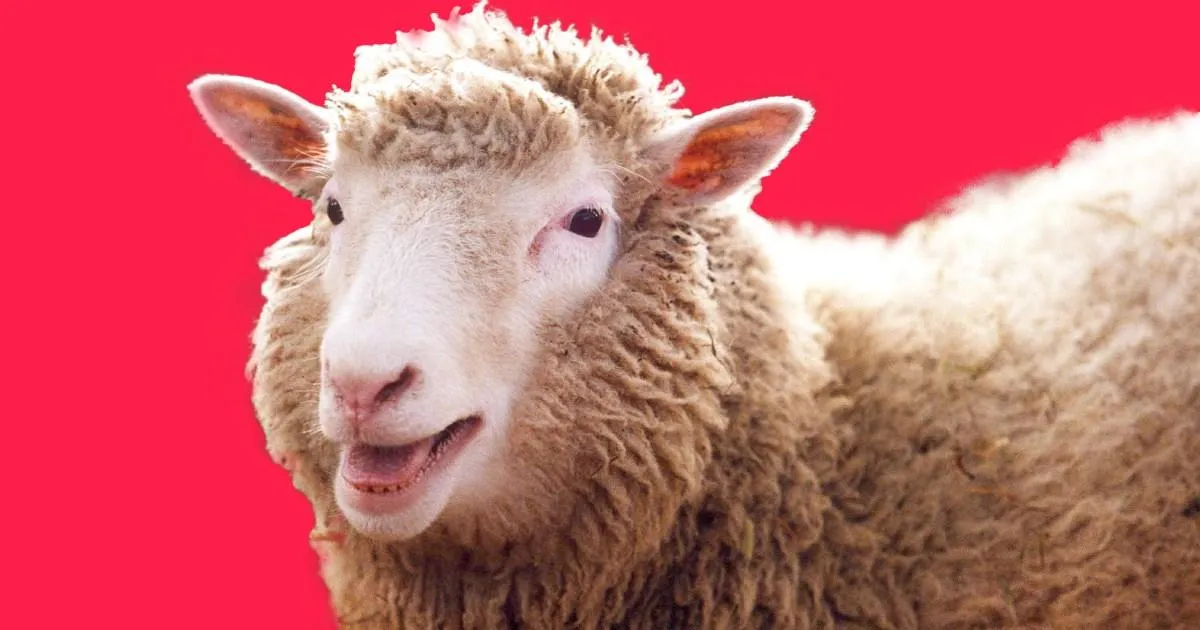
On July 5, 1996, a quiet revolution took place at the Roslin Institute in Edinburgh. A lamb named Dolly entered the world, and despite her humble beginnings in a petri dish as the code “6LL3,” she would rewrite the rulebook of biological science. Led by Professors Ian Wilmut and Keith Campbell, the team achieved what was previously thought impossible: cloning a mammal from an adult somatic cell. By taking the nucleus from a mammary gland cell of a Finn Dorset sheep and placing it into an egg cell stripped of its own genetic material, they created a biological carbon copy. Named after the legendary Dolly Parton—a cheeky nod to the source of the cells—the lamb quickly transitioned from a scientific experiment to a global cultural icon, proving that biology was far more flexible than experts had ever dared to imagine.
The announcement of Dolly’s existence in 1997 triggered a whirlwind of “Dolly-mania.” News crews descended on the Roslin Institute within hours, desperate for a glimpse of this impossible creature. William Ritchie, an embryologist at the lab who witnessed Dolly’s birth, recalls a sheep with a surprisingly strong personality. Far from a passive specimen, Dolly was a bit of a diva who expected treats from every visitor, often turning her back on those who came empty-handed. Beyond the press circus and her charming, sometimes stubborn demeanor, Dolly’s presence held profound emotional weight. For some, like the researchers whose family members were struggling with illness, she represented a flicker of hope for scientific advancement, solidifying her status not just as a laboratory success, but as a living creature who inspired genuine affection.
Dolly’s emergence sparked a fierce, panicked debate that stretched far beyond the walls of the laboratory. While scientists argued over the validity of the breakthrough, politicians and ethics committees immediately began grappling with the dark specter of human cloning. In the United States, President Bill Clinton moved swiftly to ban federal funding for human cloning research, wary of the Pandora’s box that Dolly had nudged open. Yet, for the team at Roslin, the goal was never to replicate human life; it was to unlock the mysteries of disease. Over time, the aggressive fear of the 90s cooled, and while the Institute eventually moved away from cloning altogether, the conversation shifted toward the legitimate, life-saving potential of understanding cellular development.
In the years since, the world has seen the emergence of a bizarre commercial industry built on the foundation of Dolly’s legacy. From high-end racing horses to the beloved pets of Hollywood A-listers like Barbra Streisand and Paris Hilton, cloning has become a niche, high-cost commodity for those wishing to “bring back” a lost companion. Modern firms like ViaGen Pets charge tens of thousands of dollars for the service, banking on the enduring human desire to bypass grief. However, experts like Ritchie offer a sobering reality check: while you can replicate the genetics, you cannot replicate the soul. A clone is never a true replacement, providing no guarantee of the same personality, quirks, or physical health that made the original pet so uniquely dear to its owner.
The true, lasting value of Dolly lies in the scientific doors she kicked open, far surpassing the ethics of pet production. Her existence acted as the catalyst for Shinya Yamanaka, whose work on induced pluripotent stem cells—which earned him a Nobel Prize—would never have blossomed without the proof provided by Dolly. By showing that adult cells could be “reset,” she paved the way for modern regenerative medicine, a field that uses cells as blank slates to study and potentially treat debilitating diseases. Dolly passed away in 2003 at the age of six, but her death was not linked to some failure of the cloning process; rather, it was a common lung ailment she acquired from living indoors, a sad, natural end for a sheep who lived a life far removed from the rolling pastures of her ancestors.
Today, Dolly resides in the National Museum of Scotland, a taxidermied figure on a rotating display that attracts endless crowds, both curious children and thoughtful scientists. Her curator, Dr. Andrew Kitchener, notes that she remains one of the museum’s most popular exhibits, as people still search her eyes, wondering if they are looking at the “real” pioneer who shattered scientific dogma. She is a reminder that breakthroughs often happen when we dare to challenge the impossible. While the science of cloning remains a complicated and often controversial frontier, Dolly herself remains a symbol of human curiosity. She was a first, a “madam” with an attitude, and a tiny lamb who inadvertently helped humanity peer into the very building blocks of life, forever changing the course of medical history.