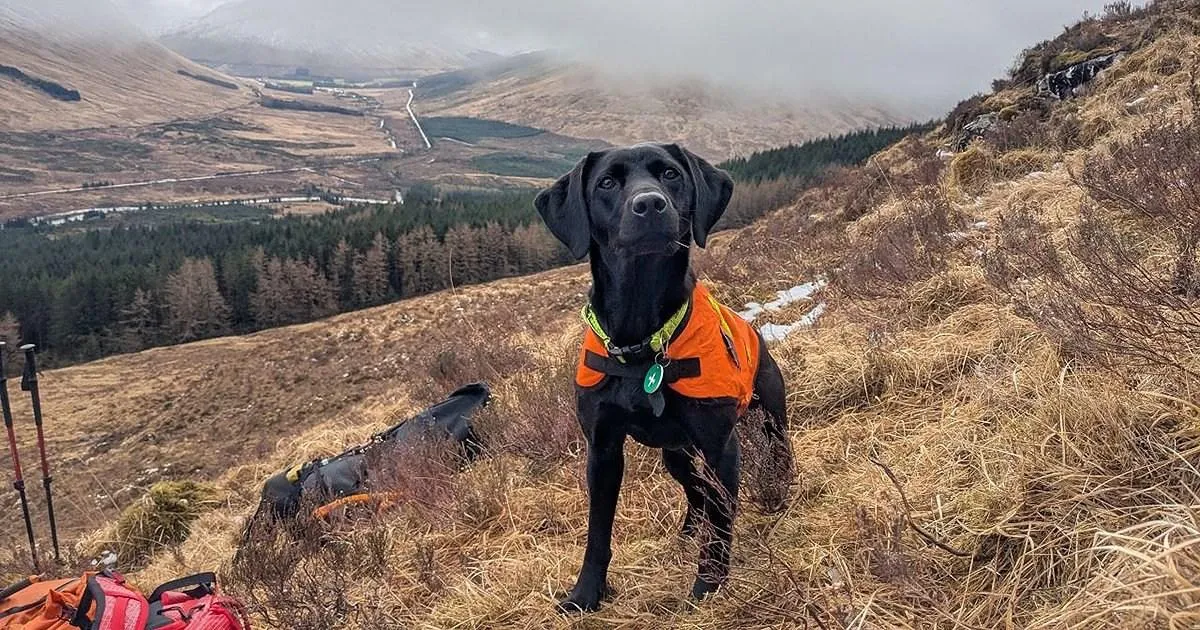
On a windswept shore in the Scottish Highlands, where the sea meets ancient rock and the air smells of salt and heather, a black Labrador named Sgiath is doing something no dog has ever been asked to do before. With her nose pressed close to the waterline, she sniffs through seaweed, stones, and shallow pools, searching for a creature that has no legs, no face, and no obvious scent to most of us. But to Sgiath, this invasive marine organism—nicknamed “sea vomit” by those who have seen its slimy, sticky growths—is as unmistakable as a rabbit’s trail or a hidden bird. She has become an unlikely heroine in the fight to protect Britain’s coastlines, and this year she has been named the International Fund for Animal Welfare’s Animal of the Year. It is an extraordinary honor for an extraordinary dog, and one that has placed her alongside rescue heroes, conservationists, and beloved companions who have changed the world simply by using the gifts they were born with. Sgiath doesn’t know she is making history. All she knows is that her owner, marine ecologist Dr Texa Sim, asks her to search, and when Sgiath finds what she is looking for, the rewards are treats, praise, and the deep joy of a job well done. But that simple partnership has opened a brand new door in marine biology, proving that some of our greatest environmental tools are not machines or chemicals, but the wet noses and wagging tails we have loved for thousands of years.
Dr Texa Sim first began to wonder if a dog could help hunt sea vomit out of sheer frustration. The carpet sea squirt, as it is formally known, is a nightmare for marine ecologists. It smothers native species, devours nutrients, and spreads at alarming speed. Traditional methods of detection rely on human eyes, underwater cameras, and trained divers—all slow, expensive, and often too late. But dogs have been used for decades to find everything from drugs and explosives to rare plants and even cancer cells, so why not an invasive marine creature? No one had really explored this possibility before, and what started as a proof-of-concept experiment quickly became a stunning success. Sgiath took to the challenge with a brilliance that left even her owner speechless. She learned to distinguish the unique smell of sea vomit from the rich, complicated world of coastal scents—barnacles, kelp, crabs, fish, and the shifting saltiness of the tide. She could find colonies hidden beneath overhanging rocks and tucked into tangled seaweed, places a human diver might easily miss. Dr Sim described her as incredibly clever, with phenomenal problem-solving skills and an ability to adapt so quickly that watching her work felt like witnessing something magical. Every expectation was exceeded, and soon the project grew from a wild idea into a serious conservation tool. For Sgiath, it was never about saving the ecosystem or understanding the threat of invasive species. It was about the bond between a dog and her human, and the simple pleasure of being useful.
The creature Sgiath hunts is as unsettling as its nickname suggests. Sea vomit looks like something that might be coughed up by the ocean itself—a rubbery, yellowish, gelatinous mass that clings to hard surfaces in shallow waters. It can appear as a smooth, spreading mat or as branching, finger-like lobes, and its color can range from pale cream to vivid orange. Biologists believe it originally came from Japan, though it has since travelled the world in the warm, dark spaces of ships and their hulls. It was first spotted in British waters in 2008, and since then it has become a serious headache for those who manage coastal ecosystems. Sea vomit is not just ugly; it is dangerous. It forms dense carpets over the seabed, smothering the delicate organisms beneath it, sucking nutrients out of the water, and leaving little room for crabs, mussels, oysters, and other native life to survive. It infiltrates oyster farms, wraps around aquaculture equipment, and damages marine infrastructure. In 1969, the waters off France and Portugal saw their Portuguese oyster populations almost completely destroyed by this same creature, a warning of just how devastating it can become. Part of the problem is that sea vomit rarely needs a mate to reproduce. It can clone itself, and even a tiny fragment left behind can grow into an entirely new colony. It thrives in warm weather, which means this summer’s heatwaves gave it an extra boost, and it can survive in surprisingly cold water. The Institute of Marine Research explains that while it needs temperatures of eleven to fourteen degrees Celsius to produce larvae, it can withstand temperatures down to minus two degrees. In colder waters, it may fail to spread through larvae, but it can still be carried by shipping and regrow from fragments, making containment even more difficult.
This was the battle Sgiath stepped into, and her award is a recognition that she has won something more important than a game of fetch. Sharon Livermore, director of marine conservation at IFAW, was glowing in her praise. She noted that Sgiath would already deserve recognition for her work as a mountain rescue dog, saving human lives in the unforgiving Scottish landscape. But by helping pioneer a world-first approach to detecting invasive marine species, Sgiath placed herself in a league of her own. The Animal of the Year Award is not handed out lightly; it honors animals whose actions have made a tangible difference, often against great odds. For Sgiath to receive it alongside other inspiring animals is a testament to what happens when human ingenuity meets animal instinct. The award also highlights an important truth: sometimes the best way to solve a crisis is not to invent something new, but to look at the natural abilities already around us. Dogs have been our companions for thousands of years, and they have served us as hunters, herders, protectors, and friends. Now, with a changing climate and increasing numbers of invasive species, they are emerging as conservation scientists too. It is a humbling reminder that we do not always need more technology; sometimes we need more trust in the creatures we share the planet with.
Behind the headlines and the scientific terminology, there is a deeper human story. Dr Texa Sim did not just train a dog to do a job; she built a partnership based on patience, trust, and mutual respect. Watching Sgiath work, you can see the extraordinary connection that forms when a person learns to listen to an animal rather than simply command it. Sgiath’s successes are celebrated with treats and cheers, and her failures—because there are always failures—are met with patience and encouragement. That is the heart of good animal work: not forcing them to obey, but inspiring them to want to help. And Sgiath clearly wants to help. She approaches every search with enthusiasm, her tail sweeping through the air, her whole body alive with focus and joy. She is not a laboratory tool or a piece of equipment; she is a living, breathing partner with her own quirks and preferences. Sometimes she might stop to investigate something interesting, or get distracted by a particularly good smell that has nothing to do with sea vomit. But that is what makes her so endearing and so effective. She brings heart to a problem that could easily feel hopeless, reminding us that even the smallest creature—or a dog who loves to run through the waves—can make a profound difference in the most unexpected ways.
As Sgiath enjoys her well-deserved recognition, the work she has begun is far from over. The discovery that dogs can detect sea vomit opens the door to a whole range of possibilities. If one Labrador can learn to sniff out an invasive sea creature, perhaps other dogs can be trained to detect different threats in delicate marine environments. Conservation teams around Britain are watching Sgiath’s progress with excitement, and there is hope that her nose could become a model for other coastal regions facing similar problems. But for now, perhaps the most important thing is simply to celebrate her. She is a reminder that we are surrounded by extraordinary animals whose abilities we have barely begun to understand. She turned a strange, slimy invader into something we can fight against, with love, patience, and a good dose of canine enthusiasm. Her story is not just about science or conservation; it is about hope. It is about looking at a problem that seems impossible and asking, what would my dog do? And then trusting the answer. Sgiath may not understand why people are so impressed with her underwater sniffing expeditions, but she knows she has made her human proud, and that is all that matters to her. In a world full of bad news and environmental despair, she has given us something to smile about—a black Labrador from the Scottish Highlands, nose to the water, wagging her tail as she saves the coast one sniff at a time.