

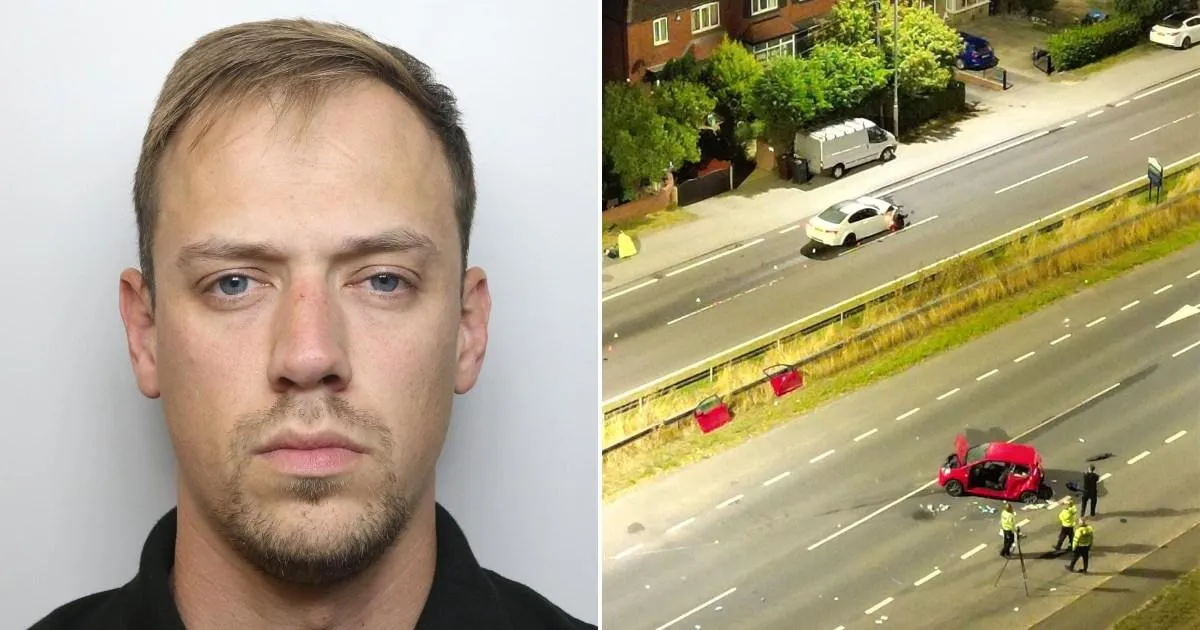
The tragic death of 18-year-old Georgia Bendelow serves as a heartbreaking reminder of how quickly a life brimming with promise can be extinguished by the reckless actions of another. In August 2022, Georgia was traveling in a car driven by her mother, with her boyfriend by her side, when their lives were irrevocably altered. Thomas Sherwood, a 36-year-old man from Leeds, had borrowed a high-powered BMW M3 from a friend and, disregarding both the law and the safety of others, treated the public road as his personal racetrack. Speeding at 80mph in a 50mph zone, Sherwood’s decision to operate a vehicle he wasn’t even insured to drive turned a routine journey into a scene of absolute devastation.
The impact was cataclysmic. When Sherwood’s BMW collided with the vehicle carrying Georgia, it sent their car spiraling across the carriageway for over 1,000 feet, eventually coming to rest on the opposite side of the road as a mangled wreck. For Georgia’s father, the nightmare began when he heard of the crash and raced from his nearby home to reach the scene. What he discovered was a parent’s worst fear: his daughter, along with her mother and boyfriend, trapped inside the twisted metal. In the final, agonizing moments of her life, Georgia’s father stayed by her side, holding her hand and offering what little comfort he could as she struggled for breath.
The victim impact statements delivered during the trial at Leeds Crown Court painted a picture of a family shattered beyond repair. Georgia’s father recounted the horrific sight of his daughter gasping for air, blood running down her face, trapped in the wreckage as he desperately tried to reassure her that help was on the way. The trauma of those moments is something he carries with him every day, a haunting vision that no parent should ever have to witness. He spoke of being a “broken man,” a parent forever marked by the helplessness of standing by as his daughter slipped away from a world that had been hers just a moment before.
Georgia’s boyfriend, Mark, expressed a similar sense of profound loss, describing her as the “love of his life” and mourning the future they had planned together—a future that was stolen in an instant. Her grandparents, reflecting the collective outrage and grief of the family, poignantly described Sherwood’s BMW as nothing less than a “lethal weapon.” The detective who investigated the case, Sergeant Steve Suggit, echoed these sentiments, noting that had Sherwood simply adhered to the speed limit and shown even a modicum of responsibility, Georgia would still be here today, surrounded by the friends and family who loved her.
The legal system ultimately handed down a 14-year prison sentence to Sherwood, who was found guilty of death by dangerous driving and two counts of causing serious injury by dangerous driving. Beyond the jail time, he was banned from driving for over 14 years, with a requirement to pass an extended test should he ever attempt to get back on the road. While this judgment brings a sense of formal accountability, it offers very little comfort to the Bendelow family. When a life is cut short so violently, justice often feels like a hollow substitute for the presence of the one who was lost, leaving survivors to navigate a lifetime of “what ifs.”
Ultimately, the story of Georgia Bendelow is a testament to the fragility of human existence and the devastating ripple effects of selfish, dangerous choices. While the courtroom proceedings have concluded and Sherwood has been sentenced, the real story remains with those Georgia left behind—the parents who must wake up every day without their daughter, and the loved ones whose lives have been permanently stunted by their grief. We are all reminded, quite painfully, that driving is not merely an act of convenience; it is a profound responsibility that carries the weight of other people’s lives. Georgia deserved a full life, and her presence is a profound loss that continues to be felt deeply by all who knew her.