


1.
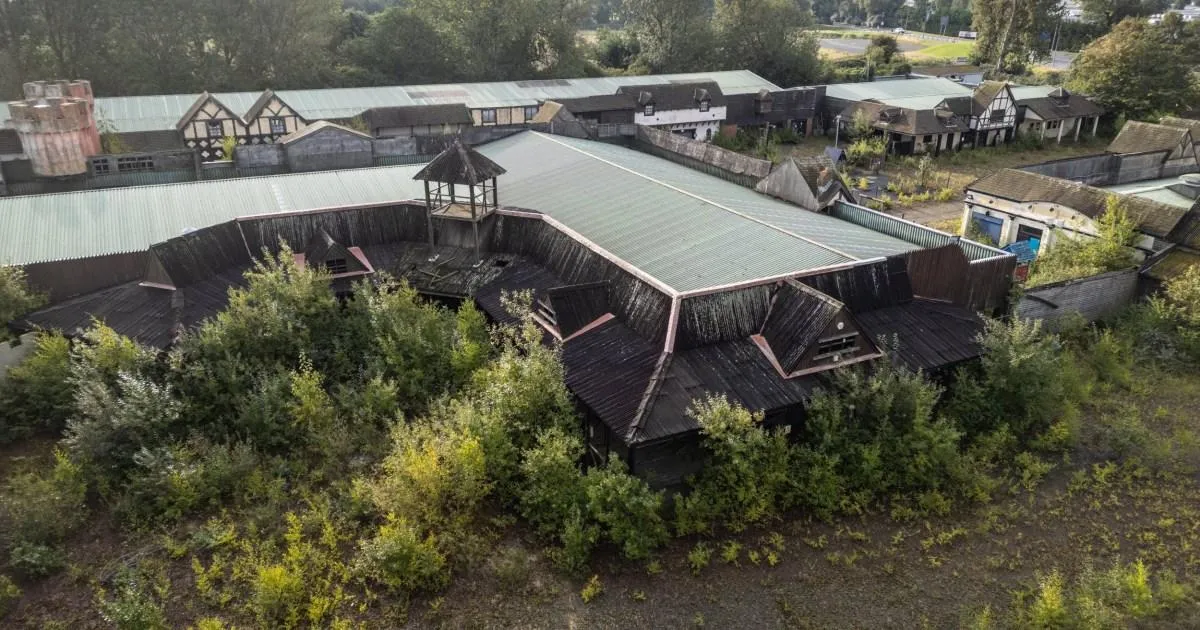
There is something profoundly unsettling, and yet strangely beautiful, about a place built for joy being slowly swallowed by the earth. The photographs emerging from Cleethorpes, Lincolnshire, capture exactly that haunting transition. Pleasure Island, once a glittering kingdom of childhood wonder and teenage thrills, now sits crumbling and silent, its faded castle walls wrapped in twenty-foot-high shrubs and creeping vines. The scene looks less like a seaside attraction and more like a set from The Last of Us, where nature has reclaimed every surface that human hands once polished and painted. The dodgems building is now a tangle of weeds, the waterpark features are rusted and hollow, and the vast 57-acre expanse has become a magnet for urban explorers seeking a thrill of a very different kind. It has been a decade since the park shut its gates for good in October 2016, and in that time, the site has transformed from a symbol of family fun into a monument to neglect. The overgrowth is not just physical; it is emotional, a slow burial of memories that thousands of families carry with them. Every peeling mural, every shattered window, every abandoned ticket booth tells a story of laughter that once echoed through these spaces. And yet, the silence now is deafening. The only sounds are the rustle of leaves, the call of birds, and the occasional crunch of gravel under the boots of someone who should not be there. The park has become a ghost, and its haunting is felt most acutely by the locals who remember what it once was.
2.
To understand the depth of this loss, one has to go back to the beginning, to a sunnier time in the early nineties when Pleasure Island opened its gates with a blaze of color and promise. It was May 27, 1993, and the park was divided into six themed areas: Africa, Kiddies Kingdom, Morocco, Old England, Spain, and White Knuckle Valley. For a seaside town like Cleethorpes, the park was more than just an attraction; it was a badge of pride, a destination that put the area on the map for family holidays and weekend adventures. Parents packed picnic bags and sunscreen, kids tugged at their sleeves with impatient excitement, and teenagers screamed with delight on rides designed to push the boundaries of courage. The Boomerang rollercoaster was a rite of passage, a twisting, turning beast that left riders breathless and grinning. The Alakazam ride carried families on a gentle journey of wonder, its whimsical theme capturing the imagination of younger visitors. White Knuckle Valley delivered the adrenaline, while Kiddies Kingdom offered a softer, safer space for the smallest thrillseekers. It was a place where birthdays were celebrated, first rollercoaster rides were conquered, and ice cream always tasted better in the shadow of a castle tower. For the people of Cleethorpes and the surrounding area, Pleasure Island was woven into the fabric of their summers. It was where grandparents watched grandchildren squeal with delight, where first dates happened under the guise of a funfair, where school trips ended with tired legs and happy hearts. Those memories are still vivid, still warm, still achingly present. That is why the current state of the park feels like a personal betrayal, a chapter of collective childhood abandoned to the elements.
3.
Now, a decade later, the site is a shadow of itself, and the locals are watching with a mixture of anger, sorrow, and helplessness. The buildings that once housed arcade games and burger stands are rotting, their roofs collapsed in places, their walls stained with damp and moss. The car park, once full to bursting on warm bank holiday weekends, is cracked and empty, home only to litter and weeds. The urban explorers have come, drawn by the thrill of trespassing through the ruins, and their presence has brought with it anti-social behaviour that further degrades the site and worries the community. One local resident, speaking with the weariness of someone who has watched this decline unfold in slow motion, said, “I don’t understand why this has not been opened up again as another theme park in that time; it’s been that long. That would actually create jobs and bring in more tourists. My kids used to love this in the 90s, but at the minute it looks like a massive eyesore. It’s such a huge chunk of land just wasted; I don’t think any of us want to see it in ruin.” Another added, “Something needs to be done, or else it’s going to become even more of a hotspot for urban explorers. We can’t be having it sit untouched like that for another ten years or so; it’s not good for the area or the environment.” These are not just complaints about aesthetics; they are cries from a community that feels abandoned alongside the park. The land represents potential, jobs, tourism, and pride. Instead, it stands as a constant reminder of failure and bureaucracy. Every day the gates remain closed, the message to locals is clear: nothing will be done, no one cares, and the memories will continue to crumble until there is nothing left but dust and regret.
4.
The rides, those icons of joy and adrenaline, are now scattered across the globe like refugees from a lost world. The Boomerang rollercoaster, which once hurled screaming passengers through loops and corkscrews, now operates in a park in Indonesia, its familiar tracks standing against a foreign sky. The Alakazam ride, once a gentle journey of family fun, now spins and sways more than 3,000 miles away in Kuwait’s Winter Wonderland, where it has been rebranded as “Fly Away.” The name feels almost cruelly poetic, as if the ride itself has flown away from the land that gave it life. More than 3,500 days have passed since Pleasure Island closed its gates, and in that time, the site has been stripped bare of the very things that made it special. The rollercoasters, the carousels, the spinning teacups, the log flumes—all sold off to the highest bidder, all dismantled and transported to new homes in new countries. What remains is just the shell, the bones of the park, the infrastructure that could not be moved. It is a strange kind of grief, knowing that the physical objects of one’s childhood memories no longer exist in the place where they were made. You cannot visit the corner where you cried when the ride was too scary, or the bench where you sat with a candy floss watching the world go by. Those spaces are now empty, overgrown, and inaccessible. The rides themselves have new lives, new names, new crowds of laughing children. But for the people of Cleethorpes, there is no comfort in that. The magic was not in the metal and wires; it was in the specific place, the specific light, the specific sound of the sea breeze and the distant arcade bells. That magic is gone, and no amount of distance or rebranding can bring it back.
5.
Yet there is still a glimmer of hope, however fragile, in the form of a £70million redevelopment plan that has been touted as a “Centre Parcs-by-the-sea” style destination. The vision is ambitious: 272 holiday lodges, a Lidl supermarket, and its very own Costa Coffee, all set within the sprawling 57-acre site. For many, it sounds like a dream come true, a way to breathe new life into a dead space, to create jobs, attract tourists, and give the area a much-needed economic boost. The planning application was submitted in 2023, and residents held their breath, daring to imagine a future where the overgrown ruins were replaced by fresh timber lodges and the smell of fresh coffee. But three years on, the council is still arguing over what exactly will be built on the land. Late legal challenges from Tesco and another party, both questioning the “retail impact viability” and environmental details of the proposal, have thrown the entire project into doubt. North East Lincolnshire Council has deferred the final planning decision to an unspecified future date, leaving the site in a state of limbo. Every delay feels like a fresh wound for the community, who watch the calendar pages turn with growing dread. Another ten years of this, and what will be left? The buildings will have collapsed entirely. The weeds will have become trees. The site will be beyond saving, or at least beyond any reasonable economic restoration. And the people, those who remember the laughter and the lights, will be older, wearier, and even less hopeful. The legal challenges are standard procedure in the world of retail development, but to the locals, they are just another brick wall between the present and a better future. The land is not just sitting idle; it is actively decaying, and every day of bureaucratic indecision is a day closer to total ruin.
6.
In the end, the story of Pleasure Island is not just a story about an abandoned theme park. It is a story about time, memory, and the delicate balance between progress and preservation. It is about what happens when communities are left behind, when promises are made and broken, when the places that shaped us are allowed to rot because no one can agree on what should come next. The photographs of the overgrown castle walls are beautiful in a melancholy way, but they are also a warning. Every abandoned building, every rusted ride, every weed-covered pathway is a reminder that neglect has a cost, and that cost is paid not just in money, but in morale, in identity, in the simple dignity of a place that was once loved. The locals are not asking for miracles. They are not demanding a return to 1993, when the world was younger and simpler. They are asking for action, for decisions, for someone to look at that vast stretch of wasted land and see what they see: potential. They see jobs for their children, visitors for their town, a reason to be proud again. They see a future where the silence is replaced by laughter, where the weeds are replaced by flower beds, where the crumbling walls are replaced by warm, welcoming spaces. Whether that future arrives depends on the council, on Tesco, on legal arguments and environmental assessments. But it also depends on something less tangible: the will to remember that places like Cleethorpes matter, that the people who live there deserve better than a decades-old scar on their landscape. Pleasure Island gave joy to thousands, and it still could, not as a theme park perhaps, but as something new, something hopeful. The ruins are not the end of the story. They are just the saddest chapter, waiting for someone to turn the page. Until then, the wind blows through the empty halls, the ivy climbs higher, and a community holds its breath, hoping that before it’s too late, someone will care enough to bring the light back to the park by the sea.