


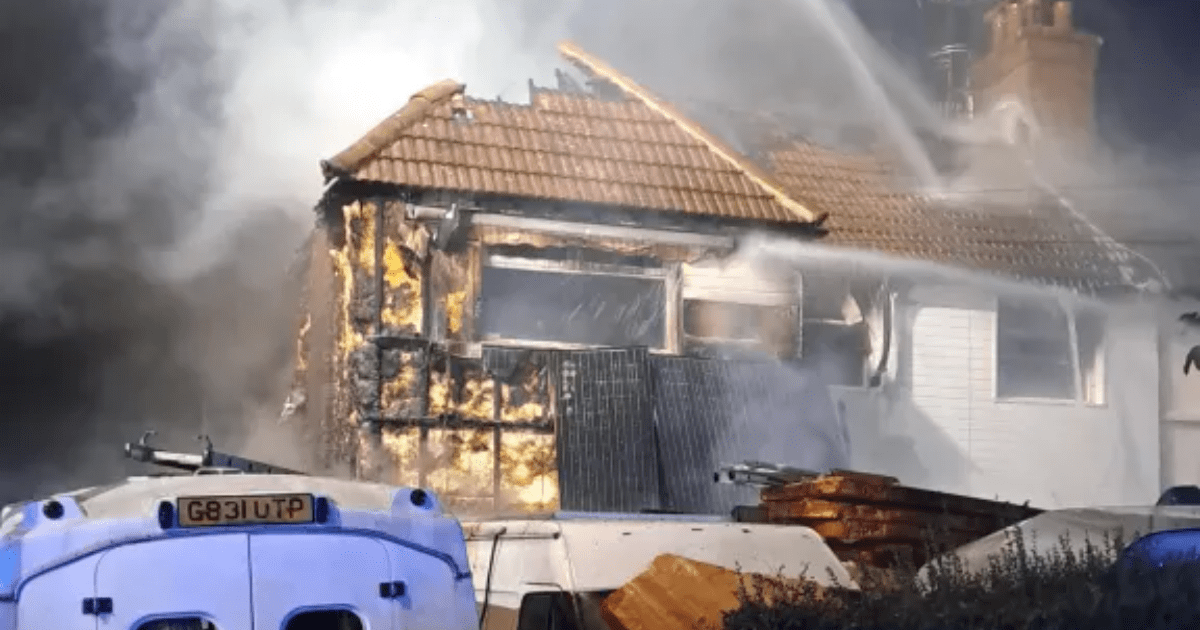
Just after nine thirty on a cool evening in New Malden, the kind of quiet suburban night when families are settling in and the streets have emptied, everything changed. Mount Pleasant Road, a street that would ordinarily be known for its neat semi-detached houses and familiar sense of calm, suddenly became the centre of an urgent emergency. A fire had broken out in a home, and by the time the London Fire Brigade arrived, flames were already moving through the lower part of the building. The fire had taken hold of both the ground floor and the first floor, and in the way that fires so quickly do, it slipped through spaces that people never think twice about during ordinary daylight hours. It spread through the house with a frightening, hungry speed, and within a short time, the whole property was no longer someone’s home in any comforting sense of the word. It was simply a burning structure, glowing against the evening sky. Neighbours must have felt their hearts drop at the sight of the first plume of smoke, and then at the arrival of the first engines, their sirens cutting through the gentle darkness. By 9.35pm the night was officially no longer quiet. Firefighters poured onto the street, silhouetted by the blaze, and set to work doing everything they could to stop the flames from spreading even further into the row of houses nearby.
What followed was not a quick rescue but a long, gruelling operation that would keep firefighters on the scene for several hours. The brigade remained at the house until around 1am. The fire, though it had been caught and fought with everything they had, had already carved a large, ugly hole in the roof, as if the house itself had been opened up to the night. Photographs, later shared by the London Fire Brigade, show the damage in stark detail. The roof is no longer whole. The familiar shape of a suburban two-storey home has been twisted by heat and smoke, and what was once neat and ordinary now appears dangerously fragile. Even the solar panels at the top, designed to catch the light and help create safe, efficient energy, were left blackened and destroyed, their usefulness completely erased by the blaze. The pale insulation that covers the front of the building was also exposed, now burned and stained, hanging off the walls in a way that lays bare how much damage had been done. There is something deeply unsettling about seeing brightness and protection simply flattened in a few hours. The house didn’t just burn; it was broken apart by heat and time, from the inside out. Yet, in all of that noise and destruction, no one inside was hurt. No one was injured. Though the final count of all that had been lost is still coming together, the fact that the family who lived there, or the people who happened to be luckier that night, escaped unharmed is nothing short of a quiet miracle.
The driveway, too, tells a story. A carport in the front garden that was probably built to keep a family car from snow and rain, to add a little comfort to a small piece of daily life, was completely destroyed. The vehicle that had been parked beneath it is gone as well, now no more than another piece of burnt wreckage. For many people, a car is just metal, glass and plastic; for others, it holds their child’s finds, the groceries from the weekend, the old playlists, the everyday notes and memories that got left behind. It was a regular little piece of life that will never be same. But there was another hazard hidden amid the scene. Firefighters discovered a gas cylinder somewhere on the property. These canisters are more dangerous than they look because when exposed to intense heat, they can explode with terrifying force. The team knew this and quickly removed it, then cooled it down to a safer temperature, a precaution that may well have stopped another disaster. It was one of those quiet, momentous decisions firefighters make all the time, not in a boardroom with time to think, but with instinct, experience, and an urgent responsibility. They did not talk much about maybe it somehow had explosive power; they simply took care of it. Along with all the water, smoke, and flames, the gas canister shows that fires are not just about one or two flames; they are loaded with hidden dangers waiting to go off, and every firefighter on this occasion brought an extra layer of calm to those moments.
Station Commander Steve McGhie, who was there overseeing the operation, reflected on how difficult and delicate the situation was. He called it a fire that needed to be fought from above, not just from the street. That fact alone tells you something about how elaborate this blaze was, and how much thought had to go into every next move. This was not a small fire that could be dealt with using one hose and a quick ladder system. It was something spread across levels, well beyond that, and it required an unusually large response. In total, around 70 firefighters were committed to this one house here. At one point, the fire in the house was producing smoke that affected a wide area, wrapping around just a normal block of house lives and casting a dark shadow. The advice went out to neighbours and people in the immediate area: keep their windows and doors closed as much as possible, and simply ride it out until the smoke passes. That kind of advice sounds simple, but never the truth when thick, black smoke is hanging in the air and the sound of engines and crackling wood is all you can hear across the night. For close neighbours, there would have been moments of real uncertainty. Would their home be next? Is it safe to go outside? What about their pets? These are the ordinary, unfiltered anxious questions that sudden fire brings into life, and not one of them is easy to answer in the middle of the night. In all of this, the firefighters were also making sure the fire did not wander to other homes and turn a frightening event into something much worse.
No one was injured, which is nothing less than an extraordinary stroke of luck and the smart work of crews. Fires like this could have quite easily made terrible stories, especially at night when a fire often catches people silently, while their eyes are closed and their guard is down. The fact that every single person inside, new residents, old or visitors, was safe is the single most important sentence in all of the incident report. Still, the investigation is only bowing. The causes of the fire are still unclear, and it will be some time before we hear what exactly about, whether it was electrical, accidental, or perhaps some other chain of events. In the meantime, the hearts of many go out to the people who lived there and to the neighbours who watched from behind their windows in fear and sympathy. There is something watching a house light up in the dark that causes you to think about your home, your own protect. In New Malden, comfort has been damaged widely; loss is not just a person but an entire house, a car, a carport, pieces of everyday ordinary life spread across the sidewalk. The burnt-out remains will stand as a reminder every time someone walks past this stretch of road, a quiet memory to fire safety, to the unpredictability of accidents, to the way life can be changed in a moment, often with no warning at all. The investigation ahead is about the origin of fire, but for the London Fire Brigade, there is also a deeper responsibility to support the community left behind, and to help them understand what happened.
Fires like this also speak loudly, even before the actual cause has been uncovered. It’s a reason to check the smoke detector, to think twice about anything that is too close to the heat. But more than that, it is a reminder of the dependable work firefighters do all year round, at all hours, all over society. They were taken might be on their way to Mount Pleasant Road at 10pm on a regular Tuesday night and did not assume this is another false alarm. They answered a call in the same way they always do, boiling into the risk and standing in front of the danger. The 70 firefighters who attended this blaze deserve an extra word of gratitude alongside the people and families of the fire. Their work was not merely technical; it was human. They fought long into the small hours, watching a piece of somebody’s life fall apart moment by moment, and still they stood their ground, protecting what they could, racing to remove a gas cylinder, fighting the fact of the roof, and in the middle of all that, comforting the people with what must have been a hard but certain reassurance: no one was injured. As the sun comes up over New Malden and the smoke finally fades, the road will be all too different, a charred silhouette where a home stood, a damaged car, evidence of an overnight war. But they will also be evidence of what it means when a community fight combines with the courage of strangers to prevent absolutely tragic outcome. The cause may be unclear, but what is clear is that heavily shaken street in South West London is still standing, still breathing, and day, user.