


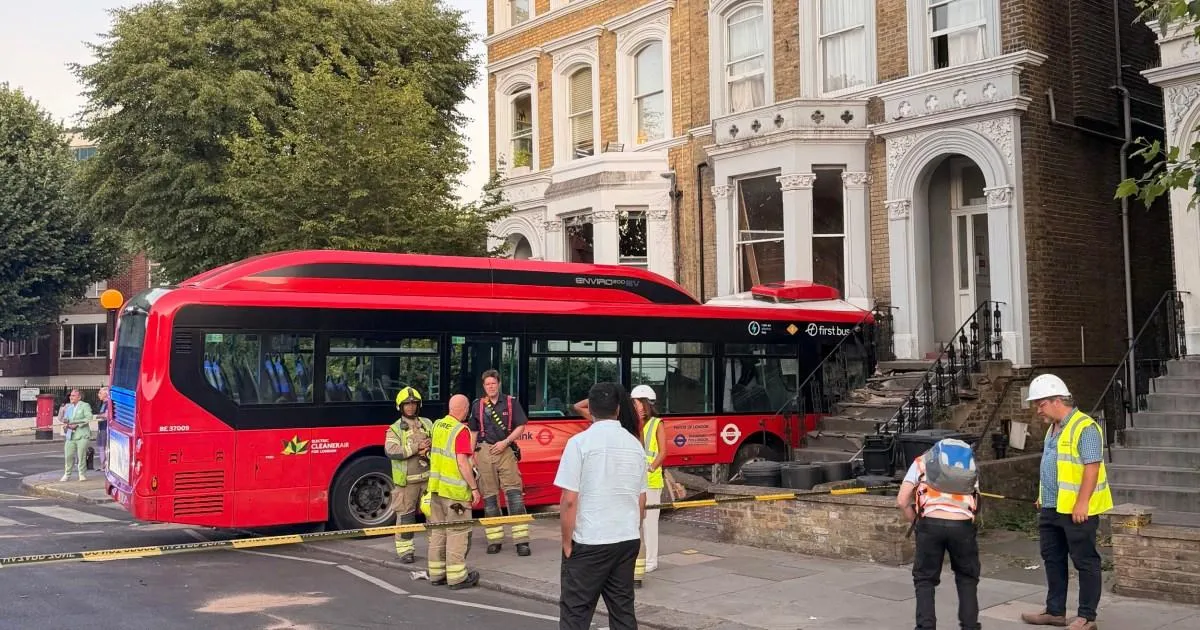
The tranquil atmosphere of a quiet residential street in Notting Hill, West London, was shattered yesterday evening when a red single-decker bus veered off the road and plowed directly into a terraced home. The force of the impact was so significant that the vehicle became wedged into the property’s bay window, effectively crushing the entryway and leaving the front steps in ruins. For those living nearby on St Quintin Avenue, the sudden violence of the crash was shocking; one witness described the sheer power of the collision as feeling like a localized “earthquake” that rippled through the immediate neighborhood.
Emergency services, including fire crews from North Kensington, Hammersmith, Chelsea, and Croydon, rushed to the scene shortly after the 7:12 p.m. call to secure the area and ensure no residents were trapped. Debris from the shattered facade littered the pavement throughout the night while a heavy police cordon was established to protect the public. Despite the visual devastation caused by the bus embedding itself into the structure of the home, authorities later confirmed that, miraculously, no injuries were reported among the passengers, the driver, or the occupants of the house.
The timing of the event was particularly chaotic, as this crash occurred just moments after a separate incident involving another bus and a Waymo autonomous testing vehicle on nearby Barlby Road. With white driverless Waymo cars currently being trialled throughout the capital, the proximity of the two collisions created significant disruption in the area. While there is no immediate indication that the two incidents were linked, the back-to-back accidents forced widespread diversions for other bus routes and prompted a major emergency response that dominated the local news cycle for hours.
In the aftermath of the crash, the Metropolitan Police have launched an inquiry to piece together exactly how a vehicle could lose control so spectacularly in an otherwise mundane residential spot. Officials have been clear that, at this stage, no criminal offenses have been identified and no arrests have been made, suggesting that the event is being treated as a technical or mechanical failure rather than a malicious act. Officers on the scene have appealed for anyone who might have witnessed the moments leading up to the impact to come forward and provide details to assist with their ongoing investigation.
Transport for London (TfL) and the bus operator, First Bus, are currently working in tandem to understand what went wrong. A spokesperson for TfL emphasized that the safety of the public remains their primary focus, confirming that a rigorous internal investigation into the bus driver’s vehicle and the circumstances of the route is already underway. Local council representative Johnny Thalassites echoed the collective sense of relief shared by the community, stating that while the physical damage to the property is extensive, the most important outcome is that the neighborhood avoided what could have easily been a horrific tragedy.
As the recovery process begins, residents of St Quintin Avenue are left to process the jarring sight of the bus being removed from their neighbor’s front room. The cleanup operation, which continued into the following morning, serves as a stark reminder of how quickly the routine of city life can be upended. For now, the street is beginning to return to some semblance of normalcy, though the investigation remains a priority. The incident stands as a rare and alarming disruption, one that will undoubtedly lead to a comprehensive review of safety protocols meant to prevent such an unnerving collision from ever happening again.