
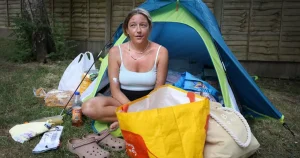

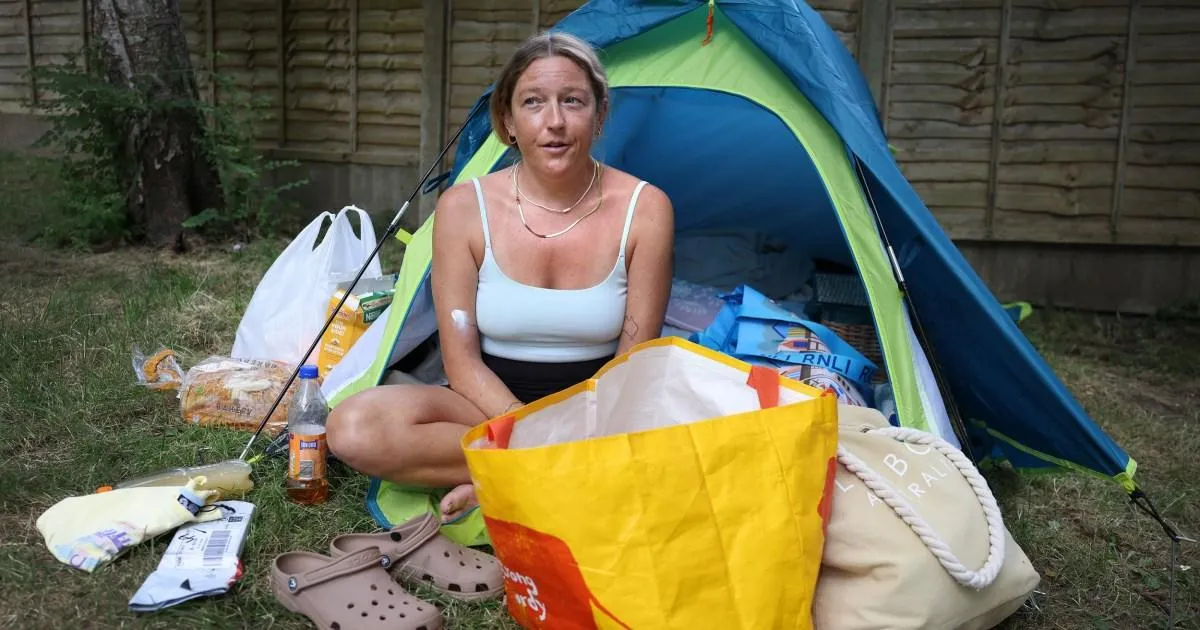
The story of Olivia Hill, a 33-year-old former registered nurse, offers a heartbreaking glimpse into the cracks of a social safety net that seems designed to catch no one at all. Currently living in a tent after being rendered homeless, Olivia finds herself caught in a Kafkaesque nightmare where two of our most fundamental support systems—the NHS and local government—have effectively pushed her into a state of permanent instability. Despite a documented history of severe mental health struggles, including borderline personality disorder, she has been deemed ineligible for emergency housing by the High Peak Borough Council, while being simultaneously barred from hospital admission by medical professionals who claim she does not meet their criteria for inpatient care.
The absurdity of her situation reached a nadir when council officials, having denied her a permanent roof over her head, provided her with a tent and a few food vouchers in the parking lot of a local discount store. Even more concerning was the council’s suggestion that she pitch this shelter near the Woodhead Reservoir, a solution that highlights a total disconnect between administrative “policy” and the reality of a human life. For Olivia, a woman who once dedicated her own career to the professional care of others, becoming the one in need has revealed a cold, bureaucratic heart that categorizes her as neither sick enough for the hospital nor unstable enough for a shared home, leaving her stranded in the impossible space between.
Olivia’s path to this point was not marked by a single catastrophic event, but rather a series of systemic disappointments. After returning to Glossop following stints in hostels across Manchester and Cornwall, she found herself without money and without a safety net, her Universal Credit payments insufficient to cover the rising costs of temporary accommodation. When she turned to the council for help, she was met with a, “not in priority need” decision. Because she is single, has no children, and is not a victim of domestic abuse, the council’s rigid criteria prevented them from offering anything more than an, “ongoing relief duty.” This bureaucratic language serves as a hollow mask for the fact that she has been left to fend for herself in the wilderness.
The mental health aspect of her case highlights a particularly cruel catch-22. The council refuses to place her in shared social housing because they deem her mental health status a “high risk,” identifying her as fundamentally unstable. Yet, when she reaches out to the NHS to seek the very support that might manage that instability, she is discharged and told that her needs should be “managed in the community.” There is profound irony in being told one is too unstable to live in a house, yet not unstable enough to be treated in a hospital—leaving the person in question to navigate life from the confines of a canvas tent on public land, entirely unsupported.
The emotional toll of this experience has left Olivia feeling, in her own words, “broken and distraught.” There is a haunting imagery to her situation: a former nurse, someone who once held the hands of the dying and comforted the ill, now questioning how a society that calls itself civilized can look at her circumstances and find no vulnerability. She is a person trapped in a loop where the lack of housing exacerbates her mental health decline, and her mental health decline is used as the very justification for denying her housing. It is a cycle of exclusion that prioritizes rigid, narrow criteria over the basic dignity of a human being.
Ultimately, Olivia’s story is a searing indictment of how we define “vulnerability” in modern Britain. When we categorize people based on boxes they check—marital status, dependents, or specific diagnostic codes—we inevitably overlook the human reality of homelessness. Her case serves as a loud warning that when the local council and the healthcare system stop communicating and start operating in silos, it is the most vulnerable people who slip through the gaps. Until the system begins to prioritize people over procedures, women like Olivia will continue to be abandoned in the cold, given nothing but a tent and an apology for a life that deserves so much more.