


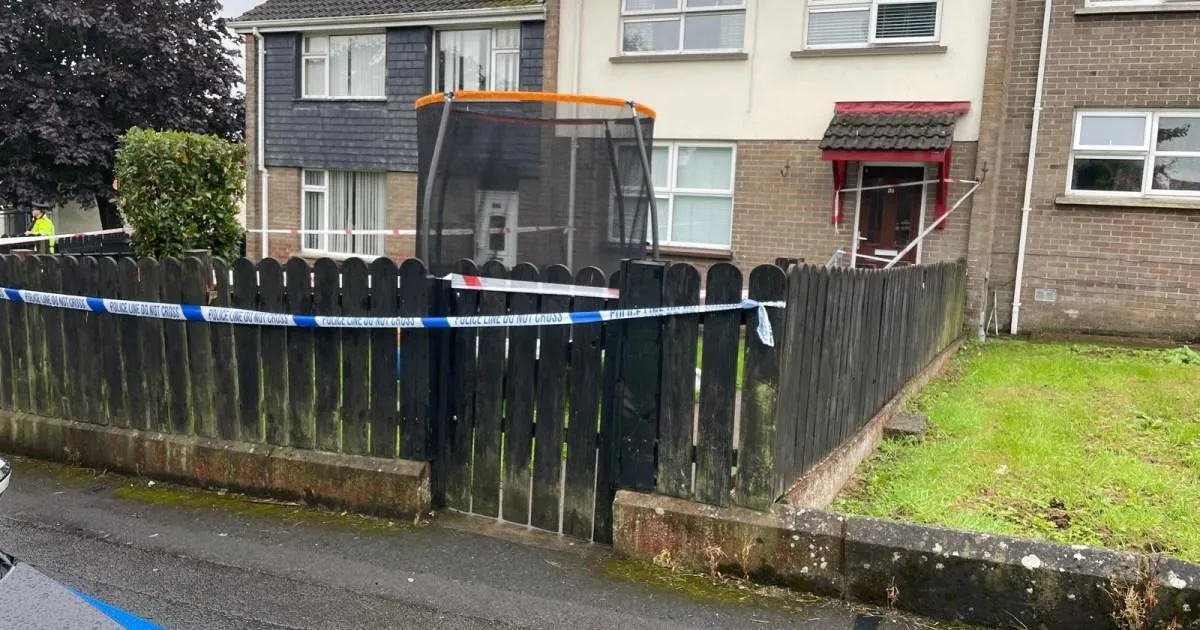
On an ordinary street in Dungannon, Northern Ireland—the sort of quiet residential road where Saturday mornings are usually given over to washing cars, kicking footballs in the garden, and exchanging small talk with neighbours over the fence—the arrival of police vehicles changed everything in a single moment. A terraced family home on Lisanahull Road had become the centre of an emergency response so serious that officers quickly cordoned off the property with blue and white police tape. The front garden of the house, small and unassuming, contained a child’s trampoline. In any other context, that trampoline would be the happiest of sights, a bright object of play and laughter, the kind of thing that makes an ordinary house feel like a home. But on that Saturday it sat in the shadow of something unspeakable, its cheerful colours made incongruous and painful by the presence of police, the silence of the street, and the tears of people who had gathered at a distance. Behind the closed door of that house, officers found the body of a man. A child had been seriously injured and was taken to Belfast, where a hospital team was fighting to save a young life. A woman who was also inside the home had sustained injuries that were not life-threatening, and she has since been released from hospital care. The official language—body of a man, critical condition, non-life-threatening injuries—could not begin to capture the human tragedy contained in those phrases. Neighbours stood in clusters, hugging one another, speaking in hushed voices, trying to reconcile the familiar brickwork of a house they had passed every day with the terrifying news now unfolding. The trampoline remained exactly where it had always been. For anyone who looked at it, the sight was almost unbearably sad.
Detective Chief Inspector Robinson, the officer leading the investigation, provided the first official details of what had occurred. Police had been called to the house on Lisanahull Road, also spelled Lisnahull Road, at around 11am on Saturday 29th August. The scene that awaited them was one of devastation, the kind that remains with first responders for the rest of their lives. Inside, they discovered the body of a man. Also present in the home were a seriously injured child and a woman who had sustained wounds that were not thought to be life-threatening. The child was rushed to a hospital in Belfast, where medical teams were described as working to save a life. Every hour in an intensive care unit becomes its own struggle, a waiting game measured in small victories and sudden setbacks. The woman, once treated and discharged, walked out into a world that was radically different from the one she had woken up in. Her physical injuries may have been healing, but her psychological wounds were only beginning. A male suspect was arrested at the scene on suspicion of murder and attempted murder; he remains in custody. The speed of that arrest, and the fact that it happened at the house itself, suggested something profoundly unsettling: the violence was not random, not the work of an unknown intruder who had slipped in through a window. It was rooted in the family home, in the relationships that should have offered love and safety. That realisation made the tragedy harder for the community to digest and gave the investigation an intimacy that is always the most painful kind. The formal cause of the man’s death has not yet been established, and post-mortem examinations are expected to take place in due course. Forensic teams, detectives, and family liaison officers have begun the painstaking work of gathering evidence and interviewing those who knew the family. For the public, information is slow, and the gaps are filled with anxiety.
Speaking to journalists, DCI Robinson chose his words with the caution that such investigations demand. He confirmed the discovery of the man’s body, the child’s critical condition, and the woman’s presence at the scene. He also confirmed that a male had been arrested at the scene on suspicion of murder and attempted murder and was in custody. Because legal proceedings were now underway, Robinson explained, it would be inappropriate to comment further, and he asked the public to avoid speculation. That request, common in major investigations, was also an acceptance of how difficult it is to control rumour in the age of social media. In the absence of official answers, the vacuum will always be filled with whispers, theories and assumptions, many of them inaccurate and some deeply harmful. Robinson then offered a measure of reassurance that the community desperately needed to hear: police did not believe there was any ongoing risk to the public, and at that stage they were not seeking anyone else in relation to the death. Within the space of a few sentences, the officer conveyed both the gravity of the incident and the containment of the threat. The danger, it seemed, had ended. The suffering had not. He concluded with an expression of sympathy that is often dismissed as routine, but which, in the context of a dead man, a critically injured child, and a woman whose life had been shattered, carried genuine weight: “Our thoughts are very much with the family and friends of those involved.” It was a reminder that behind the police statement, behind the technical language of murder and attempted murder, there were human beings in the middle of a nightmare. The investigation would continue quietly, out of the public eye, as the family tried to find its way through grief.
Among the first public voices to respond was Sinn Féin councillor Deirdre Varsani, the chairwoman of Mid Ulster District Council. In a statement that combined official responsibility with human compassion, she said the first concern was for the victims and for anyone who may have witnessed traumatic events. Her understanding of trauma extended beyond the immediate family. She acknowledged that an incident of this kind can bring up all kinds of feelings in people—fear, anger, sadness, confusion, even a jarring sense of one’s own vulnerability—and she encouraged the community to be gentle with themselves and with one another. Then came the phrase that would frame public understanding of the attack: “This particular incident appears to have been at the more extreme end of a domestic incident, with a man now confirmed dead and a child seriously injured.” The label “domestic incident” is often used by officials to describe the heartbreaking conflicts that unfold behind closed doors. But the qualifier, “extreme end,” removed any doubt about the severity of what had happened. This was not an argument that spilled over in the way people sometimes imagine. It was a deadly assault that had killed a man and left a child fighting for life in a Belfast hospital. The word “domestic” also carried an uncomfortable second meaning: it pointed to the home, to the family unit, to the very place where society expects people to feel most protected. When that protection fails, the shock is especially profound. For the people of Dungannon, a town where community ties run deep and families are often known to one another, the event was felt as a personal blow. It would be discussed in shops, in churches, in schools, in workplaces, and in kitchens across the area. Parents would hold their children a little tighter that night. Neighbours would look at one another with an awareness that beneath the surface of everyday routine, there may be hidden pain.
At a broader level, this tragedy is a reminder of the reality of domestic violence and the silent struggles that can exist inside families. The precise circumstances of the case are not yet known, and it would be wrong to speculate. But the phrase “domestic incident” cannot be allowed to become a euphemism. It refers to a kind of violence that is all too common, that thrives in the privacy of homes and in the reluctance of outsiders to interfere. It affects people of every background, every income level, every identity. It is often preceded by warning signs that go unrecognised or unreported, by conversations that never take place, by help that is not sought or not available. The child now lying in a Belfast hospital is the most fragile of victims—an innocent whose life has been torn apart by forces that should never have touched them. Children are supposed to be protected from the darkness of the adult world. They are supposed to be allowed to grow up slowly, safely, with the freedom to worry only about school, friends and play. Instead, this child has been caught in a catastrophe. Even if the body survives, the mind may carry the weight of memory for a lifetime. The woman released from hospital faces her own long recovery. She must live with the images of what happened in her own home, with the loss of someone she knew, with questions that may never be fully answered. The road back to anything resembling a normal life will be long and winding. Around the immediate family are the wider victims: friends, relatives, neighbours, schoolmates, and the first responders who walked into a scene that no one should ever have to confront. Trauma radiates outward like ripples on water, touching even those who only know the story from the news. Domestic violence is not a private matter; it is a public wound.
In the days ahead, the machinery of justice will move slowly but steadily. Post-mortem examinations will seek to establish the exact cause of the man’s death. The arrested male will face the criminal justice system, and evidence will be gathered, tested and presented. For the family, however, no verdict will be a true victory. The man who died will not return. The child, if they survive, will carry the memory of this day into an uncertain future. The woman will have to find a way to rebuild a life from the ruins of a sudden calamity. The community will have to learn to live with the imprint of police tape and the vivid presence of the child’s trampoline, that small symbol of innocence and play that stood defiantly in the middle of a nightmare. In time, the investigation will conclude, the house will be released, and the physical traces of that Saturday morning will be cleaned away. But memories are not so easily scrubbed. For everyone who saw the cordon, who heard the sirens, who read the headlines and felt a coldness inside, the story will linger. What tragedy demands of us is not idle curiosity or raw shock, but a renewed commitment to listening for the signs of domestic violence and abuse, to supporting those who are caught in it, and to protecting the children who are its most vulnerable victims. It asks us to be better neighbours, better friends, better citizens. And it asks us never to forget that the most ordinary-looking house, with the most ordinary front garden, can contain a drama of enormous pain. Our thoughts remain with the family and friends of those involved. Our hope is for the child’s recovery, for the woman’s strength, and for a community slowly finding its way back to peace.