

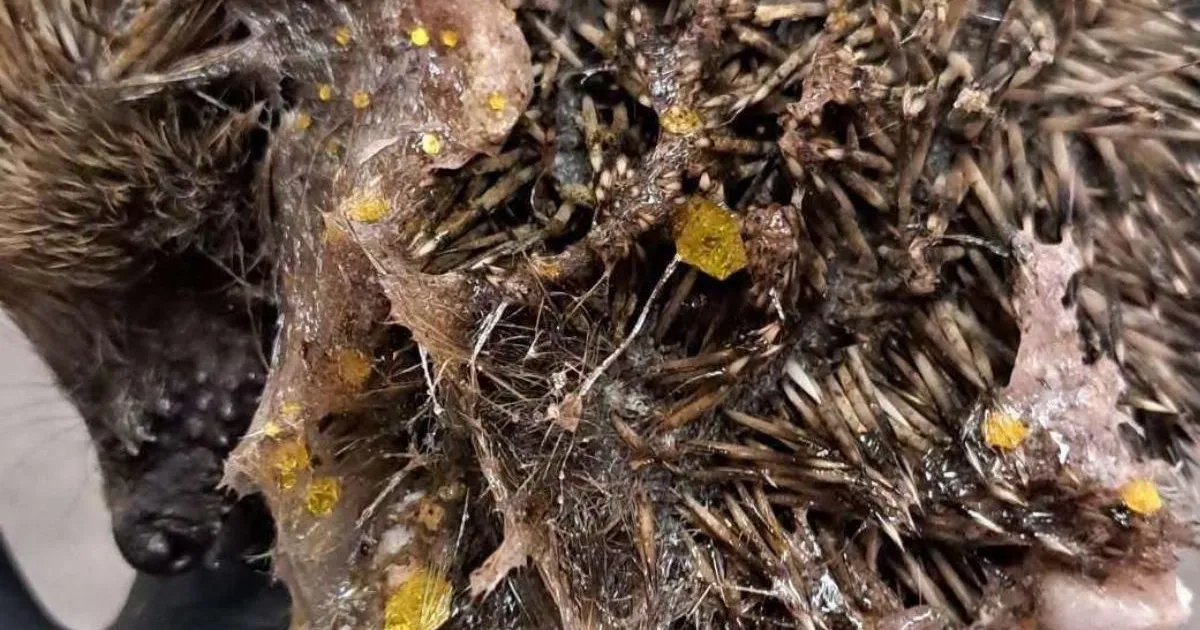
There was a moment, just before she was found, when Sparkle must have believed her short life was already over. She was only three months old, still young enough to be considered a baby, still small enough to fit into the palm of a human hand. But somewhere along a roadside in Herne Bay, Kent, her world turned from the quiet simplicity of a summer night into a nightmare of stickiness, blindness, and fear. She had somehow come into contact with a discarded children’s toy, a glittery, gold-colored slime that had been carelessly left behind, and it had coated her tiny body from head to toe. The substance was thick, heavy, and fast-setting, and it had hardened around her face, sealing one of her eyes completely shut. When a kind passerby spotted her lying helplessly in the road, she could barely move. She was not curled into the protective ball that hedgehogs instinctively rely on; she was stretched out, vulnerable, unable to defend herself from anything. It was clear she had been fighting the goo for some time, but it had won. The sticky layer trapped her quills against her body, made every step a struggle, and left her exposed to predators, traffic, and the elements. She was, in every sense, a tiny creature at the end of her strength.
Her rescue was a stroke of pure luck. The stranger who found her did not walk past, did not assume someone else would help. Instead, they gently picked her up and brought her straight to Dottie’s Little Hog Hospital, a small animal charity that has become a sanctuary for hundreds of hedgehogs in need. There, the staff took one look at the miserable little animal and knew exactly what had happened. They gave her the name Sparkle, partly because of the glittering mess she was covered in, but also because she still had a glimmer of life in her. The charity’s founder, Jo Hogbin, later described the scene with a mixture of sadness and anger. She explained that the slime was almost certainly from a child’s toy, and that it had been discarded outdoors where wildlife could easily stumble into it. It was not just sticky, she said; it was more than likely toxic. It had worked its way all over Sparkle’s body, making it impossible for her to curl up properly, which is a hedgehog’s only natural defense. Every instinct Sparkle had was useless against this artificial enemy. She could not hide, she could not roll, she could not escape. All she could do was lie there and wait. And had no one found her, the outcome would have been devastating. Hogbin’s Facebook post about the incident received more than eleven thousand reactions, a sign that people were deeply moved by the little hedgehog’s ordeal and perhaps also a sign that many of us are starting to understand how our discarded items affect the creatures we share the world with.
The road to recovery was slow but tender. Sparkle did not simply need a wipe down; she needed multiple baths, each one carefully administered by the charity’s dedicated volunteers. The slime had set like glue, clinging to her fur, her quills, and the delicate skin around her eyes. It took patience, warm water, and a gentle touch to loosen the grip of that glittering goo. Bath after bath, the gold began to fade, and underneath it emerged a familiar, beautiful hedgehog face. Her eye, once sealed shut, opened again to the world. Her quills began to stand up properly, allowing her to do what hedgehogs do best: curl into a safe, spiky ball. After a few days of rest, good food, and the quiet warmth of the hospital, Sparkle was unrecognizable. She was slime-free, comfortable, and clearly relieved. Anyone who has ever cared for an animal in distress knows that moment when the fear leaves their eyes. For Sparkle, that moment came after the last bath, when she finally felt clean and safe enough to relax. She could walk without dragging sticky goo. She could breathe freely. She could be a hedgehog again. The transformation was not just physical; it was emotional. She had been given a second chance, and her tiny body seemed to understand it. Yet her story is not unique. It is part of a heartbreaking pattern of hedgehogs being harmed by things humans throw away without a second thought.
In fact, Sparkle is just the latest in a long series of preventable tragedies. Earlier this year, a six-week-old hoglet was brought to a rescue center with a piece of plastic embedded tightly around its neck, a horrifying image of how our waste can strangle even the smallest of creatures. In the space of a single month, five hedgehogs were found covered in paint, another toxic and unnecessary ordeal caused by carelessness. These stories rarely make national headlines, but they happen far more often than most people realize. Hedgehogs, by nature, wander. They travel through gardens, across roads, along hedgerows, and into open spaces, always on the lookout for food. They do not understand what a slime toy is, or paint, or plastic. They only know that something is stuck to them, and they cannot get it off. Unlike a larger animal, a hedgehog cannot easily shake off a substance or bite through a piece of plastic. Their small size means that even a little bit of litter can become a life-threatening hazard. When confronted with something like Sparkle’s glittery slime, they are completely defenseless. The very things that make hedgehogs so endearing, their trusting nature and slow, determined pace, are the same things that make them so vulnerable to the careless debris of human life. Every discarded toy, every dropped ring of plastic, every spilled pot of paint is a potential trap for a creature that simply wants to live.
Jo Hogbin’s plea after Sparkle’s rescue was heartfelt and direct: if you have children who use slime or similar products, make sure every last bit is disposed of properly, and never leave it where wildlife can come into contact with it. She did not ask for much, just vigilance and basic kindness. Dottie’s Little Hog Hospital is currently home to around two hundred hedgehogs, each one with its own story of struggle and survival. The charity survives on the goodwill of people who care, and every rescued hedgehog represents hours of labor, love, and often heartbreak. But the work is not just about caring for the animals who are brought in; it is about preventing the next Sparkle from ever being found by the side of the road in the first place. Hogbin encouraged the public to stay vigilant, to look out for hedgehogs in their gardens and neighborhoods, and to help in simple, practical ways. Putting out fresh water, especially given the recent warm weather, can be a lifeline for thirsty animals. Providing meaty cat or dog food, served in a shallow dish, offers a much-needed meal for hedgehogs who might otherwise struggle to find enough insects and worms. These small gestures cost little, but they can make an enormous difference. They remind us that we do not need to be rescue workers to be rescuers. We all share this world with these spiny, gentle creatures, and the least we can do is make sure our presence does not make their lives harder.
The hope is that Sparkle will soon be released back into the wild, once she has reached adult size and proven that she is strong enough to survive on her own. Her release will take place in a hedgehog-friendly garden, a place where she can roam, forage, and eventually raise a family of her own. It is a beautiful ending to what could have been a tragic story. But it should also serve as a reminder that not every hedgehog is so lucky. For every Sparkle saved, there are others who are never found, who suffer silently and die alone because of something someone threw away without thinking. The glittery slime that nearly killed her was not a natural predator. It was not a harsh winter or a hungry fox. It was a piece of everyday human life, discarded carelessly, and it became a deadly trap. We can do better. We can put our toys away, dispose of our waste properly, and spare a thought for the tiny creatures who share our streets and gardens. Sparkle’s story is one of survival, but it is also a gentle accusation. It asks us to look at our own behavior, to consider how our small, thoughtless actions ripple outward into the lives of others. If we can learn anything from her ordeal, perhaps it is that kindness, like litter, can be left behind. But while litter takes away life, kindness gives it back. And in Sparkle’s case, a moment of kindness from a stranger gave a tiny hedgehog her entire future back.