


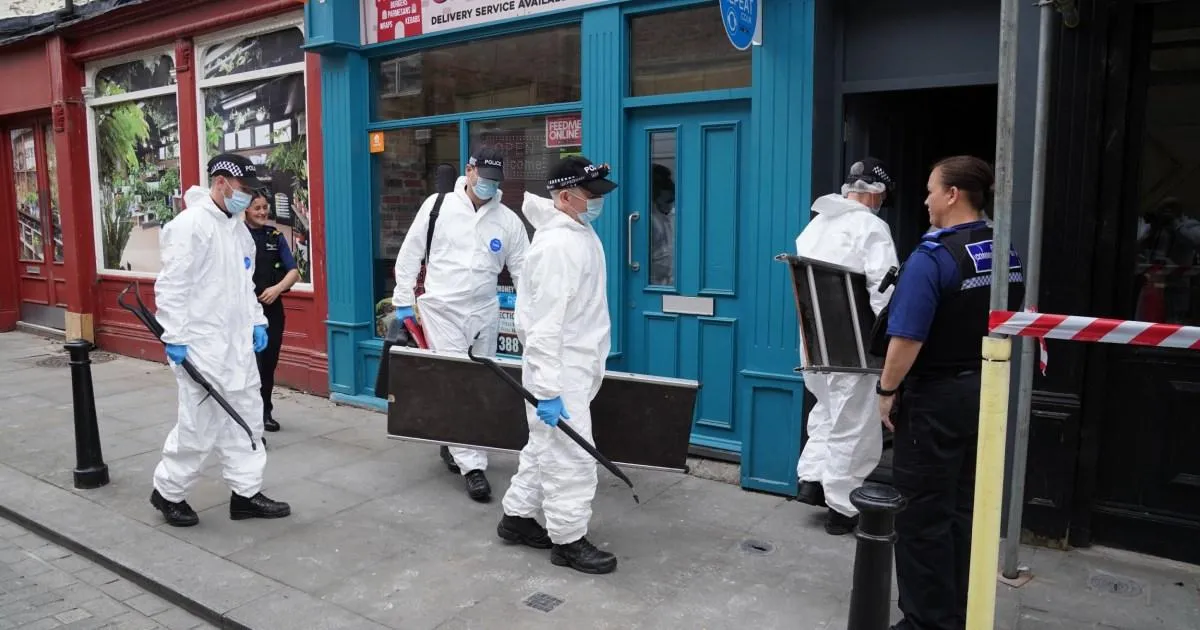
In the quiet, unassuming town of Bishop Auckland, County Durham, the mundane act of renovation was interrupted by a discovery that would bridge over a century of silence. It was July 2024 when Peter Moody, the owner of a disused building on Fore Bondgate, found himself peeling back the floorboards of a second-floor room, expecting nothing more than the usual dust and debris of an old structure. Instead, he uncovered a small, heartbreaking secret that had been deliberately hidden for generations: the skeletal remains of a newborn baby. The find was not just a forensic puzzle; it was a deeply human tragedy that had been sealed away, literally beneath the feet of countless people who had lived, worked, and walked above it for over a hundred years. The tiny body, which had been mummified by the dry, protected conditions beneath the floor, was wrapped carefully in pages of a newspaper called The Umpire—a publication that dated back to 1910. The image is a haunting one: a child, never given a name in life, nor a proper farewell, left to be discovered by strangers in a later century, his story untold and his identity a mystery that the modern world has been left to piece together with science and compassion.
The subsequent inquest, held at Crook Civic Centre, drew a solemn picture of an investigation that combined cutting-edge DNA technology with the painstaking work of anthropologists and historians. Coroner Crispin Oliver opened the proceedings with a fittingly somber observation, calling it “a sad and unusual case,” and the task before the court was to determine whether this infant’s death was an unnatural, violent, or simply unknown event. Through DNA testing, investigators were able to establish that the baby was a boy, and he has since been given the tender, humanizing name “Baby Auckland”—a moniker that serves less as a legal label and more as a way to honor the little life that was lost. A radiocarbon dating expert, using a bone sample, provided a startlingly broad yet haunting timeframe: the child had been born somewhere between the mid-1600s and 1955. This means that for up to three hundred years, this tiny soul had been resting in that concealed space, a silent witness to the passage of time, surviving wars, social upheavals, and countless generations of occupants who never knew he was there. The precision of the forensic work contrasted sharply with the profound ambiguity of the baby’s brief existence, leaving the court, and the public, to grapple with the knowledge that this child’s story began and ended in secrecy.
The forensic examination delved into the physical details of the infant’s final moments, painting a picture that was both clinical and unbearably poignant. Dr. Micol Zuppello, a forensic anthropologist, determined that the body had been placed face-down, carefully positioned beneath the floorboard. The baby was judged to be at 38 to 40 weeks of development—a full-term pregnancy, meaning he was ready to enter the world, yet never got the chance to experience it. The remains showed no signs of skeletal trauma, and the mummified state of the body meant that soft tissue had long since degraded, making it impossible for Home Office pathologist Dr. Louise Mulcahy to ascertain the cause of death. She could not say whether the child had been born alive or stillborn, a crucial distinction that remained frustratingly out of reach. What was clear, however, was the most disturbing detail of all: the twine. Dr. Mulcahy confirmed that a length of garden twine, roughly a meter long, had been looped and knotted directly around the baby’s neck—not once, but three times, with a knot and a further loop. The twine was not used to tie the newspaper wrapping like a parcel, as one might initially imagine; it was deliberately and solely placed around the infant’s neck. This detail cast a long shadow over the proceedings, suggesting a level of intent and desperation that transcended the simple act of hiding a body, although the medical experts were adamant that this did not necessarily indicate a violent death, as the child could have been stillborn before the twine was ever applied.
The police investigation, led by Detective Chief Inspector Mel Sutherland, was exhaustive in its search for answers, yet it was met with one dead end after another. The inquiry considered the possibility of consulting a knot expert, but the cost was deemed prohibitive given that there was no realistic prospect of a prosecution after all this time. The twine itself was identified as a generic type, offering no forensic lead. DNA testing yielded no matches with any known living relatives, leaving the baby’s lineage a blank page. In a moment of hope, public appeals in the media prompted two sisters to come forward, believing they might be connected to a former servant who had worked at the property in the early 20th century. But a DNA test dashed those hopes, severing the tenuous link that might have solved the mystery of who this child was and who had placed him there. Coroner Oliver, in a thoughtful line of questioning, wondered aloud whether the twine might have served a religious purpose, perhaps holding a talisman or artefact around the baby’s neck, or whether it could have been part of a midwifery practice of the time. Det Chf Insp Sutherland, however, stated that neither explanation was considered likely. The investigation revealed a mystery that seemed impervious to the tools of modern forensic science, leaving investigators to conclude that the answers may have died along with the individuals who were involved in this tragic concealment.
Beyond the forensic details, the story of Baby Auckland resonates because it forces us to imagine the human circumstances that led to this desperate act. The building on Fore Bondgate, which served as a cafe in recent times, was constructed in the late 19th century, and its history would have included a web of servants, tenants, and workers. To hide a newborn in such a manner suggests a profound level of fear, shame, or desperation. In an era where illegitimacy was a severe social stigma, where unmarried mothers faced ostracism, poverty, and the loss of their livelihoods, the decision to conceal a pregnancy and birth was a tragic reality for some. The newspaper from 1910 situates this event in the Edwardian era, a period of strict moral codes and rigid social hierarchies, where a woman in distress might have seen no other option but to hide this devastating secret. The fact that the baby was placed face-down, wrapped with care in newspaper, and hidden in a location where he would not be disturbed, speaks to a conflicted act—one that involved a degree of deliberate thought, perhaps even a twisted form of protection, ensuring the child would never be found, but also never be honored. This duality—the attempt to erase a life while simultaneously preserving it in a hidden space—is the crux of the tragedy. We are left to wonder if the mother held her son one last time before covering him, or if the act was done in a hurry, in panic, or in the depth of a despair that we can scarcely comprehend.
The resolution of the story, however, offers a measure of grace and dignity that was denied to Baby Auckland in life. The inquest concluded with Coroner Oliver expressing his intent to provide a formal conclusion, and in April, a funeral was organized by Durham County Council, with the support of a local funeral director who donated their services and a memorial firm that provided a headstone. This final act of humanity was a stark contrast to the cold concealment of the past. Cathy Hunt, the council’s cabinet member for children and young people’s services, spoke with heart-wrenching eloquence, saying, “Sadly, for reasons we will never know, this little boy was never given the dignified and appropriate burial he deserved, so it was important that he was laid to rest in a way that honoured a life that could have been.” In this act of remembrance, the community of Bishop Auckland gave Baby Auckland the respect and love that his life, however fleeting, always warranted. His name now stands as a memorial, not just to a forensic case closed, but to the enduring human spirit that refuses to let a life be forgotten, even one that was invisible, silent, and hidden for over a century. As the public reflects on this story, it serves as a profound reminder of the delicate thread of life, the weight of social pressures, and the fundamental, timeless need to honor the innocent, the forgotten, and the lost. Baby Auckland, finally laid to rest with a headstone bearing his name, has been reclaimed from the shadows, his small life now a poignant part of the town’s history, and a testament to the compassion that endures across the ages.