


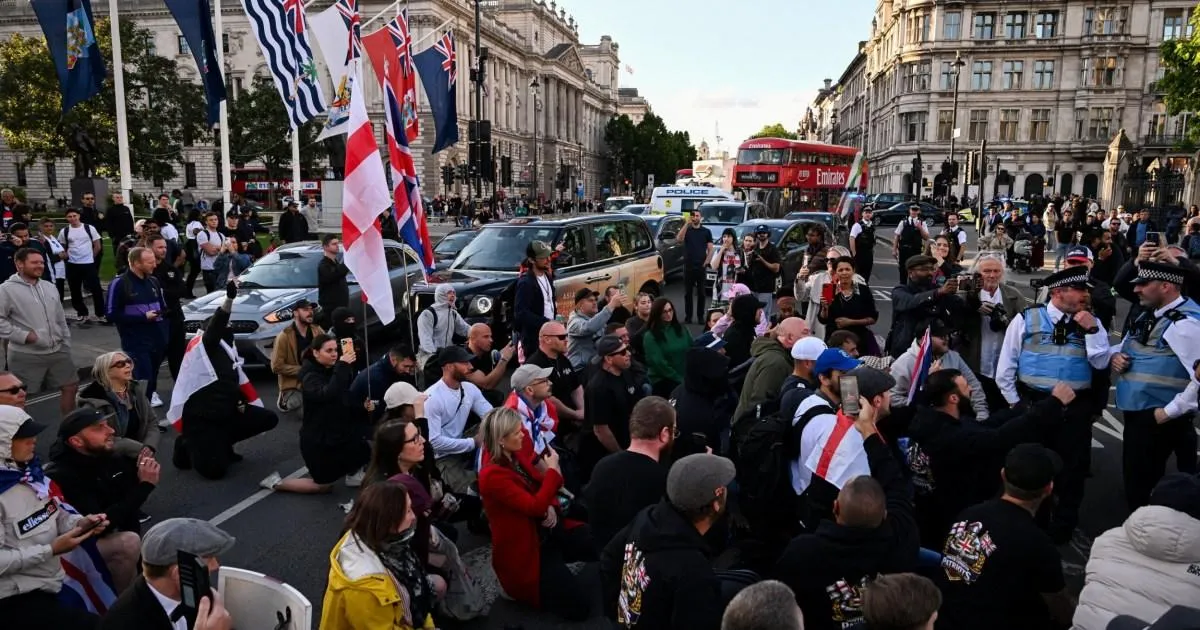
The atmosphere in London’s Parliament Square shifted violently this evening as a series of spontaneous, nationwide protests orchestrated by Tommy Robinson descended into chaos. What began as a modest gathering of roughly 50 individuals waving Union Jacks quickly transformed into an aggressive, confrontational mob. Protesters surged into the middle of the road, shrouding the streets in the acrid haze of red smoke flares as they staged a performative “taking the knee” ritual—a pointed, ironic mimicry of anti-racist movements meant to mock the original intent of the gesture. As cars, buses, and cyclists attempted to navigate the gridlocked traffic, the crowd shifted their focus toward anyone they deemed an outsider, demanding allegiance to their cause and shouting slogans like “sink the boats” and “we want our country back.”
The rhetoric on the ground was far from a civil debate; it was characterized by intimidation and an unsettling sense of entitlement to public space. The protesters cornered police officers and journalists, demanding to know why they weren’t participating in their performative kneeling, weaponizing the name of Henry Nowak to harass those who didn’t align with their worldview. For the commuters and Londoners just trying to get home, the scene was one of bewildering hostility. It was a stark reminder of how quickly a political demonstration can turn into an act of performance art designed to disrupt and provoke, rather than foster a meaningful or peaceful dialogue.
The situation turned markedly darker when two young women, Zahra Ali and Monday Rosenfeld, found themselves at the center of the mob. The two had been walking away from a nearby pro-Palestine protest when they were swarmed by the crowd. What began as a supposed “discussion of differences” rapidly devolved into a harrowing display of targeted hate. Monday, only 23, later recounted the event with visible shock, describing the abuse as some of the most vile she had ever witnessed. Men who claimed to be gathered to “protect our women” turned their aggression toward her, leveled threats of violence that were as graphic as they were terrifying, including threats of physical mutilation and death.
The targeted nature of the abuse highlighted the ugly undercurrents of the protest. Nineteen-year-old Zahra was repeatedly grilled about her religious practices and told to “go back to Somalia,” despite the fact that she has never called any country but the United Kingdom her home. The irony was palpable and deeply painful; these men, who draped themselves in the flags of a diverse, modern Britain, were the very people enforcing an exclusionary vision of the country that refuses to acknowledge its citizens’ actual lived realities. The intersection of xenophobia and radicalization was on full display as the crowd sought to define who “belonged” in their version of the UK.
Even those who might have expected solidarity within the movement were not spared from the volatility of the group. One woman, Jennifer, who initially identified with the crowd’s frustrations, found herself on the receiving end of the very prejudice they were projecting. After confronting Zahra, Jennifer was shocked to find that members of her own protest side turned on her, judging her based on her physical appearance and race rather than her political alignment. A man in the crowd even directed his vitriol toward a Sikh police officer, barking racist questions about the officer’s ceremonial kirpan. It was a chaotic feedback loop of hate, where even the “insiders” were subject to the shifting whims of a mob desperate for a target.
As the evening drew to a close and police finally ordered the protesters to disperse, the lingering question was not about the validity of their grievances, but about the cost of their methods. Jennifer, speaking later, insisted that the public was being “ignored” and that blocking roads was their only way to be heard. However, the scene left behind was one of shattered community trust. When protest becomes synonymous with harassment, intimidation, and the dehumanization of neighbors, it stops being a vehicle for change and instead becomes a source of collective trauma. London reflected tonight not a country having a conversation, but a country struggling to contain the ripples of emboldened, unchecked vitriol.