


Here is a summarized and humanized narrative of the event, expanded to meet your requested length and structured into six paragraphs.
—
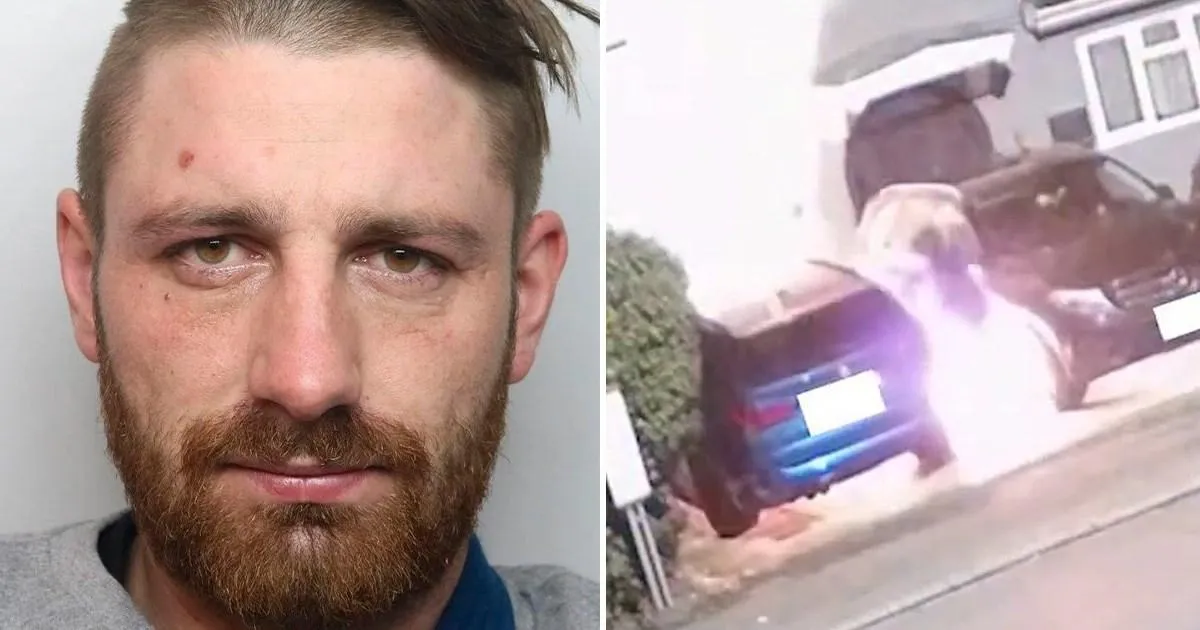
The quiet suburban stillness of a residential street in Slough was shattered in the early hours of March 9th, when a determined but ultimately hapless arsonist attempted to destroy a neighbor’s property. Krzysztof Orzechowski, 32, crept onto a private driveway, armed with a can of fuel and a plan. Under the cover of darkness, he methodically poured the accelerant over a row of parked cars, intending to engulf them and perhaps the adjacent home in flames. The act was brazen and dangerous, a calculated attack designed to cause maximum fear and destruction. However, in the midst of his work, the plan went disastrously and immediately wrong. In a moment of carelessness, the fuel he was pouring splashed onto his own hand, and when he ignited the vehicles, his hand was caught in the blaze. The searing pain was instant, leaving him with a significant burn—a lasting, physical mark of his own criminal folly, and the first sign that his scheme was unraveling.
The moment the cars burst into a roaring inferno, the situation escalated beyond a simple act of vandalism. Flames licked high into the night sky, illuminating the street and sending thick, acrid smoke billowing through the neighborhood. The heat was intense enough to pose a genuine threat to the adjoining house, forcing the families inside to evacuate their homes in a panic. The terror was palpable; this was no longer just an attack on property, but a direct assault on their sense of safety and security. For the victims, the damage was extensive, leaving them with charred vehicles and a home that now felt violated and unsafe. Yet, amidst the chaos and destruction, there was a stroke of profound fortune: no one was physically injured. The escape from the houses was swift, and the flames did not claim any lives, a small mercy that would later be a central point of relief for both the prosecution and the victims.
Meanwhile, Orzechowski, with his hand throbbing and his criminal act complete, fled the scene. His escape, however, was less a clean getaway and more of a high-octane, reckless flight from justice. He jumped into his own car and sped off, tearing through the streets of Slough with a blatant disregard for his own safety or anyone else’s. His driving was erratic and dangerous, with police soon pursuing him at high speed. The chase became a desperate game of cat and mouse, with Orzechowski swerving and accelerating, pushing his vehicle and his luck to the absolute limit. He reached speeds of up to 100mph, turning the residential roads into a potential death trap. The chase finally came to a crashing end when he lost control of his vehicle, swerving dramatically and colliding, bringing his frantic bid for freedom to an abrupt and definitive halt, where he was swiftly detained by officers.
The aftermath moved from the streets to the courtroom. Appearing at Reading Crown Court on April 13th, Orzechowski faced the consequences of his destructive and dangerous actions. He pleaded guilty to a series of serious charges, including two counts of arson with intent to endanger life, acknowledging that his actions in setting the cars alight had put the residents of the home in grave danger. He also admitted to one count of dangerous driving for the reckless police chase that followed. In a further admission that painted a complete picture of his troubled state, he pleaded guilty to two counts of possessing controlled drugs, namely cocaine and cannabis. It was a full and swift confession to a night of catastrophic decision-making, leaving the court to determine a sentence fitting the severity of the terror he had unleashed on an innocent community.
Detective Constable Chloe Winchcombe, who led the investigation, did not mince words in her assessment of Orzechowski. She described him as a “dangerous offender” who posed a significant risk to the public, highlighting that his actions could have easily resulted in tragic, fatal consequences. The force of her statement underscored the sheer recklessness of the crime, emphasizing that he had not only endangered the lives of the occupants of the house but also the lives of police officers and the public during the subsequent high-speed chase. The court clearly agreed with this assessment, handing down a substantial sentence of five years and seven months in prison, followed by an extended three-year license period. He was also banned from driving for a year, a further consequence of his erratic behavior behind the wheel.
The human cost of the incident was powerfully articulated through a victim impact statement read to the court. The victim described how the incident had ripped apart their sense of security, stating, “I feel like every part of my life has been impacted by this.” They spoke of a profound psychological shift, moving from a feeling of safety in their own home to one of constant anxiety and fear. The statement poignantly captured the lingering trauma: “We are frightened, unsettled and constantly on edge. It has affected every part of my life and my family’s life, and I am not sure when or if we will ever fully recover.” Beyond the physical damage, the emotional scars were the most enduring. DC Winchcombe offered a reassuring message to the community as the case concluded, stating that Thames Valley Police will “never tolerate such offending” and will “always work tirelessly to bring perpetrators like Orzechowski to justice and support victims.” For the neighborhood, the scars may remain, but the closure of a conviction offers a small, first step toward rebuilding their shattered peace of mind.