


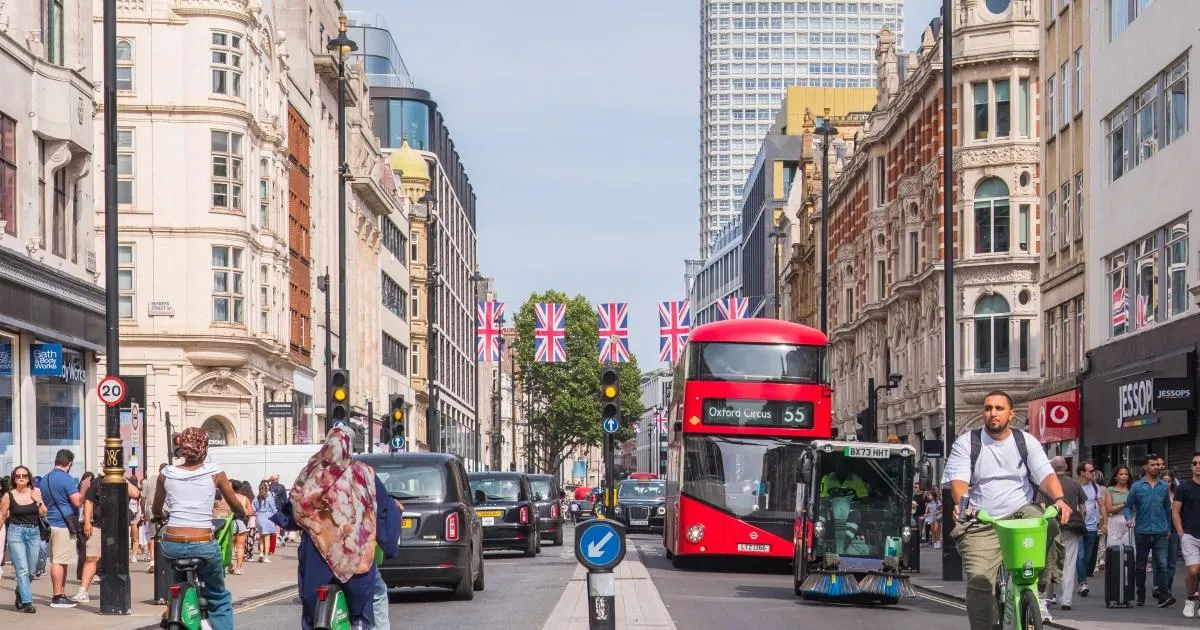
It starts in the middle of a crowded street, with shoppers weaving around pushchairs, tourists pausing to take photos, and delivery bikes skimming between buses. The stage is Oxford Street, one of the busiest shopping destions in Britain, a place that already feels overwhelmed by people and energy. But underneath the sign of an ordinary afternoon, something less ordinary is being planned. The Mayor of London has signaled that live face recognition cameras could become a permanent fixture on this iconic street, placed on lampposts and other permanent stone structures, quietly scanning the faces of everyone who passes by. If you look more deeply, this is not a theoretical education. The technology would analyze faces in real time, compare them with images stored in national crime database, and instantly flag people wanted by the police or known repeat offenders. It sounds clever to some and disturbing to others, and the divide, in a place as public and contested as London, is now sharply visible. Civil liberties groups have declare that it would be a step too far, an unsafe lurch toward the surveillance society. Shop owners, security guards and citizens who have seen crime increase began to see the camera as a useful tool. Shoppers, many of them tourists accustomed to fugitive and free-minded norms, are less certain. They wonder if the price of security is liberty, exactly how reliable the camera may be, and what happens when a face no longer belongs to the person walking through the commotion.
On this busy street, there is no shortage of security signs. Security guards wearing bright yellow vests guard shop entrances, sync headphones scanned at the souunds, and closed number of pieces in plastic except every contrun, they speak quietly into their earpieces and move dozens of suspicious people. The street is already dominated by CCTV, some run by Westminster Council, many by private businesses. In luxury God and jewellery stores, the fear is not just a shoplifter but armed bandits, and their prepares have been fine-trainned accordingly. So there is already, as many point out, a whole layer of security. But the move to live face recognition marks a more serious step. Not gone longer be just a remembered street of recorded images, but a street run by active technology, where each normal face can be analyzed, matched and judged by machines. The plan announced includes six areas in the West End to use the technology, with Oxford Street at the centre of this testing. For supporters, it is a necessary expansion of a tool that has already shown what it can do. The Met Police trial in Croydon, they says, was successful, with persistent crime while official 10% and 173 arrests in six months. And if you walk through the beauty areas and see the face of smartphone and shoplifting incidents, of young guys stealing from shops or tourists, it is not hard to imagine why official figures might see this as an idea worth pursuing. The argument that it will protect the public is not without evidence. That matters, because the people who are proposing it are saying that, in the dangerous business of keeping London safe, the street is no longer enough.
But among the people pushing bags and browsing the windows, there is a different story. Man of the public nearby are more quietly uncertain. Knud Leis, a 69-year-old tourist from Norway, staring at the packed up street, said he did not sleep about the rights of ordinary people being given away to make the future easier. “The difficulty is that fighting crime is obviously important,” he said. “But I think civil liberties and its intactcation are more important in this case. If it was proposed in Norway, I would be against it. The intrusion is too great.” Nearby, Chloe Marshall, 28, from Northampton, out with her mother, was just as careful but still uneasy. “I don’t like the idea of this if the technology makes a mistake and in general it seems intrusive,” she said. We are already surrounded by cameras. It seems like we are being watched all the time. I would like to be sure no one could hack it. It makes me uneasy.” Those fears were echoed by a German tourist, Kasper (?)Moller, who convicted that the public wanted less crime, but who was unwilling to accept that a machine’s version of the truth was always safe. “It’s a difficult debate as everyone wants less crime,” he said. “But civil liberties are very important and who knows if technology is 100% accurate? As a tourist walking down Oxford Street, I would not like my face analyzed, and what if I am wrongly identified as a bad guy? It’s a step too far. I think.” In these voices, you ready close with the cold feeling that this new arm of surveillance, no matter how hidden, is not seen as protection but as suspicion. A society where every walker must worry about automatic identification, they ask, does not feel in same way a safe society. It feels like a place where the system has stopped assuming the best and instead silently assumes the worst from each and every pass.
But then there are the people who work for real daily threats. At a branch of a major retail chain along the street, a separate had a view that is probably not at the loud in the political debates but are very loud in the staff rooms. Shop thefts are a common occurrence, said the employee. “We are fighting the uphill battle against criminals who are stealing from us and from customers. The police cannot keep up with it and no one says it is easily fix; they simply do not have enough resources.” For him, face recognition is not a distant plan but a common sense tool. “If the face recognition can help them, then I think we have to back the decision. I know bussinesses are in favour and I think the public will get used to it. Just like they are used to CCTV.” The righting guard at a nearby technology store agreed strongly, though he did not want to be identified. The crimes are deeply foolish. Someone looks because they are tourists and are not paying full attention; they have valuable phones and pain credit cards. These groups know that and they circle. He also said “We see people we know are dangerous because their body iss and sometimes because they have been arrested in the past. The cameras would catch them.” What they describe are not abstract, faceless wrongdoer, but people who have taken from the street in broad daylight, maybe caught the attention on cameras but not for too long to be stopped. The camera, in their eyes, is not an invasion of them, but a protection of them. Some in the crowded throunath stood likewise. Mark Culley, 52, sees the bagchain as a relentless increase. “The streets of London have become plagued by phone thieves and shoplifters. We have to do something and if it helps law and order, I’m in favour.” Peter, 41, a Hungarian national who visits London often for trabalho, said he used to stay in the same hotel for years, but now the streetlife feels different. “The crime is terrible and the law is too soft here. Yes, bring in cameras or anything that can stop this crime.” In his voice, the support comes not from achild of surveillance that in trouble, but from a global traveler who has watched a popular commercial street become more dangerous and is ready to accept almost any instrument that will help restore calm.
The civil liberties groups have taken nearly be opposing line. They are presented by a kind of warning, not about what the street is, but about where leads to. Ruth Ehrlich, perhaps from Liberty, said the important face of Live Facial Recognition not merely in the crime files, but in the way it casts suspicion onto every citizen who walks past, become even the innocent gets an invisible check. “This technology scans the face of everyone who passes by, regardless of if they are suspected of any wrongdoing,” she said. If it is being placed on one of busiest storefront and tourist spot, there is no shortage of practical concern. It must be fully open about how it will be used, what safeguards will be in place, and how its impact on people’s rights will be surveyed. The government, she noted, has promised a legal framework for live facial recognition. She said clearly that theMet should not be rolling out any more of this technology before the framework is in place. The permanent cameras on Oxford Street would be a serious escalation in our nation’s capital.” That sentence carries a meaningful phrase: “escalation,” because to civil liberties groups, this is not a anti-crime, but a permanent, durable, structural transformation of public space. They do not frame the issue as speeding up valid prosecution; they frame as a change in the relationship between state and citizen. In the presence of enormous CCTV and security forces, they fear no longer balance but permanent identification and a gradual repeat where people accept mass seeing as normal. They challenge the official number, not just the technology, and their position is designed to slow down the process in a way that official office might see as obstruction, but as important democratic brake. The debate, as she sees to it, is not about arrest statistics, but about whether the city, in trying to catch the criminal, will cross the line into treating everyone as a suspect.
The reaction from official, however, is strong and prepared. A spokesperson for the Mayor stressed the city’s commitment to turning Oxford Street not just into a safetyly safe zone but into “a world-class, pedestrian-friendly and safe destination.” London, Council, the Met team, the West End task force, and the Oxford Street Development Corporation are all working together, he said, to make technology as well but another city operation. He also noted that, backed by a record funding from City Hall, the Met is leading in technology including e-bikes, drones and Live Face Recognition to catch dangerous criminals and to stop violence before of crime. They claimed that in Westminster there had been 14,000 fewer offences in a past year since face recognition cameras were introducted. For the Met Police, the case, they say, is not hidden. They argued that static system will only be turned when officers are present, and signs will clearly make public that the deployment is happening. The public should rightly expect the police to look at new technologies to keep capital safe.” The exact locations of cameras, they added, have not be yet decided. This final sayletter of unwe left opened question: If a few feet of camera not known yet, what will be tolerated and where? So on Oxford Street the conversation is not yet over. A tourist may be unwell comfortable with a eyes on them; a shopmaker may be comfortable; an activist is still fighting, and Mayor’s office remains convinced. There is no statue but a dynamic, a street that is already moving to a not entirely clear point. It has design account: life in a capital, with the security as a condition of freedom. And the old questions do not disapear: Who is The right, who policies, when a likely becomes a police? There is no one answer. But as the city’s most popular sidewalk prepares to become testing ground, the strength, of all people who shop, as workers, as tourists, as whether in a office and a at national, will be carried with them on every step of the way, and every face in the crowd will be part of the new debate.