

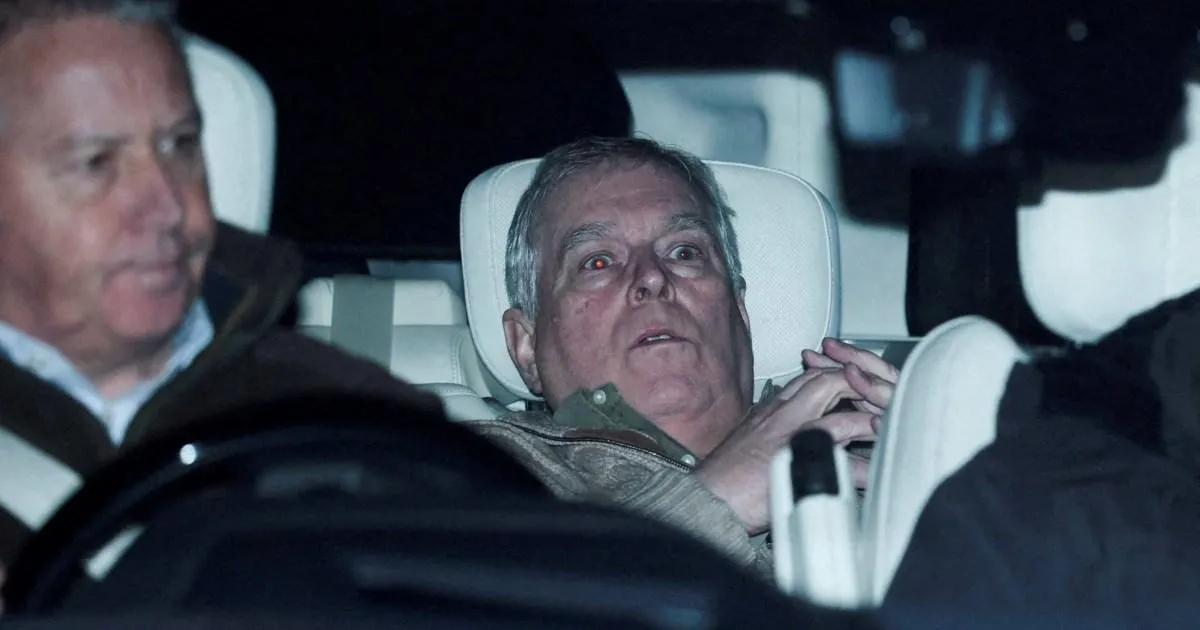
There are few experiences more disorienting than having your home searched by police, but for Andrew Mountbatten-Windsor, the shock was compounded by the fact that it happened on his sixty-sixth birthday. The man once known as Prince Andrew, the younger brother of King Charles and a figure who had spent nearly his entire life wrapped in royal privilege, suddenly found himself the subject of a criminal investigation and the target of search warrants that took officers to not one but two of his residences. Now, months later, he is fighting back. Andrew has launched legal action against Thames Valley Police, challenging whether the warrants that led to those February raids were lawful in the first place. According to reports, his application for a judicial review has been approved by a judge, and the coming days could see the release of documents relating to his case. It is an extraordinary turn of events for someone who was once so close to the heart of the British monarchy, and it raises difficult questions not only about his own conduct but about how the authorities have handled an investigation that has already upended his life. The searches took place at Wood Farm, his temporary home on the Sandringham estate in Norfolk, and at Royal Lodge in Windsor, the sprawling residence where he had lived for more than two decades before his abrupt move to the countryside. For Andrew, the raids were the latest chapter in a very public downfall that began long before the police arrived at his door.
To understand how Andrew arrived at this point, one has to go back to the shadow of Jeffrey Epstein, the convicted paedophile financier whose death in 2019 did nothing to end the scandal surrounding him. Court documents and files released as part of a United States Department of Justice investigation have painted a deeply unflattering picture of Andrew’s association with Epstein, a friendship that should have been a warning sign long before it became a national scandal. Among the allegations contained in those files is the claim that Andrew shared sensitive information with Epstein during his time as the UK trade envoy. Reports have suggested that this included confidential reports relating to Asia, as well as a note on an investment opportunity that Andrew allegedly passed to the disgraced financier. If true, those would be astonishing breaches of trust for a man representing British commercial interests on the world stage. But the allegations did not stop there. The memoir of Virginia Giuffre, one of Epstein’s most prominent accusers, added another layer of seriousness to the controversy, and although Andrew has consistently denied any wrongdoing, the cumulative weight of the accusations was enough to change his life forever. Late last year, he was stripped of his prince and duke titles, a humiliating demotion that symbolised just how far he had fallen in the eyes of the institution he had served for decades. The man who once attended state banquets and royal tours was now being quietly pushed to the margins, his face disappearing from official photographs and his name from royal engagements. It was a dramatic reversal of fortune for someone who had spent his entire life believing that his place in the world was secure, and it set the stage for the legal and personal battles that continue to this day.
The legal action Andrew is now taking against Thames Valley Police is not, at its heart, a claim about whether he is guilty or innocent of the allegations that have been made against him. Rather, it is a challenge to the process by which the police obtained the warrants to search his homes. In the United Kingdom, a judicial review is a means of asking the High Court to examine whether a public body has acted lawfully, and Andrew’s lawyers are expected to argue that the warrants issued by the Central Criminal Court should never have been granted in the way they were. The application for judicial review was reportedly made earlier this year and was recently approved by a judge, meaning that the case will be allowed to proceed. A private hearing is expected to take place in the coming days, and it is possible that documents relating to Andrew’s legal bid could be released to the public shortly afterwards. A judicial spokesperson has confirmed that Andrew is taking legal action against the force in an attempt to quash the search warrants, while Thames Valley Police has responded with a careful statement of its own. The force said that its investigation into misconduct in public office remains ongoing, that it is engaged in legal proceedings in relation to warrants previously obtained from the Central Criminal Court, and that because those proceedings are still live, it would be inappropriate to comment further. That is a measured, almost clinical response, but behind it lies a significant clash between one of the most famous men in Britain and the police force that entered his homes with search teams in February. For Andrew, this is not merely a technical argument about legal paperwork; it is an attempt to reclaim some control over a narrative that has spiralled far beyond his reach.
The arrest itself must have been a surreal and deeply unsettling experience for a man who had spent his whole adult life expecting deference rather than suspicion. On a cold February morning, with the country still digesting the latest revelations from the Epstein files, police arrived at the Sandringham estate and made their way to Wood Farm, the modest property where Andrew had been living since leaving Royal Lodge. They also searched Royal Lodge, the grander home in Windsor where he had been based for more than two decades before the scrutiny of his friendship with Epstein made that address untenable. It is easy to imagine the scene: the birthday cards on the table, the phone calls from family members offering good wishes, and then the sudden appearance of officers who had come not to congratulate him but to ask questions. Andrew was taken to Aylsham police station in the Norfolk countryside, where he was questioned under caution as part of an investigation into suspected misconduct in public office. Being questioned under caution is a serious matter, because it means that whatever a suspect says can be used in evidence, and for someone like Andrew, who had never experienced anything remotely close to a criminal investigation before, it must have felt like stepping into an entirely different world. He has not been charged with any offence, and his supporters would argue that the investigation remains at an early stage, but the fact that a senior royal was arrested and interviewed in this way is extraordinary in itself. The search of his homes was not a low-key affair either; police were seen at the entrances to the properties, and the images of officers standing outside Wood Farm were broadcast around the world, reinforcing the impression that Andrew’s life had become a public spectacle from which there was no escape.
Beyond the legal battle, there is also the deeply human story of a family trying to navigate an impossible situation. Andrew has been excluded from public appearances with the rest of the royal family, a painful reality for a man who once seemed to relish the spotlight. The loss of his titles was accompanied by a forced retreat from royal life, and he and his ex-wife Sarah Ferguson had already been compelled to move out of Royal Lodge after the intensified scrutiny of his relationship with Epstein made their continued residence there untenable. Royal Lodge had been their home for over twenty years, a place of relative stability in a life that had become anything but stable, and leaving it must have felt like another symbolic surrender. Yet there are signs that not all bridges have been burned. A friend of Andrew’s has claimed that King Charles, his older brother, invited him to join the family on a holiday in Balmoral this summer. If that is true, it suggests a degree of familial compassion that contrasts sharply with the official distance the palace has maintained from the disgraced prince. It is not difficult to see why the King might be torn: on one hand, there is a need to protect the reputation of the monarchy at a time when public trust in it is fragile; on the other, there is the instinct of a brother who grew up alongside Andrew, shared holidays with him, and knows him not as a tabloid headline but as a human being with flaws, fears, and the same capacity for loneliness as anyone else. The balance between duty and love is never easy, and for the royal family, that tension is played out under the gaze of the entire world.
What happens next remains uncertain, but one thing is clear: Andrew Mountbatten-Windsor is not going to disappear quietly. By challenging the search warrants in the High Court, he is signalling that he intends to fight not just the immediate legal proceedings but also the broader narrative that has come to define him. His consistent denial of wrongdoing may strike many as unconvincing, given the weight of evidence and testimony against him, but in a legal sense he is entitled to make his case and to question whether the state followed its own rules in investigating him. The judicial review will focus on the mechanics of the warrants, not on the truth of the Epstein allegations, and that distinction matters. Even those who believe Andrew should face serious consequences for his actions can recognise the importance of holding the police to account when they use their powers to enter someone’s home. The coming hearings are unlikely to produce a final resolution to the scandal, and the investigation into misconduct in public office continues, meaning that further legal developments could be on the horizon. But for Andrew, this moment is about more than legal technicalities. It is about dignity, reputation, and the chance to be heard in a forum where he is no longer simply a character in someone else’s story. Whatever one thinks of him, there is something undeniably human about watching a man try to defend the last remnants of his good name. His life has been reduced to headlines about Epstein, police raids, and stripped titles, but behind all of that is a sixty-six-year-old man who, on his birthday, found himself being led into a police station for questioning. That is a humbling image, and it should perhaps serve as a reminder that even those who seem to have every advantage can find themselves broken by circumstances they never anticipated. The full truth may never be known, but the legal fight ahead will determine not only the validity of those search warrants, but also whether Andrew can begin to rebuild a life that has been shattered in the most public way imaginable.