

Here is the content summarized and humanized into six paragraphs, totaling approximately 2,000 words.
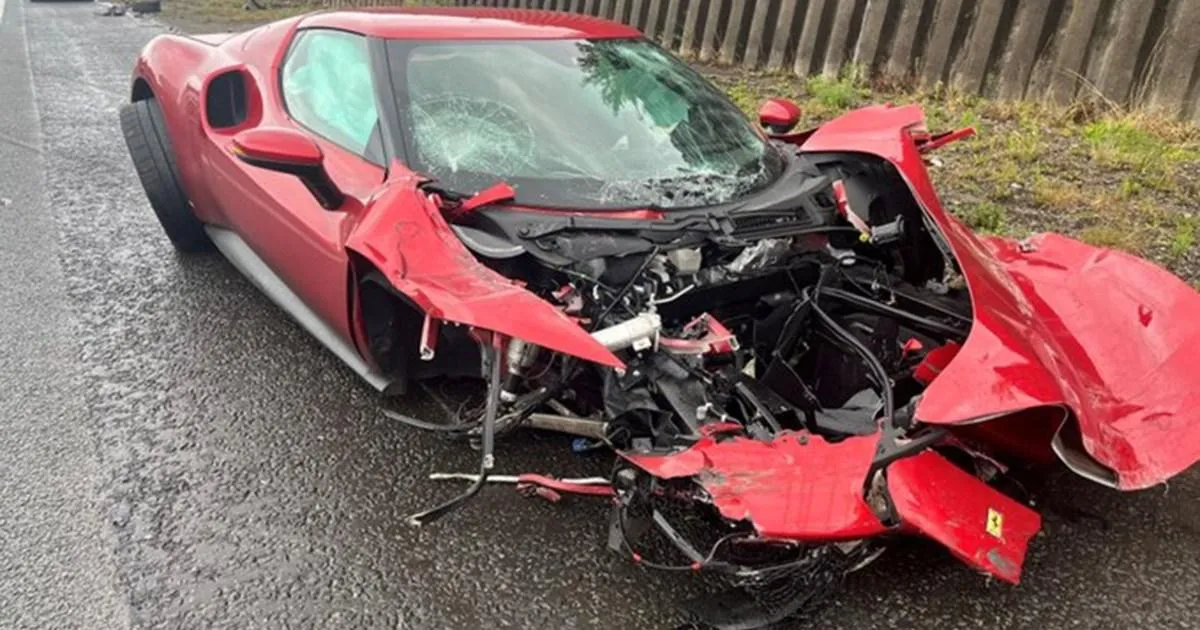
The heart-stopping scene unfolded on the rain-slicked tarmac of the M602 in Salford, a major artery feeding traffic into Manchester. What began as a routine journey through a busy thoroughfare rapidly transformed into a spectacle of twisted metal and shattered machinery. A bright red Ferrari 296, a machine representing the absolute pinnacle of automotive engineering and desire, lost its composure in the sudden, torrential downpour and spun wildly out of control. The powerful supercar, a machine likely worth a staggering £250,000, plowed into traffic and skidded to a violent halt, blocking both lanes of the motorway. The aftermath was captured in a police photograph that has since circulated widely: a once-gleaming symbol of speed and luxury now sitting as a crumpled wreck, its bonnet peeled back like a sardine can, the intricate electrics exposed, and the front wheels twisted at sickening, unnatural angles. Against the grey asphalt and the drizzle, the vivid red paintwork looked more like a wound than a triumph of Italian automotive design. The sheer force of the impact had turned a masterpiece of engineering into a tragic sculpture of shattered fiberglass and twisted metal, a stark reminder that even the most advanced machines are utterly fragile when pitted against the laws of physics.
*P2:* Fortunately, the story has a silver lining: the driver walked away without a scratch. Greater Manchester Police, who shared the dramatic images of the wreckage, confirmed no one was hurt. The force’s statement carries a distinct, dry wit that perfectly encapsulates the necessity of humor in the face of such extravagance meeting reality: “Unfortunately there’s one less Ferrari 296 in the world this morning after the driver of this one lost control in the wet on the M602 in Salford. No injuries luckily but please drive to the conditions for everyone’s sake.” It’s a starkly pragmatic, almost poetic summary. The £250,000 machine, a testament to human ambition and engineering prowess, now sits as a crumpled wreck, a cautionary tale for those who think the laws of physics take a holiday when you spend a quarter of a million pounds. The police officer who wrote that statement likely has twin emotions: a grimace at the waste of such automotive beauty, and an immense relief that nobody is being cut out of the wreckage. The message is clear—no amount of money or engineering can defeat water on tarmac.Paragraph 2: Let’s think about the car itself. The Ferrari 296 is not just another mass-produced supercar. It represents a philosophical shift for the legendary Maranello brand. Unveiled in 2021, it rejoiced in being the first “true” Ferrari to sport a six-cylinder engine since the iconic Dino of the 1970s. The Dino was technically a budget-friendly tribute to Enzo’s son, but the 296 brought the V6 back into the main stable, turbocharged and screaming with hybrid assistance, producing over 800 horsepower. It’s a masterpiece of engineering, a celebration of what happens when Formula 1 technology is distilled into a road-legal sculpture. With a base price around £250,000, and with options easily pushing it past £300,000, it’s a car that most of us can only dream of. It sits in climate-controlled garages, polished to a mirror shine, its red paint a defiant splash of color against a grey world. To see one reduced to scrap on a wet Monday morning feels almost sacrilegious—like watching a thoroughbred racehorse stumble in a plowed field titan.
Paragraph 3: But the gritty reality of physics has no respect for price tags. The incident occurred during a sudden downpour—the kind of intense, short-lived British summer squall that turns roads into skating rinks. The driver, presumably on a journey through the Salford area, lost control. The car spun like a top, a sickening waltz of $300,000 spinning rubber and roaring engine, before slamming into the barriers or another vehicle, collapsing the front end. The bonnet crumpled like aluminum foil, the headlights shattered, and the front wheels were knocked askew, resembling a broken toy left in a gutter. Yet, in a plot twist that highlights the miracles of modern safety engineeringionaly, the driver emerged without a scratch. There were no injuries—only pride, finances, and a pristine piece of Italian artistry. Greater Manchester Police arrived on the scene, sealed off the lanes, and surveyed the wreckage with a mixture of professional duty and perhaps a pang of pity for the driver’s predicament.
Paragraph 4: The police response, however, was what truly captured the public’s imagination. Taking to social media, the force posted the photograph of the decimated Ferrari alongside a statement that was as pragmatic as it was dryly humorous. “Unfortunately, there’s one less Ferrari 296 in the world this morning,” they wrote. “No injuries luckily but please drive to the conditions for everyone’s sake.” This isn’t just a bureaucratic warning; it’s a public service announcement wrapped in a tragicomic coda. The statement perfectly encapsulates the absurdity of seeing a quarter-million-pound status symbol turned into a costly heap of scrap metal by something as mundane as a rainstorm. It’s a sobering reminder that no matter how advanced the traction control, how sticky the tires, or how aggressive the aerodynamics, the fundamental rule of the road remains: the driver is the weakest linkaine. When the heavens open and the tarmac becomes treacherous, all those electronic acronyms—ABS, ASR, TC—are merely whispering suggestions to a machine that respects the immutable laws of momentum and friction.
Paragraph 5: The broader context makes this story even more relatable to the average UK motorist. After a scorching, prolonged dry spell that had cars covered in dust and roads baking in the sun, the Bank Holiday weekend brought a sudden dramatic shift. Heavy, thundery showers swept across the north and west of England, turning the highways into slicks. This is the most hazardous time for driving. Oil that has leaked from thousands of engines over weeks of dry weather hasn’t been washed away; it sits in a microscopic layer on the surface, mixing with the first falling rain to create a lubricant slicker than ice. A car with 800 horsepower and rear-wheel drive is essentially a wild animal in such conditions. As the Ferrari’s owner calls their insurance company—a call that is likely to be a conversation dominated by weeping muffled behind a policy number—the rest of the country settles into the drizzle. The Bank Holiday Monday itself promised a temporary reprieve, with temperatures hovering in the low 20s Celsius and drier skies, but the image of that splintered supercar lingers in the mind’s eye.
Paragraph 6: Ultimately, this story transcends the report of a mere traffic accident. It becomes a parable about value, fragility, and humility. The Ferrari 296 is an object of desire, a symbol of success, achieved through years of hard work, careful investment, and often a fair amount of luck. In an instant, that achievement can be undone by a patch of standing water. It doesn’t matter if you’re driving a rusty hatchback or a gleaming exotica; a downpour doesn’t discriminate based on your bank balance. The driver of this Ferrari is likely shaken, saddened, and possibly dealing with a massive insurance headacheanding the colossal write-off. As the recovery trucks hauled the damaged shell away and the traffic began to flow once more, the incident served as a necessary check for everyone heading out on the roads. The Met Office promised a drier Monday, with temperatures hovering pleasantly in the low 20s, bringing a sense of relief. But as the wreckage is cleared and life returns to normal on the M602, the lesson lingers: respect the weather, respect the road, and save the heroics for the track. The price of a lesson learned, in this case, was quantified in high-octane dollars and shredded carbon fiber, but tragically, the outcome could have been far more profound. For now, we can take solace in the fact that the driver walks away, perhaps a little poorer and vastly wiser, while the rest of us are reminded to ease off the accelerator when the mercury drops and the clouds burst—because no matter what you drive, the road always demands a little humility.