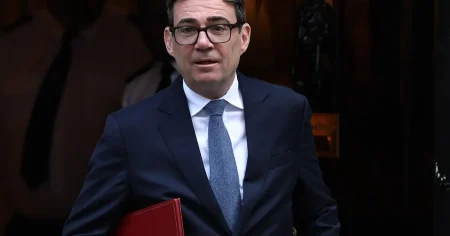



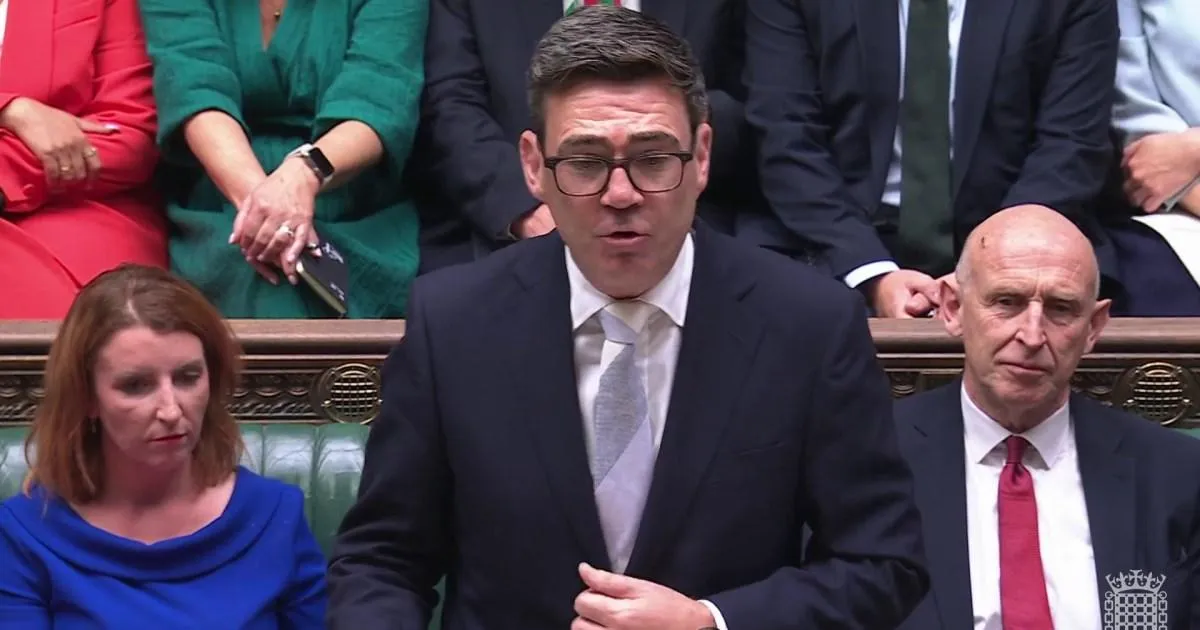
It feels strange to begin a piece about Andy Burnham’s first speech to Parliament as Prime Minister by telling you to skip the speech itself, but that is exactly what I am going to do. There is something almost uncomfortable about watching a man like Burnham stand at the despatch box in a stiff suit, reading carefully from a prepared script, pausing for effect, and trying to sound like the kind of leader who has been doing this for years. He is not that kind of leader, and it shows. I do not think Burnham would appreciate the comparison, but watching him today reminded me of the way Donald Trump looks when he is reciting lines from an autocue: restless, impatient, almost annoyed that he has to perform this particular ritual before he can get to the real work. From the press gallery this afternoon, I could see it in his shoulders and in the way his eyes kept flicking toward the backbenches. He wanted to tear off the tie. He wanted to step out from behind the desk, walk to the centre of the chamber, and just talk to people the way he talks to crowds in Manchester or on a picket line. The speech itself, which he introduced with the grand and slightly self-conscious phrase “a statement on the direction in which I will lead our country,” was not bad. It hit all the notes you would expect from a Burnham premiership: devolution, public ownership, reindustrialisation, the idea that the country has been hollowed out for too long and needs to be rebuilt from the ground up. But if you are looking for a real sense of who this man is and how he intends to govern, I would honestly suggest you skip the formal address and go straight to what happened afterwards. That is where the real story begins.
And what happened afterwards was Kemi Badenoch. This was her first real chance to stand up and ask the new Prime Minister a question, or rather a series of questions, about his statement. She was quick to point out that it had been six weeks since Burnham became leader of the country, and in all that time she had not had a single opportunity to challenge him directly. She was not about to waste this one. Badenoch took exactly the same approach she used against Sir Keir Starmer: acerbic, swaggering, leaning into her role as the pantomime villain that Labour MPs love to boo. She mocked his record, questioned his mandate, and tried to paint him as a man who would say anything to get into power. The Labour benches responded with the usual jeers and theatrical outrage, and Badenoch seemed to feed off that energy. She is one of those politicians who performs better when the room is hostile, and today the room was very hostile indeed. But the most interesting thing was not what Badenoch said. It was what Burnham did while she was speaking. He did not sit there with a carefully rehearsed smile, waiting for his turn. He did not stare straight ahead with the frozen, slightly detached expression that we all became so familiar with under Starmer. Instead, he scribbled notes on the back of the pages containing his speech. He wrote quickly, furiously, occasionally looking up at Badenoch with something that looked almost like amusement before returning to his scribbling. And when he jumped up to deliver his rebuttal, the contrast with his predecessor could not have been starker. This was not a man reading from a soundboard. This was a man who had been listening, who had been provoked, and who was genuinely enjoying the fight.
To understand why that matters, you have to remember what we have been through for the past few years. Keir Starmer was never somebody who revelled in the theatre of the House of Commons. He treated it as a necessary chore, a box to be ticked, a place where he had to show up and perform a certain role because the constitution demanded it. Perhaps that is one of the reasons he decided to walk away rather than face another three years on the backbenches. He had done his time. He had won the election. He had restored Labour to power. But the daily cut and thrust of parliamentary debate seemed to drain him rather than energise him. Whenever he had to respond to the opposition, he would reach for the same stock phrases, the same reliable soundboard: “14 years of Conservative government,” “the £22 billion black hole,” “the Liz Truss mini-budget.” That last one was a particular favourite, because it always got a loud response from the Labour MPs behind him. It was a safe bet, a guaranteed applause line, a way of changing the subject without actually engaging with the argument. And it worked, in a narrow political sense. But it also made Starmer look like a man who was going through the motions, a manager rather than a leader, someone who had won power but did not seem to be having any fun wielding it. So it was a genuine surprise today when Burnham’s first mention of Liz Truss was not an attack but a compliment. He praised her work on Ukraine, of all things, and made it clear that he was willing to work with politicians of any party if they were genuinely interested in finding solutions. He mentioned twice, almost as if he wanted to make sure everyone had heard it, his ambition to work across the House. This was a deliberate signal, a way of saying that the old tribal battles were not going to define his premiership.
But at the same time, Burnham made it very clear that he was not interested in a bland, conflict-free politics where everyone agrees to disagree and nothing ever changes. He acknowledged that there were deep disagreements between the parties, and he seemed to relish the idea of arguing about them. There is an old expression, which he quoted with obvious affection: his mother never bred a jibber. In other words, he was not raised to back down from a fight. That is another point of contrast with Starmer, who never seemed particularly interested in political debate as an intellectual exercise. Starmer wanted to win, but he did not seem to enjoy the battle. Burnham is different. When the Tory benches jeered at him for claiming that the UK is still battling the legacy of the Thatcher government in the 1980s, he did not retreat or soften his language. He turned to them and said, almost cheerfully, “Well, let’s have this argument in this House.” It was a small moment, but it said a lot. Here was a Prime Minister who was not afraid of confrontation, who did not see disagreement as a threat, and who seemed to believe that the best way to convince people is to engage with them directly rather than to talk past them. And there was a third difference with the previous PM, one that was harder to define but impossible to miss: Burnham genuinely seemed to be having a good time. He smiled. He cracked jokes. He leaned on the despatch box like a man who was exactly where he wanted to be. There were a few light-hearted quips among the scribbles on his paper, including, it must be said, a second mention of Liz Truss. After Badenoch raised the length of his term in office so far, Burnham told MPs: “The honourable lady said the fact that I have been in my position for 43 days. Well, can I turn that around and say, in six days this government will have outlived the Truss government and we’ll be here for a lot, lot longer.” The chamber erupted. Even some Tories could not help but laugh. It was a good line, delivered with perfect timing, and it captured something essential about the new Prime Minister.
The question, of course, is whether this sharp change in approach will be enough to win around the country by the time we next go to the polls. Burnham has been in office for only a few weeks, and there is a sense of excitement, a feeling that something has shifted. But there is also a sense of uncertainty. The country is still struggling with the cost of living, with crumbling public services, with a housing crisis, with the long-term damage of austerity. Burnham’s speech was full of big ideas and bold promises, but the hard part is always delivery. He talked about devolution, about giving power back to communities, about rebuilding the industrial heartlands that have been left behind for so long. These are themes he has been developing for years, and they clearly come from a genuine place. He is not a politician who has to fake his enthusiasm for the north of England or for the working-class towns that used to be the backbone of the Labour movement. He grew up in those communities. He understands them. He speaks their language. But the danger is that the same qualities that make him so appealing as a campaigner might not translate into the grind of government. The House of Commons is a strange place. It rewards discipline and caution as much as it rewards passion and authenticity. Burnham’s willingness to argue, to engage, to be spontaneous, is refreshing, but it also carries risks. He could say something he regrets. He could be caught off guard. He could find that the very qualities that made him a breath of fresh air start to look like recklessness if things go wrong.
And yet, watching him today, I could not help but feel that this is exactly what the country has been missing. For too long, our politics has been dominated by carefully managed performances, by politicians who are so afraid of making a mistake that they never say anything interesting, by a culture of caution that has drained the life out of public life. Burnham is not like that. He is messy, human, and unapologetically himself. He makes jokes about Liz Truss. He scribbles notes on the back of his speech. He tells the opposition to bring on the argument. He looks like a man who is enjoying the job, which is a rare and precious thing in modern politics. Whether that will be enough to solve the country’s problems is another matter entirely. The challenges facing the new government are enormous, and no amount of charisma or good humour can fix a broken NHS or a stagnant economy on its own. But there is something to be said for having a leader who actually seems to want to be there, who does not treat every day in office as a burden to be endured, and who understands that politics is not just about policy but about people. Burnham has that understanding. He has always had it. And today, in his first real test as Prime Minister, he showed that he is not going to let the institution change him. He is going to try to change the institution instead. Whether he succeeds is anyone’s guess, but for the first time in a long time, it feels like the fight is worth watching.