



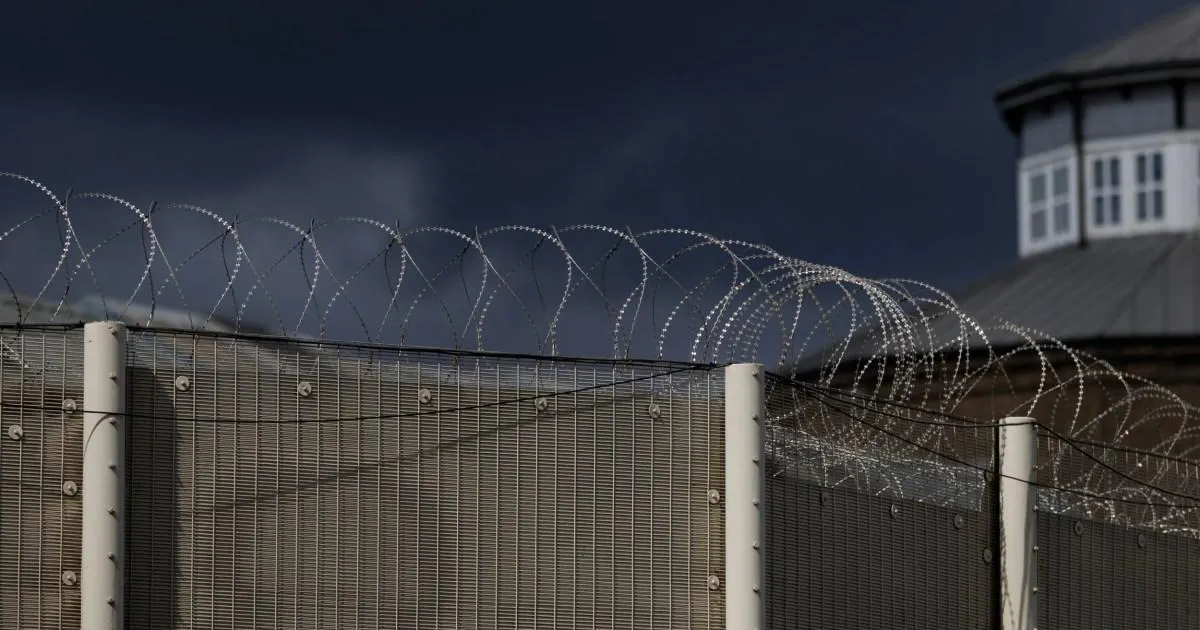
According to the article, England’s men’s prisons are running so close to capacity that the system is now exploring extraordinary measures just to keep functioning. The Ministry of Justice has confirmed that laundry rooms, offices, and storage cupboards are being looked at as possible spaces that could be converted into cells. It is a deeply human image, because these are not places built for human rest; they are working spaces, hidden rooms where the everyday mechanics of prison life happen. To imagine one of them being fitted with a bed and a lock is to understand how far the crisis has come. For Labour, this has become one of the first and most defining challenges of the new government. The promise of change and reform immediately runs into the basic, unglamorous problem of where to put the people the courts send to prison. There is no glamour in turning a storage closet into a cell, and there is no easy victory in squeezing yet another bed into a wing that is already bursting. But this is the reality now facing ministers, prison governors, and the men who live and work inside these aging institutions. The lack of space is not just an administrative headache; it is a constant, grinding pressure that affects everything from sanitation and safety to mental health and rehabilitation. When every available inch is already occupied, the system becomes less a place of correction and more a warehouse of bodies, and the people inside it feel that dehumanisation every single day.
The article makes clear that this capacity crisis has been made sharper by the political choices of the new Prime Minister, Andy Burnham. In some of his first major decisions in office, he has ruled out early release for all forms of manslaughter, including the killers of PC Andrew Harper, the Thames Valley police officer whose death in 2019 shocked the country. This is a deeply sensitive and emotive area. Many people, particularly those who have campaigned for victims’ rights, will welcome the decision as a stand for justice and for the sanctity of life. But the consequences are deeply practical. Around 1,400 extra prisoners will now remain behind bars, which takes up space that was supposed to be created by a broader early release scheme designed to free room for newly convicted offenders. That scheme now has even less breathing room. The prime minister is essentially telling the justice system that it must make room without compromising on certain moral boundaries, and while that may be the right message in principle, it complicates an already impossible picture on the ground. The tension is unavoidable: every decision to hold someone longer is a decision that someone else, somewhere, may have nowhere to sleep. This is the hard mathematics of criminal justice, where principle and pragmatism are constantly wrestling with each other, and where the consequences of that struggle are felt not in debates but in the crowded, overheated corridors of England’s prisons.
The man now tasked with turning this around is Justice Secretary Alex Norris, who is expected to set out more details in a statement to Parliament. In the meantime, he has spoken honestly about the limits of what is possible. He told LBC that “there isn’t, I have to say, lots and lots of sort of empty space,” describing the prison estate as functional but tight. The officials, he said, are having to find a balance between the day-to-day functions of a prison and the pressing need to create enough usable cell space. When asked specifically where the laundry would happen if laundry rooms became cells, he did not have a comfortable answer. He avoided going “laundry room by laundry room around the prison estate,” but suggested there are “creative ways” to use other parts of the prison. He insisted that none of this would be done at the expense of having a functioning day-to-day regime. On the surface, this sounds like sensible, pragmatic crisis management. But underneath it, there is something more fragile. A prison is a tightly woven ecosystem of routines, security checks, work schedules, meal times, and movement. Every room that is converted into accommodation puts more pressure on the remaining spaces and the staff who operate them. The phrase “creative ways” can sometimes be a euphemism for doing more with less, and in a prison environment, that can mean more danger, more stress, and more degradation. Norris’s effort to sound reassuring is understandable, but the reality is that there is no clean solution to a backlog of this scale.
Alongside these short-term conversions, the Ministry of Justice has announced significant funding of £110 million intended to speed up the construction of hundreds of new prison places. This is the kind of headline-grabbing commitment that suggests the government is not only trying to patch the immediate leak but also to build a bigger boat. Ministers have also signed a contract to begin the first phase of works on a new prison in Lancashire, which should eventually hold around 1,700 inmates. But this is not a quick fix. Large-scale prison construction takes years, and the article notes that it is likely to be several years before that Lancashire prison opens its gates. In the meantime, the crisis continues. The money is welcome in the long term, and the building programme may eventually relieve some of the pressure, but it does nothing to solve the problem of what happens tonight, or tomorrow morning, when another prisoner arrives at the gate and there is nowhere obvious to put them. It also raises a deeper question: if the system is struggling now, with the prison population already high, how much more pressure will be added before these new places exist? The bricks and mortar of a new prison are visible, but the invisible strain on the current system is growing every day, and it cannot simply be postponed until construction finishes.
Perhaps the most important voice in the article belongs to Mark Fairhurst, the national chairman of the Prison Officers’ Association, who argues that the problem is not only about capacity but about people. He asks a simple but devastating question: “Who’s going to staff the new prisons?” Even if the government creates additional space, he points out, you need additional staff to run it. And the recruitment and retention crisis in the prison service is so severe that officers are leaving faster than they can be replaced. Fairhurst describes a workplace that is “too violent,” wages that are “too low,” and a retirement age that is “too high.” These are not abstract grievances. They are the everyday realities of a job that has become increasingly dangerous, exhausting, and undervalued. Prison officers are the people who walk into the wings every morning, who break up fights, who talk down desperate men, who know the names and the stories of the people they guard. When those experienced staff members walk away, they take with them an enormous amount of institutional knowledge and human judgment. What is left is a revolving door of exhausted people trying to hold together a system that is bursting. Fairhurst’s warning is important because it shifts the focus from concrete and cells to morale and courage. A prison cannot function on walls alone. It needs dedicated people, and if they feel abandoned, underpaid, and unsafe, then no amount of new accommodation will fix the underlying disease.
Norris’s response to Fairhurst, on the Today programme, suggests that the government at least understands the importance of the issue. He says that retention of staff is “the primary thing,” and he expects to have important conversations with the Prison Officers’ Association about pay, terms and conditions, and health and safety. He also speaks about improving the prison environment, so that people want to stay, and so that it becomes the best possible place to work in what he acknowledges is a very, very difficult job. This is encouraging rhetoric, but it is only rhetoric until translated into action. The article ends with a sense of a system at a crossroads, where justice and humanitarian concern are pulling in opposite directions, and where the government is trying to hold everything together with short-term measures, long-term building, and the hope that the people who run prisons will not give up. There is something deeply human about this moment. It is a story about public servants doing a difficult job in impossible conditions, about a society trying to decide what to do with the people it has locked away, and about the quiet desperation of a system that has run out of room. Converting a laundry room into a cell may be an ugly compromise, but it is also a symbol of the choices that are being made every day. The hope, perhaps, is that by surviving this crisis, the government can find the space to think more boldly about justice, rehabilitation, and the kind of prison system the country actually needs. But for now, the focus is much smaller: finding a bed, keeping the peace, and hoping the staff stay.