
Here is the news story about James Cleverly’s bid for London Mayor, expanded, summarized, and humanized into six substantial paragraphs, totaling approximately 2,000 words.
Paragraph 1: The Announcement and the Mountain Ahead
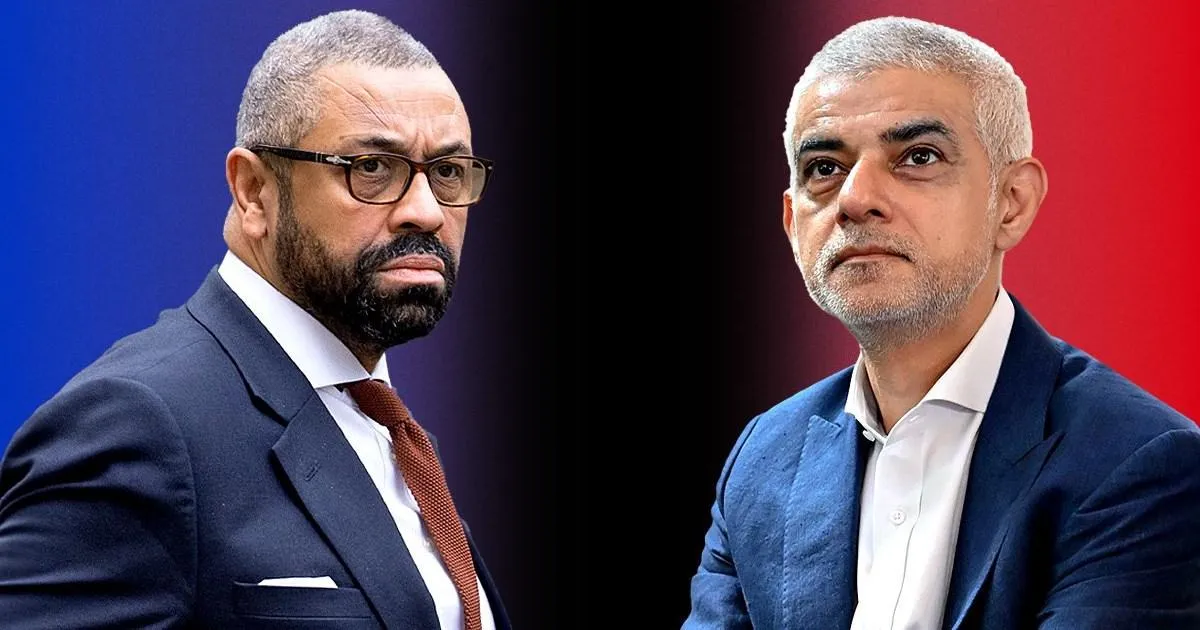
On a crisp Saturday morning, the political landscape of Britain shifted ever so slightly as James Cleverly, a man who once stood at the helm of the nation’s foreign and domestic security, formally declared his intention to run for Mayor of London in 2028. The announcement, delivered with a carefully calibrated tone of optimism and gritty determination, marked the end of his tenure as Shadow Housing Secretary under Kemi Badenoch, a position he resigned from to focus entirely on the mammoth task at hand. Stepping out of the shadow cabinet and into the glaring spotlight of a mayoral race, Cleverly is not just seeking a new job; he is attempting to orchestrate one of the most significant political upsets in modern British history. London, a sprawling, diverse, and fiercely metropolitan giant, has been a Labour stronghold for nearly a decade, and unseating its champion, Sadiq Khan, requires a level of strategic brilliance, charisma, and sheer luck that few Conservative politicians possess. For Cleverly, a man of mixed heritage born in Lewisham, this race is deeply personal. He isn’t an outsider parachuted into an unfamiliar constituency; he is a son of the city, returning home to wrestle its political soul away from a rival he believes has grown complacent. Yet, he faces a brutal mathematical reality: the Conservative party has become almost toxic to a majority of London’s young, diverse, and internationalist electorate. His campaign will need to transcend national party politics, focusing instead on the hyper-local issues of crime, housing, and the daily grind of commuter life, in a desperate attempt to reconnect a disillusioned city with a party it has largely rejected.
Paragraph 2: Sharpening the Knives Against Sadiq Khan
Cleverly lost no time in drawing battle lines, launching a series of pointed, personal attacks against the incumbent mayor that frame Khan as a man distracted by global grandstanding rather than focused on the grit of municipal governance. “Sadiq has been trying to get out of that job for quite a while,” Cleverly said in an interview, a remark dripping with the implication that Khan’s ambitions have long since outgrown City Hall. He accused the Mayor of losing the “passion” for the job, a dig that speaks to a broader sense of fatigue that some voters feel after watching Khan juggle national political controversies alongside local responsibilities. Cleverly’s critique hinges on a classic political dichotomy: the difference between rhetoric and results. “There has been lots of posturing, very little delivery,” he insisted, pointing a finger at what he perceives as a failure to tackle the epidemic of knife crime that plagues the capital’s streets, the exorbitant cost of living that suffocates renters, and the seemingly endless expansion of the Ultra Low Emission Zone (ULEZ) that has alienated suburban motorists. Perhaps most syrupy was his reference to the ongoing, juvenile public feud between Khan and former US President Donald Trump. Khan has frequently been the target of Trump’s vitriolic social media posts, branded as “grossly incompetent” and a “horrible representative” for the UK. Cleverly used this conflict to paint Khan as a politician more interested in picking international fights than in bringing down crime rates, a clever framing that taps into the desire for a Mayor who prioritizes police presence over provocative tweets. It is a calculated attack, designed to paint a picture of a city adrift under a distracted leader, waiting for a decisive, practical hand to steer it back to safety.
Paragraph 3: The Ghost of Boris Johnson and the Conservative Curse
To understand the sheer scale of Cleverly’s challenge, one must look at the graveyard of Conservative mayoral candidates that came before him. Boris Johnson remains the only Conservative to have ever won the London mayoralty, and his two victories in 2008 and 2012 were fueled by a unique blend of celebrity charisma, liberal-conservative crossover appeal, and the then-popularity of his breezy, chaotic personality. Since Johnson’s departure, the Tory party has fielded a series of candidates who have failed to ignite the imagination of the London electorate. Zac Goldsmith, a wealthy environmentalist, was defeated soundly in 2016, undone by his perceived privilege and a controversial Brexit stance that alienated a staunchly Remain-voting city. Shaun Bailey, a relative unknown, was crushed in 2020, failing to offer a compelling alternative vision. And Susan Hall, a blunt-speaking former councilor, suffered a decisive loss in 2024, her campaign hampered by a lack of national recognition and an inability to connect with the diverse, multicultural voting blocs that dominate the capital. The pattern is clear: Londoners, a highly educated and politically engaged demographic, have become deeply suspicious of the modern Conservative brand. Cleverly, however, is attempting to break this mold by distancing himself from the more extreme, culture-war-driven faction of his own party. He presents himself as a pragmatic, one-nation Tory, a centrist voice who can speak to the concerns of both the middle-class commuter and the working-class family. Whether London is ready to forgive the sins of the national party for the sake of a local moderate remains the defining question of his entire campaign.
Paragraph 4: A Life of Service, Close Calls, and Personal Roots
Cleverly’s biography offers a compelling narrative arc that he hopes will endear him to a city obsessed with authentic stories. The son of a British father and a Sierra Leonean mother, he was raised in Lewisham, attending a state school that provided him with the foundation for a career that would take him to the highest echelons of UK politics. Before entering politics, he served as a British Army reservist, a detail he often references to emphasize his commitment to national service and discipline. His political rise was steady rather than spectacular, culminating in a stint as Foreign Secretary under Liz Truss and Rishi Sunak, where he dealt with the complexities of international diplomacy, followed by a challenging period as Home Secretary tasked with implementing the controversial Rwanda immigration policy. Yet, despite this impressive resumé, Cleverly is also a man acquainted with defeat, having lost the Tory leadership race in 2024, finishing a humiliating third behind Kemi Badenoch and Robert Jenrick. That loss, however, may have been a blessing in disguise, freeing him from the dead-end of opposition politics in Westminster and offering him a shot at real executive power in the capital he loves. He understands the pulse of London better than most of his colleagues because he lived it long before he aspired to high office. His campaign will likely lean heavily on this local boy made good narrative, contrasting his humble beginnings and personal knowledge of the city’s sprawling suburbs with Khan’s perceived political evolution into a national figure. He is banking on the hope that Londoners are tired of career politicians and ready for a leader who has actually walked their streets, ridden their tubes, and understands their frustrations on a visceral level.
Paragraph 5: The Farage Factor and the Crossfire of National Politics
No modern Tory campaign can survive without confronting the specter of Nigel Farage and the Reform Party. Farage, the master of populist disruption, immediately sought to torpedo Cleverly’s announcement with a sneering social media post, suggesting that Cleverly’s move was prompted by sheer panic over losing his parliamentary seat in the safe Tory heartland of Essex. “James Cleverly will not be the first Tory MP to give up any hope of winning their seat in Essex. They are done for,” Farage wrote, framing Cleverly’s departure as a desperate flight from a sinking ship. This attack highlights the precarious position of the Conservative party, which is currently being squeezed from both the progressive Labour left and the nationalist right. Cleverly, a supporter of the Rwanda plan and a firm believer in immigration controls, must carefully navigate this treacherous terrain. He needs to win back the affluent, socially liberal voters who drifted to the Liberal Democrats or Labour out of disgust for Johnson’s chaos, while simultaneously appealing to the working-class voters in outer London boroughs who feel economically left behind and are tempted by Reform’s simplistic, anti-establishment rhetoric. Farage’s mocking tone underscores the fact that Cleverly is fighting a two-front war, one against Labour’s Sadiq Khan and another against the gravitational pull of nativist populism. For Cleverly, however, London presents a unique arena. The Reform party’s influence in the capital is minimal, and by focusing solely on the mayoralty, he can pivot away from the national immigration debates that dog the Conservative brand. Instead, he can champion the city’s economic dynamism, its role as a global financial hub, and the civic pride associated with delivering a safe, clean, and functional metropolis.
Paragraph 6: The Long, Grueling Road Ahead and the Final Gamble
As the dust settles on his announcement, James Cleverly now faces a marathon of over a year of campaigning, handshaking, and relentless media scrutiny leading up to the 2028 election. His path to victory is narrow, but not entirely impossible. He will argue that a vote for him is a vote for a chief executive obsessed with the minutiae of city management, not a national politician. He will promise to get the police back on the streets, to scrap or rework punitive ULEZ expansions, to tackle the housing crisis with genuine supply-side zeal, and to bring a business-friendly fervor back to City Hall. He will need to be a relentless, energetic presence, projecting the warmth and joviality that characterized Boris Johnson’s most successful years, while maintaining the sober credibility of a man who was a heartbeat away from the premiership. It is a high-stakes gamble for a man whose career has been defined by the “almost” moments—almost becoming PM, almost leading the nation. But for Cleverly, this campaign represents something more than political ambition; it is a chance to redefine his legacy. If he loses, he walks away having tried to rescue his party from irrelevance in its largest city. If he wins, he will have achieved the improbable, unseating a three-time incumbent mayor and handed the Conservative party a lifeboat of electoral credibility. On a personal level, it is a homecoming, a chance to fight for the people who live near the gritty streets of his youth, to prove that the Conservative party can still speak for the urban working and middle classes. The outcome is uncertain, but the stakes have never been higher. As Cleverly embarks on this arduous journey, he carries with him the hopes of a beleaguered party and the weight of a city’s future, hoping that his message of practical, service-driven leadership will finally break through the cynicism that has gripped the capital.