

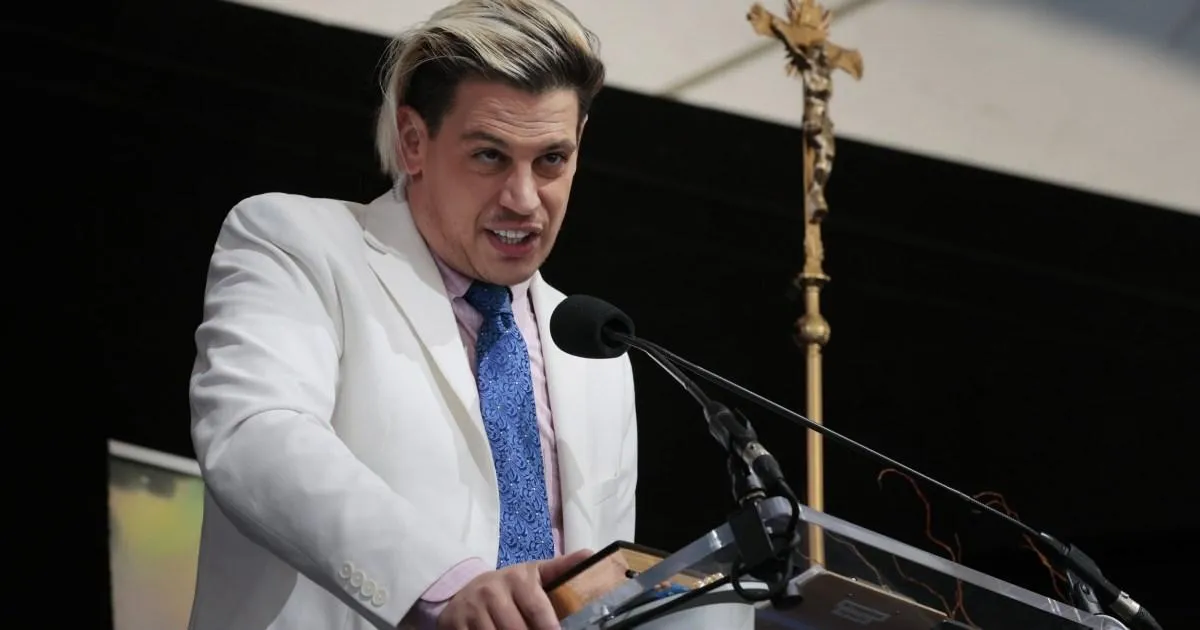
There is a certain poetic justice in the image of Milo Yiannopoulos stepping off a plane in Britain, not as a conquering hero of the populist right, but as a man who has just been shown the door by the very system he spent years cheering on. The British-born provocateur, once one of the loudest voices in Donald Trump’s America, has returned to his native country after being arrested and deported by U.S. Immigration and Customs Enforcement. It is a strange and humbling end to a strange and volatile American chapter. Yiannopoulos first rose to prominence during Trump’s 2016 campaign, using a combination of wit, cruelty, and algorithm-hacking outrage to carve out a space for himself in the far-right media ecosystem. He was a senior editor at Breitbart News, a platform that helped translate online grievance into political power, and he became a familiar figure on conservative conference stages and cable news panels, always ready with a sneer, a joke, or a carefully aimed insult. His loyalty to Trump was absolute, at least for a time, and he positioned himself as one of the most enthusiastic enforcers of the MAGA brand, attacking Republicans who strayed from the line and demanding ever harsher treatment for immigrants. He called for “total legal immunity” for U.S. immigration enforcement, suggested that California should have ICE checkpoints at supermarket entrances and gas stations, and argued that anyone who could not prove they were in the country legally should be deported on the spot. That rhetoric made him a hero to many in the Trump base, and a villain to everyone else. Now, after years of demanding that others be stripped of their right to stay, Yiannopoulos has discovered that the machinery he helped glorify does not distinguish between friends and enemies. It simply does its job. The news of his removal from the United States broke on Friday, and the irony was impossible to miss. A man who had built his American career on being an outsider in every sense—British, flamboyant, gleefully offensive—had been declared an “illegal alien” by the government he had so often praised. His own words, repeated endlessly on social media and in interviews, had come back to haunt him in the most direct way possible.
Yiannopoulos’s descent from the inner circle of the American far right was not a sudden fall, but a long and messy unraveling. For a time, he seemed untouchable. He was one of the most visible figures in the pro-Trump movement, a man whose ability to generate outrage was matched only by his ability to monetize it. He wrote for Breitbart, appeared at Mar-a-Lago, and cultivated relationships with some of the most powerful figures in conservative media and politics. But the cracks began to show early. In 2016, he was blocked from Twitter after allegedly leading a campaign of racist and sexist abuse against Leslie Jones, one of the stars of the Ghostbusters reboot. The ban did little to slow him down; it only made him more of a martyr to his followers, who saw the platform’s decision as proof that the establishment was afraid of him. The real turning point came in 2017, when a video surfaced of him discussing paedophilia in a conversation with radio hosts. In that discussion, he suggested that people were misunderstanding what paedophilia meant, and that it referred to attraction to prepubescent children, not to teenagers who were “sexually mature.” The comments were widely interpreted as an attempt to normalize sexual attraction to minors, and the backlash was immediate and devastating. He lost a book deal that had reportedly been worth a significant sum of money, and he was disinvited from speaking at CPAC, the annual gathering of American conservatives where he had once been treated as a rising star. He later issued a statement insisting that he found those crimes “absolutely disgusting” and that he had never endorsed paedophilia, but the damage was done. He slipped from the spotlight, retreating to the quieter corners of the internet, where he continued to post feverish pro-Trump content on X, the platform formerly known as Twitter, long after his mainstream relevance had faded. He worked for Marjorie Taylor Greene, then a congresswoman and one of the most outspoken MAGA loyalists in Washington, and later dabbled in the failed presidential campaign of the rapper Ye, formerly known as Kanye West. But the old magic was gone. He was no longer a kingmaker; he was a relic, a once-famous provocateur clinging to relevance by attaching himself to anyone who would have him.
The end of his American story, when it came, was remarkably mundane. According to the U.S. Department of Homeland Security, Yiannopoulos had legally entered the United States on May 14, 2019, but had chosen to “overstay his welcome in violation of our nation’s laws.” An immigration judge issued a final order of removal on July 22, after he failed to show up for his immigration hearing. Then, on August 27, he was arrested by ICE officers at Louis Armstrong New Orleans International Airport in Louisiana. The timing of the arrest was almost absurdly ordinary: he was apparently on his way to a concert by Ye, the rapper whose brief 2024 presidential campaign he had worked on. There was no dramatic showdown, no political statement, no last-minute legal battle. There was just a man at an airport, stopped by federal agents, handcuffed, and taken away. The image released by ICE showed a stern official standing next to a smiling mugshot-style photograph of Yiannopoulos, and the accompanying statement was clinical and cold. He had been given every opportunity to comply with the law, the message implied, and he had chosen not to. The language used by the government was the same language he had once used about others: illegal, violator, removal. It was the kind of bureaucratic cruelty that he had spent years demanding be applied to immigrants across the country, and now it was being applied to him. There was no room for his celebrity, no deference to his politics, no exception for the fact that he had once been a guest at the highest levels of the Trump movement. He was just another person in the system, and the system did what it was designed to do.
Perhaps the most revealing part of the whole affair is the way Yiannopoulos’s former allies reacted to his deportation. His arrest was met not with sympathy or even silence, but with open glee from some of the very people he had once fought alongside. Laura Loomer, another prominent far-right figure and a vocal Trump supporter, took to X to celebrate his detention, describing him as an “illegal alien” and claiming that he had incited violence against President Trump. She also brought up his past work for Marjorie Taylor Greene, who had recently turned against the president after years as one of his most loyal supporters, and referred to Greene as “Marjorie Traitor Greene.” It was a striking moment of intra-MAGA cannibalism, a reminder that the movement Yiannopoulos helped build has no room for loyalty or mercy when someone falls out of favor. Loomer’s tweet was not just a personal attack; it was a signal that Yiannopoulos had become persona non grata in the world he once dominated. The people who had applauded his cruelest rhetoric were now applauding his humiliation. There is a lesson in that, perhaps, about the nature of the far-right ecosystem, where alliances are transactional and yesterday’s hero is tomorrow’s target. Yiannopoulos had spent years attacking others for their immigration status, their politics, their sexual orientation, their race, their gender. He had built a career on finding the most vulnerable people and mocking them from a position of assumed safety. Now, with his own status stripped away, he was the one being mocked, and his former friends were leading the charge. It is hard to imagine a more perfect illustration of the old saying about the chickens coming home to roost.
But Yiannopoulos’s case is not just a story about one man’s fall from grace. It is also a window into the broader immigration crackdown that has defined Donald Trump’s return to office. Since Trump resumed the presidency, ICE has arrested more than half a million people as part of a mass deportation push that has become the centerpiece of his administration’s agenda. The scale of the operation is staggering, and it has touched every corner of American life, from workplaces and schools to airports and courtrooms. The stated goal is to remove people who are in the country illegally, but the reality is far more complicated. An analysis by the Washington Post found that nearly 40 percent of those arrested had no criminal record at all. Many of them were simply in the wrong place at the wrong time, swept up in raids that were designed to produce dramatic numbers rather than careful justice. There have been widespread reports of poor conditions in immigration detention facilities, of people being held for weeks or months without adequate medical care, and of families being separated with little regard for due process. Some of the most heartbreaking cases involve people who were brought to the United States as children, who have lived in the country for decades, who have gone to school, worked, paid taxes, and built lives, only to be deported to countries they barely remember. Yiannopoulos, with his platform and his connections, was able to generate attention for his own case, but he is just one of many people caught in the machinery he so enthusiastically supported. The difference is that he asked for it. He wanted a system that would be harsh, unforgiving, and fast. He wanted checkpoints and on-the-spot deportations. He wanted immigrants to be treated as enemies of the state. He did not imagine that he would ever be one of them.
In the end, the story of Milo Yiannopoulos is a story about the cruelty of believing in your own exemption. He spent years arguing that the rules should be applied ruthlessly to everyone else, never considering that the rules might one day be applied to him. He returned to Britain a diminished figure, stripped of the platform he once had in the United States, abandoned by the political movement that had made him famous, and facing a future that is, at best, uncertain. There is no triumphant ending here, no redemption arc, no moment of self-reflection. If anything, his deportation seems to have only deepened his bitterness. He had already turned against Trump, claiming that the president had “lost his way, bought off by foreign interests” after the U.S. and Israel’s attacks on Iran in late February. That break, combined with his arrest and removal, has left him in a strange no-man’s-land, rejected by the country that once welcomed him and estranged from the movement he once helped define. Perhaps that is the most human thing about him: the refusal to see himself as the villain of his own story. He still believes, or wants to believe, that he is the victim, that he was betrayed by people who were not loyal enough, that the system is corrupt and the forces arrayed against him are too powerful. What he seems unable to do is look in the mirror and recognize the man who spent years calling for exactly what happened to him. There is a kind of tragedy in that, but it is not the tragedy of an innocent man. It is the tragedy of someone who built his life on the suffering of others and then cried out when the same pain was visited upon him. As he settles back into life in Britain, he carries with him the weight of his own words. He asked for a country that would not tolerate anyone who could not prove they belonged. In the end, he proved that he did not belong there either.