

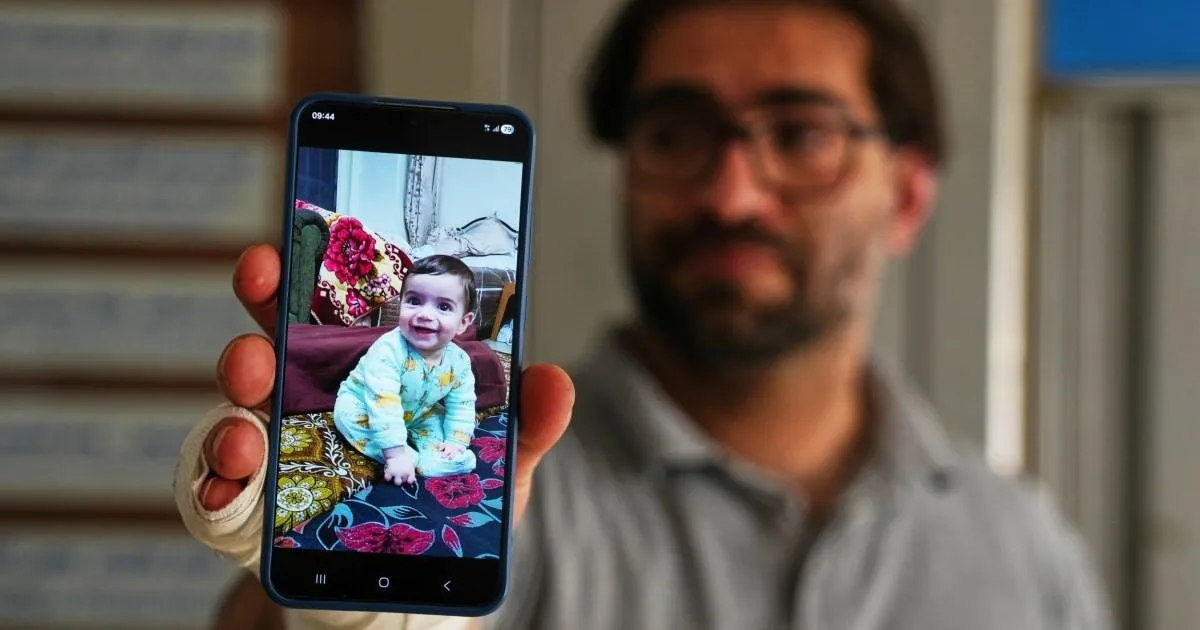
The world is a harsh place, but few images imprint themselves onto the collective conscience quite like the photograph of Fahd Abu Haikal—a forty-one-year-old father—clutching the lifeless body of his seven-month-old son, Sam. This tragedy unfolded on a quiet Friday evening in the Tel Rumeida area, south of Hebron, when a family drive turned into an unimaginable nightmare. As Fahd and his wife navigated the streets, Israeli soldiers opened fire on their vehicle. The encounter, which took mere seconds, left the mother wounded and, in a stroke of horrific misfortune, saw a single bullet take the life of their infant boy. Sam was rushed to the hospital, but the damage was irreversible; the baby who had only just begun to discover the world was pronounced dead, leaving his parents to navigate a grief that is impossible to measure.
The aftermath of the shooting is painted in harrowing snapshots: a shattered car glass, a discarded diaper bag, and the mournful faces of relatives gathered to bury an infant who barely had a chance to exist. Fahd, a lecturer at Bethlehem University, did not emerge unscathed; he suffered a gunshot wound to his hand, a physical ache that serves as a permanent, stinging reminder of the moment his family was irrevocably fractured. While the Israeli military issued a statement expressing “deep” regret for harm caused to “uninvolved individuals,” citing a mistaken belief that the vehicle was accelerating toward them, these words provide little solace to a man who watched his child die in the light of day. For a father, the military’s technical explanations are a cold, hollow substitute for the life that was extinguished in an instant.
Fahd’s account of the event strips away the military’s ambiguity and highlights a much more intimate, devastating reality. He speaks of a soldier stationed only ten meters away—close enough to lock eyes, close enough to notice the family inside, and close enough to see that the car’s windows were clear and the afternoon was bright. In his interviews, Fahd’s voice is steady with the righteous indignation of a parent who has been robbed of his future. He rejects the narrative of a split-second, necessary military reaction, insisting that the circumstances were unmistakably civilian. For him, this was not a tactical security failure; it was a visible, avoidable tragedy, and he is now determined to spend his remaining strength ensuring that the person who pulled the trigger is met with accountability rather than a closed file.
The incident has triggered a preliminary Israeli military inquiry, which confirmed what Fahd already knew: his family were innocent civilians. Yet, the word “inquiry” carries a bitter taste for those caught in the ongoing cycle of violence in the West Bank. Since the escalation of regional hostilities on October 7, 2023, the region has devolved into a landscape where such incidents have become hauntinly frequent. Every day, the news is populated by stories of loss, but there is a specific, piercing agony in the death of an infant—a life that carried no political weight, no ideological stance, and yet was destroyed by the sheer brute force of a conflict he could never understand. The “review of circumstances” is ongoing, but for the Abu Haikals, the verdict has already been delivered in the form of an empty crib and a burial shroud.
This tragedy is, unfortunately, a microcosm of the wider suffering currently gripping the Levant. Reports from the United Nations and health ministries place the death toll in the West Bank and Gaza at staggering, unprecedented levels, with over 72,900 Palestinians killed since the outbreak of current hostilities. Each number in those statistics is someone like Sam: a person with a family, a name, and a future that was systematically deleted. The normalization of these deaths poses a terrifying challenge to our humanity. When we read stories like this one, it is easy to get lost in the politics, the geography, and the military justifications, but it is vital to remember the individual cost. We are witnessing the slow erosion of a moral boundary where the life of an infant is sacrificed to the altar of “security” and “miscalculation.”
As the world turns its attention to broader geopolitical machinations, the quiet tragedy of Sam Fahd Abu Haikal reminds us that at the center of every headline is a human heart that has been broken beyond repair. Fahd’s plea for justice is not just a request for a courtroom outcome; it is a desperate attempt to assert that his son’s life mattered, that his death was not just an “unfortunate incident” to be filed away, and that there is still a sense of law or morality left to hold onto. We are left to wonder what kind of justice can truly exist when a father has to mourn the loss of his son in such a senseless manner. All we can do is bear witness, hold the memory of the seven-month-old boy close, and acknowledge the devastating reality that in the crossfire of war, it is the most innocent among us who pay the highest, most permanent price.