


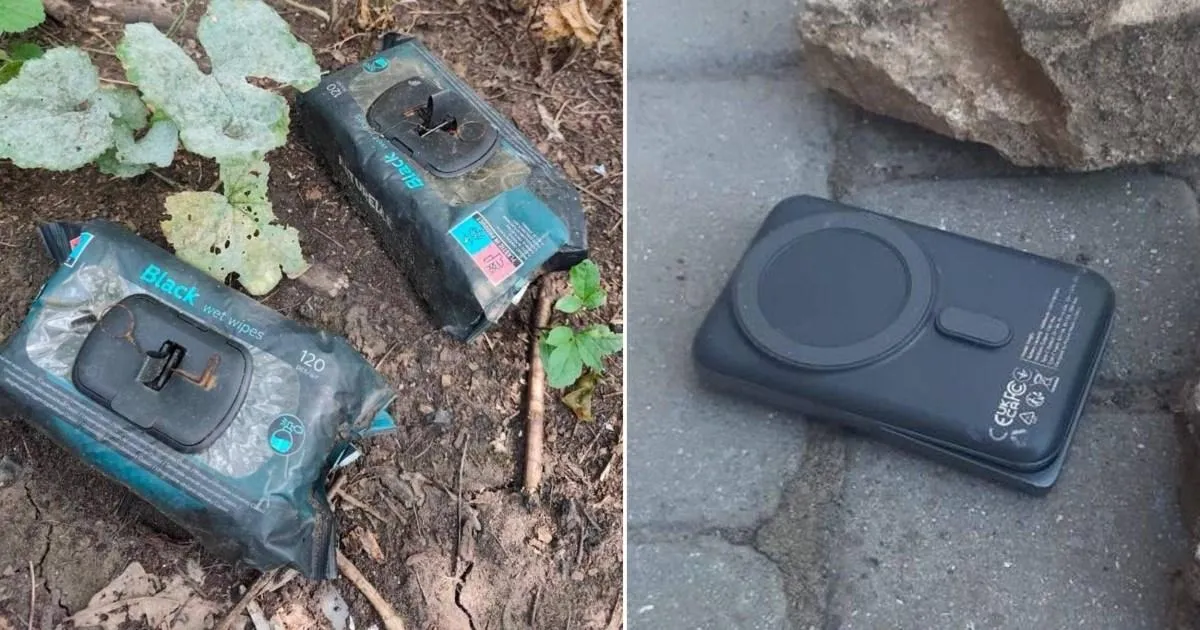
The city of Kherson, a persistent flashpoint on the Ukrainian front lines, has become the stage for a chilling new escalation in the ongoing conflict. Russian forces are reportedly deploying a tactical shift that transcends traditional warfare, opting to drop explosive devices onto city streets disguised as mundane, harmless household items. Residents have recently discovered booby-trapped wet wipe boxes and portable power banks scattered in parks and along sidewalks. These items, seemingly innocuous, are designed to lure the curious—most dangerously, children—into handling them, leading to immediate, devastating explosions that threaten to maim or kill the unsuspecting.
The psychological brutality of this strategy lies in its target: the civilian population. Yuriy Boyechko, CEO of the charity Hope for Ukraine, notes that as locals have grown cautious of previous, uncamouflaged “gingerbread” mines, the Russian military has pivoted to deceptive tactics to maintain the cycle of terror. Military administrators and local officials have issued desperate warnings to parents, urging them to hammer home the message that nothing found on the street, no matter how useful it appears, is safe. The calculation, according to Yaroslav Shanko, is as cynical as it is simple: a person picks up what they believe is a discarded charging device, and the result is fatal.
Beyond the immediate danger to pedestrians, the threat has infiltrated the military supply chain itself. Reports suggest that these explosive-laden power banks are being funneled into the black market, where they are sold to Ukrainian military units struggling to procure essential gear. Whether these sellers are unwittingly distributing compromised stock or are actively collaborating with Russian forces to sabotage the defense effort, the outcome remains the same: a weaponized economy where life-saving equipment is turned into a death trap. This development has transformed the humanitarian struggle from one of managing displacement and hunger into a grim game of avoiding “hidden traps” in daily life.
Human rights advocates and international legal experts have been swift to condemn these acts, labeling them a clear breach of the rules of warfare. Lord Alton, chair of Parliament’s Joint Committee on Human Rights, described the weaponization of everyday objects as an act of calculated cruelty, suggesting that these incidents must eventually be added to an official record of war crimes. International humanitarian law is explicit in its demand that belligerents distinguish between military targets and civilians; using deceptive items intended to entice non-combatants into injury is not just an escalation of tactics, but a fundamental violation of the principles that govern civilized conflict.
The terror campaign extends beyond handheld traps to the very roads Ukrainians use to travel. Despite efforts to ground Russian drones by stringing anti-drone fishing nets over streets, military analysts report that these drones are now being landed along the roadside, hiding in the grass like waiting vipers. As vehicles pass, these waiting weapons are activated, allowing Russian forces to strike at cars, buses, and cyclists from beneath the protective nets. This evolving strategy has shifted the war from open combat to an omnipresent, invisible threat, fundamentally changing how civilians navigate the ruins of their own neighborhoods.
Ultimately, the consensus among observers like Ross Burley from the Centre for Information Resilience is that this is no longer just a military maneuver; it is a systematic campaign of terror. By turning hospitals, parks, and even the simple act of charging a phone into potential death sentences, the invading forces aim to instill a paralyzing fear in every step a Ukrainian citizen takes. As the world watches, the reality on the ground in Kherson serves as a haunting reminder of the lengths to which a regime will go to break the human spirit, forcing the international community to grapple with the long-term, agonizing task of demining a society transformed into a minefield.