



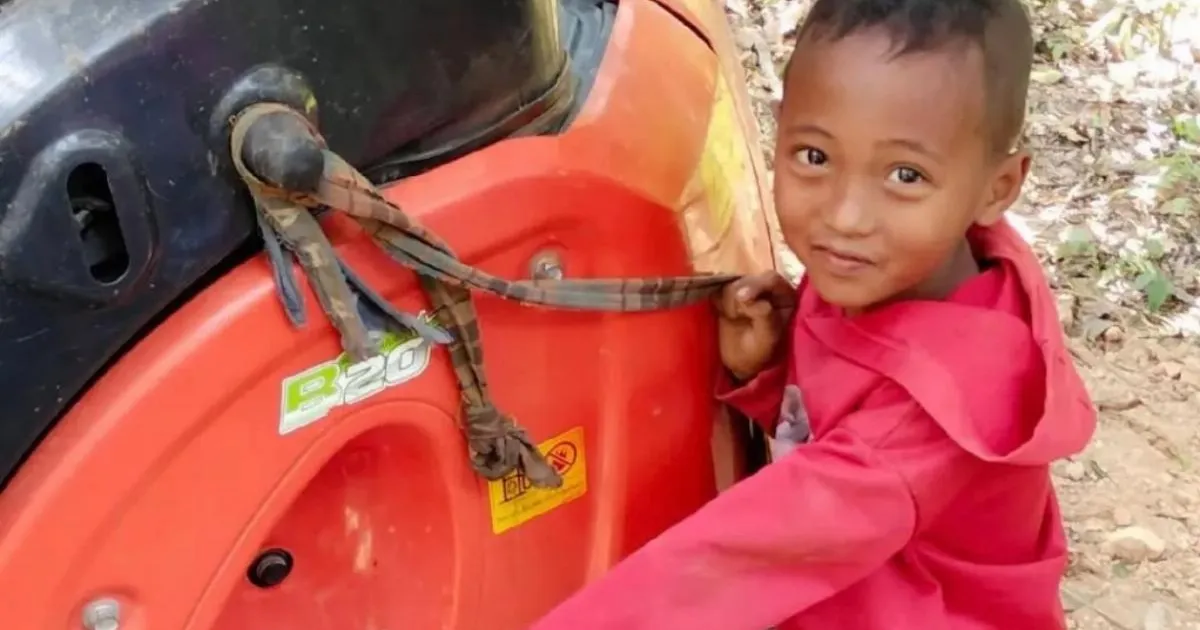
The quiet community of Nakhon Si Thammarat, Thailand, is currently reeling from a tragedy that feels as senseless as it is heartbreaking. Seven-year-old Ekkarat Srichan, a young boy known to his family as a bright and lively presence, lost his life in a horrific encounter with the family’s pet macaque, Choke. What began as a typical afternoon of play near the family home spiraled into a nightmare when the monkey, which had been tethered to a nearby bamboo pole, suddenly turned on the child. The peaceful sounds of the neighborhood were replaced by the chilling shrieks of the animal, followed by a silence that signaled a catastrophe no one could have anticipated. By the time relatives rushed to the scene to intervene, they were met with a gruesome sight: the young boy lay severely injured, and the animal remained, its teeth stained with the blood of its victim.
The medical staff at Sichon Hospital fought to save the young boy, but the nature of his injuries proved too severe for recovery. According to his mother, Daranee Srichan, the macaque’s long, powerful fangs had tragically pierced her son’s lung, striking a vital area that made survival an impossibility. While the family had initially hoped the damage was limited to a bite on the leg, the stark reality revealed at the hospital was that the animal had inflicted a deep puncture wound to the child’s right ribcage. Stunned by the loss, Daranee spoke through her grief, expressing a complete loss of faith in the practice of keeping wild animals in a domestic setting, noting that she could never risk the safety of her remaining children again.
The history of the monkey, nicknamed Choke, adds an even more frustrating layer of regret to the tragedy. The boy’s grandfather, Jaroon, had rescued the animal from the roadside back in 2022, fueled by a sense of mercy and a desire to provide a home for a creature in need. At the time, the act felt like a kindness, a noble effort to save a living being. However, that act of benevolence has become a source of agonizing remorse. Jaroon admitted that they had not seen any overt signs of hatred between the monkey and his grandson, but he now realizes that the animal was far more volatile than they had accounted for. He has since publicly expressed his deep regret, acknowledging that what he once viewed as a rescue mission was a profound mistake that ultimately cost his grandson his life.
This tragedy has highlighted the erratic and often dangerous temperament of the captive macaque, an animal that was perhaps better suited for the wild than a backyard. Neighbours reported that the monkey had long displayed signs of aggression, frequently growling and baring its fangs at anyone who dared to step onto the property. Tales of the monkey’s previous hostility—including a past attack on a stray cat that strayed too close—surfaced in the wake of the boy’s death, suggesting that the warning signs of a short fuse were present long before the final, fatal outburst. It appears the animal had become increasingly irritable, perhaps weary of its restraint or simply overwhelmed by its environment, leading it to snap at the child during a moment of routine contact.
In the immediate aftermath, the situation turned chaotic when the grandfather, caught in a moment of panic or misplaced reaction, released the monkey into the wild. This decision prompted a swift and urgent response from local authorities and wildlife experts, who launched a manhunt for the creature. There was a palpable wave of fear sweeping through the community, as residents worried that the traumatized and aggressive primate might strike again. Police and animal control officials eventually managed to track the monkey down, though its continued volatility necessitated the use of tranquilizer guns. The scene served as a grim reminder of the unpredictability of wild animals and the danger they pose when confined to human spaces.
As the community begins to mourn the passing of young Ekkarat, authorities are now examining the legal implications of the incident. While keeping macaques is technically permitted in Thailand, the practice is subject to strict, non-negotiable regulations. Laws are firmly in place to protect both the public and the animals, and failing to adhere to these mandates—particularly regarding the authorization of wild-caught or protected species—can result in severe legal consequences, including heavy fines and prosecution. For the Srichan family, these legalities are secondary to the profound silence left behind in their home, a poignant and painful reminder of the thin line between an act of kindness and a life-altering tragedy.