
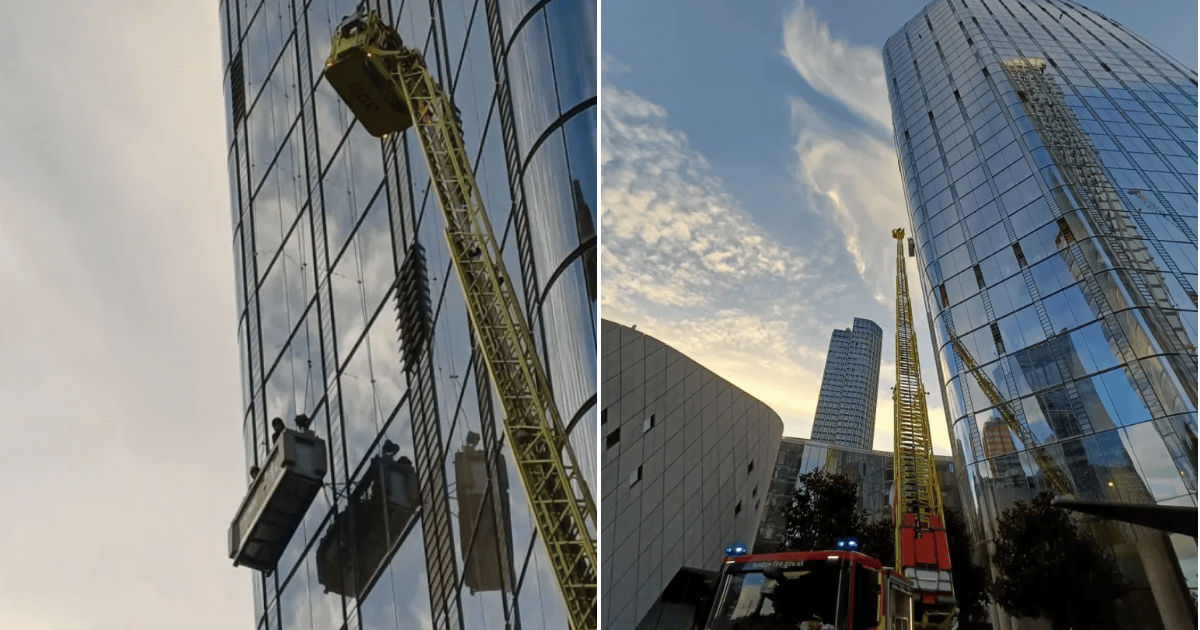
On an otherwise unremarkable Thursday evening in Southwark, the kind of quiet moment most Londoners would have walked straight past, two window cleaners found themselves in a terrifying predicament. They had been working on a suspended platform, or cradle, outside One Blackfriars by Berkeley, a striking residential skyscraper that towers over the south bank of the River Thames. The job would have seemed routine, the sort of thing they had done hundreds of times before: clip in, check the equipment, and slowly lower themselves down the glassy face of the building. But then something went badly wrong. The cradle malfunctioned, leaving the two men stranded high above the ground, clinging to a thin platform that dangled against the 15th floor. In that moment, the ordinary became an emergency. The city below continued its evening hum, but for the two men, time seemed to stop. They were not in immediate danger of falling, but they were trapped, suspended in mid-air with no way to lower themselves and no obvious way to climb to safety. It was the kind of situation that makes the heart race, a reminder of just how vulnerable people can be when the machinery they rely on fails.
Help arrived quickly, but not in the form of an ordinary rescue. The London Fire Brigade was called at 5.22pm, and within minutes a 64-metre turntable ladder was on its way to the scene. This was no ordinary piece of firefighting equipment. The ladder, which stretches into the sky like a giant yellow arm, is the tallest aerial appliance in Europe, capable of reaching heights of up to 20 floors. For the two stranded window cleaners, the sight of that ladder appearing around the corner of the building must have been one of enormous relief. Firefighters manoeuvred the ladder into position, carefully extending it toward the 15th floor, while the two men waited patiently on their broken cradle. The operation was carried out with precision and calm, the kind of expert choreography that comes from years of training. By 6.15pm, the incident was declared under control. Both men were brought down to safety, shaken but unhurt. A spokesperson for the London Fire Brigade later said: “Thankfully no-one was hurt and the men were rescued safely and quickly.” It was a simple statement, but behind it lay a story of quiet heroism and split-second decision-making.
What makes this rescue so striking is not just the danger involved, but the human reality of what it means to be trapped so far above the ground. Window cleaners are a familiar sight in London, often spotted by office workers and tourists as they swing gently beside the glass facades of the city’s tallest buildings. They are easy to ignore, almost invisible figures in hard hats and high-visibility vests. But on Thursday evening, the two men on that cradle were not invisible. They were vulnerable, exposed to the elements and to the sudden failure of the equipment they trusted with their lives. One can only imagine the thoughts that ran through their minds as they waited for help. The wind, which grows stronger and more erratic at height, would have buffeted the platform. The metal frame of the cradle would have creaked and swayed with every movement. Below them, the streets of Southwark would have looked impossibly small, the tiny figures of onlookers gathering to watch the drama unfold. Every second must have felt like an hour. In that strange, suspended moment, the two men were completely dependent on the skill and courage of others.
The rescue was a powerful reminder of the dangers that window cleaners face every single day. Most people look up at a skyscraper and see glass and steel, but they rarely think about the workers who maintain those gleaming facades. These are the people who spend their days hanging in mid-air, often in windy and unpredictable conditions, just to keep buildings looking their best. They trust their lives to harnesses, ropes and motorised cradles, pieces of equipment that are usually reliable but can, as this incident shows, fail in unexpected ways. When that happens, the difference between a close call and a tragedy often comes down to the speed and skill of the emergency services. The two men rescued in Southwark were fortunate in more ways than one. Not only did they have the London Fire Brigade on their side, but they were also working on a building that was accessible to one of the most advanced rescue vehicles in the world. Not every high-rise building is so lucky, and not every emergency happens within reach of a 64-metre ladder.
The London Fire Brigade’s response was made possible by years of investment in specialist equipment. The turntable ladder used in this rescue is a remarkable piece of engineering, a steel giant that can be raised to extraordinary heights and extended horizontally to reach people trapped on ledges, rooftops, or, as on this occasion, suspended cradles. It is the tallest such appliance in Europe, and for a city packed with ever-taller towers, it is an absolutely essential tool. One Blackfriars by Berkeley, where the rescue took place, is itself a monument to London’s ever-changing skyline. The building stands around 558 feet tall, a mixed-use development of luxury apartments, offices, and public spaces, with the Thames glinting just beyond its windows. It is the kind of building that defines modern London, sleek and ambitious, but it also presents unique challenges for emergency services. High-rise buildings require high-reach solutions, and incidents like this one underline why having the right equipment is not just a matter of convenience but of life and death. The 64-metre ladder used in the rescue is specifically designed to meet the demands of London’s increasingly vertical landscape.
For the two window cleaners, the ordeal was over, but the emotional impact likely lingered long after their feet touched solid ground. Imagine for a moment what it must have been like to stand on that narrow platform, looking down at the tiny cars and blurred figures moving far below. The wind would have been stronger up there, carrying the noise of the city and the occasional gust that made the cradle sway. Every movement, every creak of the machinery, would have felt amplified. When the cradle stopped working, the silence of the equipment must have been deafening. There was no sudden jolt, no dramatic sound, just the realisation that the mechanism was no longer responding. In that moment, the two men had to decide what to do next. Stay calm. Wait for help. Trust that someone had seen them, that someone would come. And someone did. The firefighters who responded to the call did so with the kind of professionalism that often goes unnoticed until it matters most. They did not hesitate. They did not ask whether the men’s employer had followed every safety protocol. They simply got on with the job, extending their ladder into the London sky and bringing the two workers home.
The rescue is a powerful reminder of the risks that window cleaners take every single day. Most of the time, their work goes unnoticed, just another part of the city’s endless rhythm. But when something goes wrong, it becomes a life-or-death situation. There is a certain bravery in doing a job that requires you to stand on a thin platform hundreds of feet in the air, trusting that the cables and motors holding you are in good condition. For the two men rescued on Thursday, that trust was tested in the most dramatic way possible. They were fortunate that the ladder truck was able to reach them. But not every rescue is so straightforward. The London Fire Brigade’s 64-metre turntable ladder is a specialist piece of equipment, one of only a few in the country. It is designed precisely for these high-rise challenges, where the distance between danger and safety is measured in storeys rather than steps. Its presence at the scene was no accident; it is part of the Brigade’s commitment to being ready for the difficult, unusual, and often dangerous situations that arise in a city as dense and vertical as London.
The rescue also highlights the often invisible risks faced by window cleaners and other workers who maintain the city’s tallest buildings. Every day, men and women are suspended hundreds of feet in the air, scrubbing glass and repairing facades, trusting that their equipment will hold. Most days, the work goes unnoticed. But when something fails, the consequences can be catastrophic. In this case, the outcome was a good one, thanks to the quick response of the emergency services and the effectiveness of their specialist equipment. The 64-metre turntable ladder that came to the rescue is a piece of engineering marvel, a mobile lifeline that can reach the upper floors of most of London’s skyscrapers. It is used for high-rise fires, rescues, and even unusual incidents like this one. But its existence is also a reminder of how much planning and preparation go into keeping people safe in a city that is constantly building upward. For the window cleaners, the rescue was not just a technical exercise; it was personal. They had gone to work expecting a normal day, and instead they had found themselves at the mercy of a mechanical failure, their lives depending on the skill and composure of strangers.
The building where this took place, One Blackfriars by Berkeley, is no ordinary tower. A mixed-use development that stands around 558 feet tall, it overlooks the River Thames and is a striking addition to London’s ever-changing skyline. With its sleek, curved glass façade and premium apartments, it is the kind of place where residents pay for breathtaking views. But on that Thursday evening, the building’s sheer height became the focus of a very different kind of attention. The two window cleaners had been maintaining that glass exterior, one of the most dangerous jobs in the city. Every day, men and women like them are suspended high above the streets, cleaning windows, repairing facades, and doing the maintenance work that keeps London’s towers shining. They trust their lives to harnesses, cables and cradles, and for the most part, the systems work. But when something fails, the results can be catastrophic. In this case, the outcome was entirely positive, but the incident served as a powerful reminder of the risks that these workers take every day, often while the rest of us are simply looking the other way.
The rescue itself was a testament to the skill and bravery of London’s firefighters. The turntable ladder, a massive piece of machinery that looks almost impossibly long when extended, is specifically designed for high-rise rescues. It can reach the equivalent of 20 floors, making it the most powerful piece of equipment of its kind in Europe. On Thursday evening, it was the perfect tool for the job. The two window cleaners were working on the 15th floor of One Blackfriars, a building that rises to around 558 feet and overlooks the Thames. It is a striking structure, known for its distinctive glass façade and prime riverside location. But for the two men, it was not the view that mattered; it was the floor beneath them. Or rather, the lack of it. Their cradle had malfunctioned, and they were left stranded in a kind of vertical limbo. The rescue operation was not just about reaching them; it was about doing so in a way that kept everyone safe, with the ladder positioned carefully to avoid any sudden movements that could be dangerous.
The rescue was a powerful reminder of the dangers that window cleaners face every day. Most people look up at a glass tower and see a beautiful piece of architecture, but the men and women who clean those windows see a workplace, one that becomes especially hazardous when equipment fails. A cradle suspended 15 storeys up is not a place where you want to be when things go wrong. The wind can be stronger up there, the building can sway slightly, and the city below can feel impossibly distant. For the two men on Thursday evening, the experience must have been deeply unsettling. They were not just waiting for a ride down; they were waiting for a rescue, relying entirely on the skill and courage of strangers. That kind of experience stays with you. It is easy to imagine the relief on their faces as they climbed from the cradle into the arms of firefighters, the solid ground of the ladder basket beneath their feet after what must have felt like an eternity in the open air.
The rescue was made possible by the London Fire Brigade’s commitment to maintaining specialist equipment for the challenges of a rapidly changing city. The 64-metre turntable ladder deployed that evening is not just an impressive piece of machinery; it is a lifeline for people working at height. It stands as the tallest aerial appliance in Europe, and on this occasion, it was exactly what the situation demanded. The ladder allowed firefighters to reach the stranded men without relying on the building’s internal systems, which may have been unsafe or inaccessible. It also highlighted the importance of having the right tools for the job. In a city like London, where skyscrapers continue to rise along the river and into the sky, rescue services must constantly adapt. The fire brigade’s spokesperson made this point explicitly, adding: “This is a great example of how the Brigade uses its specialist equipment to meet the challenges of London’s built environment. It is vital that we continue to have the right equipment to enable us to respond effectively and keep London’s communities safe.” The words carry weight, especially in a city where new towers are transforming the skyline every year.
For the two window cleaners, though, the statistics and the equipment were probably the last things on their minds. What mattered was the feeling of solid ground returning beneath their feet. Being stranded on the side of a building is a deeply unsettling experience, even for experienced professionals. The wind can rock the cradle, the city noise fades into a distant hum, and every second can feel stretched. The men’s relief at being rescued must have been overwhelming. They had spent the better part of an hour suspended in space, their safety depending on a piece of machinery that had suddenly stopped working. In that situation, the mind can play tricks. Every creak of the metal, every gust of wind, becomes amplified. The outside world, with its ordinary rhythms, continues below, utterly unaware of the drama unfolding above. But the rescue brought the two men back from that lonely place. As the turntable ladder reached them, hands reached out, harnesses were secured, and within minutes they were stepping onto solid ground. It is not hard to imagine the wave of emotion that swept over them as their feet touched the pavement, the sheer relief of knowing that what could have been a tragedy had ended with nothing more than a scary story to tell.
The London Fire Brigade’s response was a textbook example of why specialist equipment matters. The 64-metre turntable ladder used in the rescue is more than just a piece of hardware; it is a lifeline for people trapped in the kind of impossible situations that city life can create. London is a city of towers, and as it grows ever upward, the fire brigade must grow with it. This particular ladder, the tallest of its kind in Europe, is designed for exactly this kind of emergency. It can reach the 20th floor, which means it can access most high-rise buildings in the capital. But as the rescue in Southwark showed, equipment alone is not enough. It takes highly trained firefighters, meticulous planning, and the ability to stay calm under pressure. The operation on Thursday evening was a textbook example of how the brigade approaches complex rescues: assess the situation, bring the right tools, and execute the plan with speed and care. The spokesperson’s comment highlighted this, calling the rescue “a great example of how the Brigade uses its specialist equipment to meet the challenges of London’s built environment.”
The building at the centre of the drama, One Blackfriars by Berkeley, is itself a striking piece of London’s modern skyline. Sometimes called “The Can of Ham” because of its distinctive curved shape, the tower stands around 558 feet tall and overlooks the River Thames. It is a mixed-use development, home to luxury apartments, offices, and retail spaces, and its glass exterior is a familiar sight to anyone who crosses Blackfriars Bridge. Buildings like this have become symbols of modern London, but they also present unique challenges. Their heights mean that ordinary rescue methods often do not work. A fire engine with a standard ladder would have been useless here. It took one of the most advanced pieces of rescue equipment in Europe to bring these two men down. The 64-metre turntable ladder used in the rescue is not just impressive to look at; it represents a lifeline for the people who work on and around the capital’s ever-growing skyline. It can reach around 20 floors, a crucial capability in a city where high-rise living and working has become the norm.
But the rescue was about more than just machinery. It was about people. The two window cleaners were professionals, likely experienced in working at height, but no amount of experience can fully prepare anyone for the moment when the platform beneath you stops working. The psychological shock of being stranded on the side of a building, with the city sprawling below and the wind tugging at your clothes, is something that would stay with a person long after their feet touched the ground. They were fortunate that their emergency was noticed and that help arrived as quickly as it did. But they were also fortunate to be rescued by a fire brigade that takes high-rise emergencies seriously, with specialist training and equipment designed for exactly this kind of situation. The London Fire Brigade’s use of the 64-metre turntable ladder was not just a matter of reaching the right height; it was about bringing hope to two frightened men who had been staring down at the streets below, wondering how they were going to get down.
The rescue also highlighted the remarkable engineering and readiness that keep London safe. The turntable ladder used in this operation is the tallest of its kind in Europe, a feat of design that allows firefighters to reach up to 20 floors above street level. It is an essential tool in a city that is growing ever upward, where glass towers and high-rise apartments have become part of the skyline. One Blackfriars by Berkeley, the building in question, stands around 558 feet tall and overlooks the River Thames, a mixed-use development that combines luxury apartments with shops and public spaces. Buildings like this are designed to impress, with their sleek facades and sweeping views, but they also present unique challenges when something goes wrong. High-rise window cleaning is a job that most people never think about, until a piece of equipment fails and the whole world looks up. On this occasion, the outcome was positive, thanks to the quick response of the fire brigade and the remarkable capability of that towering ladder.
But beyond the drama of the rescue, there is a deeply human story. The two window cleaners did not expect, when they clocked in that morning, that they would end their day suspended 15 floors above the streets of London. They had probably packed their lunches, chatted about the weather, and planned for an evening at home. Instead, they found themselves at the mercy of a broken piece of machinery, their lives hanging in the balance. It is easy to imagine the fear they must have felt: the cold wind against their skin, the distant sound of traffic below, the sheer vertigo of looking down at the tiny figures moving along the pavement. But they also had to stay calm. Panic would not help. They knew that the fire brigade had been called, and so they waited, trusting the professionals who were already on their way. For the firefighters who responded, the rescue was a test of skill and nerve. They had to work against the clock, not because the platform was about to fall, but because every minute spent hanging in the air is a minute of uncertainty. The two window cleaners would have felt every vibration of the ladder, every gust of wind, every second stretching into what must have felt like an eternity.
The rescue equipment used that evening deserves special attention. The 64-metre turntable ladder that came to the rescue is not just any piece of machinery; it is a marvel of engineering, the tallest of its kind in Europe. It can reach the equivalent of 20 floors, making it an indispensable tool for emergencies in London’s dense, high-rise landscape. On this occasion, that height was more than enough to reach the 15th floor where the two men were stranded. But the drama was not just about the ladder. It was about the building itself. One Blackfriars by Berkeley is no ordinary tower. Rising to around 558 feet, it is one of the most recognisable additions to London’s ever-changing skyline, a mixed-use development of luxury apartments, offices, and amenities that overlooks the River Thames. Its glass facade reflects the water and the city lights, but for the window cleaners, that glittering surface was not a spectacle but a workplace. The building is a reminder of how much of modern life now happens in the sky, and how essential the people who maintain these towers are. Yet the very features that make such buildings beautiful, the sheer verticality, the smooth glass, the dramatic overhangs, can also make them dangerous to work on. When things go wrong, rescuers need equipment that can match the scale of the challenge.
The London Fire Brigade’s response was a perfect example of why specialist equipment matters. The 64-metre turntable ladder used in the rescue is not just impressive because of its size; it represents a critical lifeline for high-rise emergencies. It is the tallest appliance of its kind in Europe, and it can reach heights that older equipment could only dream of. In a city like London, where skyscrapers continue to spring up along the river and cranes dominate the skyline, having this capability is not a luxury. It is a necessity. The tower at One Blackfriars, where the two men were rescued, stands around 558 feet tall, a modern landmark of glass and steel. Buildings like this are built to impress, but they also create unique challenges for emergency services. A malfunction on the outside of such a building is not something that can be fixed with a standard ladder or a simple pulley system. It requires specialist equipment, extensive training, and nerves of steel. The 64-metre turntable ladder used in this rescue is a marvel of engineering, designed specifically to reach the upper floors of tall buildings and to give firefighters and rescue teams the reach they need in exactly these kinds of emergencies.
For the two window cleaners, the wait on that platform must have felt like an eternity. Suspended in mid-air, with the Thames glinting in the distance and the city sprawling beneath them, they had no choice but to hold on and trust that help would come. It is easy to imagine the adrenaline, the fear, and the overwhelming relief when the ladder finally arrived. Rescues like this are not just about machinery; they are about people. The firefighters who responded had to stay calm under pressure, communicate clearly, and work as a team while suspended in a highly visible, high-stakes environment. For the two men being rescued, it was likely the longest hour of their lives. The fact that they walked away with no injuries is a testament to both their own composure and the skill of the crew. Incidents like this rarely make headlines beyond a local news story, but they matter deeply to the people involved. They are a reminder that behind every shiny glass tower in London, there are workers who spend their days at height, trusting their equipment and the people who maintain it. When that trust is broken, even for a moment, the consequences can be terrifying.
The equipment used in the rescue was central to the happy outcome. The 64-metre turntable ladder sent to the scene is the tallest of its kind in Europe, a feat of engineering that can reach the equivalent of 20 floors. For a city like London, where skyscrapers continue to rise along the Thames and residential towers become more common, having this capability is not a luxury; it is a necessity. The ladder’s height allowed firefighters to reach the 15th-floor platform directly, avoiding the need for a more complicated or time-consuming rescue. It also meant the operation could be completed before dusk gave way to full darkness, a small mercy for the two men. The photographs released by the London Fire Brigade show the bright yellow ladder stretched out against the side of One Blackfriars, a striking contrast to the glass and steel around it. The building itself, a mixed-use development standing at around 558 feet, is one of the more distinctive additions to London’s ever-growing skyline. It overlooks the Thames, a symbol of modern urban living, but on that evening it was the backdrop to a very human drama.
The men’s ordeal was over by 6.15pm, less than an hour after the alarm was raised, but the emotional impact of such an experience is not something that fades quickly. Being trapped on the side of a skyscraper, even for a short time, is a deeply unsettling experience. There is the constant noise of the wind, the distant sound of traffic below, the cold metal underfoot, and the sheer vertical drop that seems to pull at the eyes. For the two workers, every second probably felt like an hour. They may have tried to stay calm, to focus on their training, to remind themselves that rescue was on the way. But in moments like these, the mind can race. They might have thought about their families, their friends, the simple act of stepping back onto solid ground. The fact that they were rescued unhurt is a testament not only to their own composure but also to the skill and bravery of the firefighters who brought them down. It is easy to imagine the relief they felt when their boots finally touched the floor of the fire engine, the solidity of metal beneath their feet again.
The rescue itself was a masterclass in emergency response. The London Fire Brigade’s control room received the call at 5.22pm, and the sheer speed of the response suggests just how seriously such incidents are taken. The 64-metre turntable ladder sent to the scene is an extraordinary piece of engineering, a bright yellow tower of steel and hydraulics that can be raised, extended, and angled with incredible precision. For the firefighters operating it, the challenge was not just reaching the 15th floor; it was doing so safely, in a busy urban environment, while managing the weight and balance of the ladder and ensuring that no one below was put at risk. The photographs released by the London Fire Brigade show the ladder reaching up toward the building, its silhouette stark against the sky, a thin lifeline connecting the street to the sky. The rescue was completed by 6.15pm, less than an hour after the first call. By that time, the two men were already on solid ground, their ordeal over.
But what must it have felt like to be in their shoes? Standing on a metal platform perhaps a few feet wide, with the city sprawling beneath, is not for the faint-hearted. On a normal day, a window cleaner on a high-rise might enjoy a stunning view of the Thames, the lights of London twinkling in the distance. But on this day, the view would have been the last thing on their minds. The malfunction would have caused the cradle to lurch or stop abruptly, and the men would have had to fight to keep their balance. For a few moments, or perhaps longer, their lives hung in the balance. It is easy to imagine the fear in their chests, the tightening of their hands on the guardrails, the anxious glances exchanged between them. They were wearing harnesses, of course, and the cradle was designed to hold them, but when equipment fails at height, the mind can race with worst-case scenarios. The arrival of the fire brigade, with its towering ladder and professional crew, must have felt like a lifeline. The rescue was not just about machinery; it was about trust, teamwork, and the skill of the firefighters who worked against the clock to bring the two men down.
The rescue operation itself was a striking visual, captured in photographs issued by the London Fire Brigade. The yellow turntable ladder stretched diagonally into the sky, a vivid slash of colour against the glass and steel of the tower. To onlookers, it would have looked dramatic, almost cinematic. But for the firefighters, it was all in a day’s work. The 64-metre ladder is designed specifically for situations like this, where a building’s height and design make conventional rescue methods difficult or impossible. The fact that it reached the stranded men quickly was a testament to the Brigade’s readiness and the importance of having specialist equipment on hand. The men were rescued from the 15th floor, but the ladder’s reach goes higher, a reminder that London’s skyline is constantly growing and that emergency services must grow with it. The spokesperson’s words, “This is a great example of how the Brigade uses its specialist equipment to meet the challenges of London’s built environment,” captured the significance of the operation. It was not just about saving two people, though that was the heart of it. It was also about demonstrating the value of investing in the tools and training needed to keep a rapidly changing city safe.
For the two window cleaners, the rescue was likely the most frightening moment of their working lives. One moment they were doing their job, suspended in a cradle against a wall of glass, perhaps enjoying the sweeping views of the Thames and the London skyline. The next, they were stranded, their equipment dead and useless. At that height, the wind can be strong, the building can sway, and the sounds of the city below fade into a distant murmur. There is nowhere to go, no ledge to climb onto, no door to knock on. The only thing between them and the ground was a metal platform that was no longer behaving as it should. It is easy to imagine the fear they must have felt, the quickened pulse and the shallow breathing, as they waited for rescue. But they also showed remarkable composure. They stayed put, trusted the safety of the cradle, and waited for the professionals to arrive. In situations like this, panic is the greatest enemy. The fact that they emerged uninjured is a testament not only to the skill of the firefighters but also to the two men’s own ability to stay calm under extreme pressure.
The rescue itself was a striking visual reminder of the dangers that come with high-rise living and working. Photographs from the scene show the fire engine’s huge turntable ladder, a bright yellow structure that looked almost surreal against the darkening London sky, reaching up toward the building. The ladder was extended to the 15th floor, where the two men waited in their stalled cradle, their faces likely a mixture of anxiety and relief. Firefighters worked quickly but methodically, knowing that every second counted. The ladder swayed slightly in the breeze, a normal thing for such a tall piece of equipment, but enough to make anyone’s stomach lurch. For the men on the cradle, the rescue must have felt like an eternity, even though the whole operation was over in less than an hour. The London Fire Brigade later praised its crews for their work, noting that the incident was a perfect example of how specialist equipment can be used to meet the challenges of the capital’s ever-growing skyline. “This is a great example of how the Brigade uses its specialist equipment to meet the challenges of London’s built environment,” the spokesperson said. “It is vital that we continue to have the right equipment to enable us to respond effectively and keep London’s communities safe.”
For the two window cleaners, the rescue was more than just a news story. It was a personal ordeal, a moment when the line between a normal day and a life-changing emergency blurred into something terrifying. One can only imagine the thoughts that ran through their minds as they stood on that narrow platform, hundreds of feet above the pavement. The wind, which is always stronger at height, would have buffeted them, making the platform sway gently. They may have tried to troubleshoot the cradle, checking the controls and looking for a way to restore power, but when it became clear that the equipment was well and truly stuck, there was nothing to do but wait and hope that help would arrive. Waiting is often the hardest part in any emergency. The mind races, and every second feels like an hour. But they were not alone. The fire brigade’s rapid response meant that they did not have to wait too long, and the sight of the turntable ladder extending toward them must have been a welcome one. Rescues like this are not just about machinery; they are about people. The firefighters who climbed the ladder and helped the men into the cage would have offered calm, reassuring words, guiding them through every step of the descent. For the two window cleaners, that human touch probably made all the difference.
The rescue also highlighted the remarkable capabilities of modern firefighting equipment. The 64-metre turntable ladder used in the operation is the tallest of its kind in Europe, and for good reason. London is a city of towers, and the skyline has changed dramatically over the past few decades. Buildings like One Blackfriars by Berkeley, which stands at around 558 feet tall and overlooks the River Thames, are becoming increasingly common. These buildings are mixed-use developments, containing homes, shops, and public spaces, and they present unique challenges for emergency services. A fire or a rescue on the 15th floor of a glass tower is a very different proposition from a similar incident in a traditional low-rise building. Ladders need to reach higher, hoses need to be longer, and firefighters need to train for conditions that are far from ordinary. The fact that London now has an aerial appliance capable of reaching up to 20 floors is no accident. It is a direct response to the changing shape of the city. When every second counts, having the right equipment can mean the difference between a successful rescue and a tragedy.
The London Fire Brigade spokesperson was quick to praise the safe outcome, saying: “Thankfully no-one was hurt and the men were rescued safely and quickly.” But behind that carefully worded statement lies a much larger point about the importance of investment in public safety. Emergencies are rarely predictable, but the response to them must be. When the call came in at 5.22pm, the fire brigade was ready. The crews had trained for exactly this kind of incident, and the equipment had been maintained and tested. In a city as dense and complex as London, that readiness is not a luxury; it is an essential part of keeping people safe. The incident also serves as a reminder of the risks that window cleaners and other maintenance workers take every day. They go to work high above the city, suspended by ropes and metal arms, and they do it without much fanfare. Most people never think about them until something goes wrong. But when it does, their lives are suddenly in the hands of others. The rescue at One Blackfriars was over in less than an hour, but for the two men involved, it was a moment they will never forget. They will probably tell the story for years, not just about the fear of being stuck on the side of a building, but about the relief of being brought down safely.
In the end, this was a story about ordinary people and the extraordinary professionalism of those who keep them safe. The two window cleaners will go home to their families tonight, a little shaken, perhaps, but otherwise unharmed. The firefighters who carried out the rescue will go home too, ready to do it all again the next time the alarm sounds. And the building itself, so tall and elegant against the evening sky, will stand as a reminder of just how much of our lives are lived, quite literally, in the hands of others. The city moves fast, and stories like this are often forgotten almost as quickly as they happen. But for those involved, the memory of a routine evening suddenly turning into a fight against time and gravity is something that stays with them. The rescue was a success, but it also offers a quiet reminder of the value of preparation, the courage of emergency workers, and the simple joy of solid ground beneath your feet.